
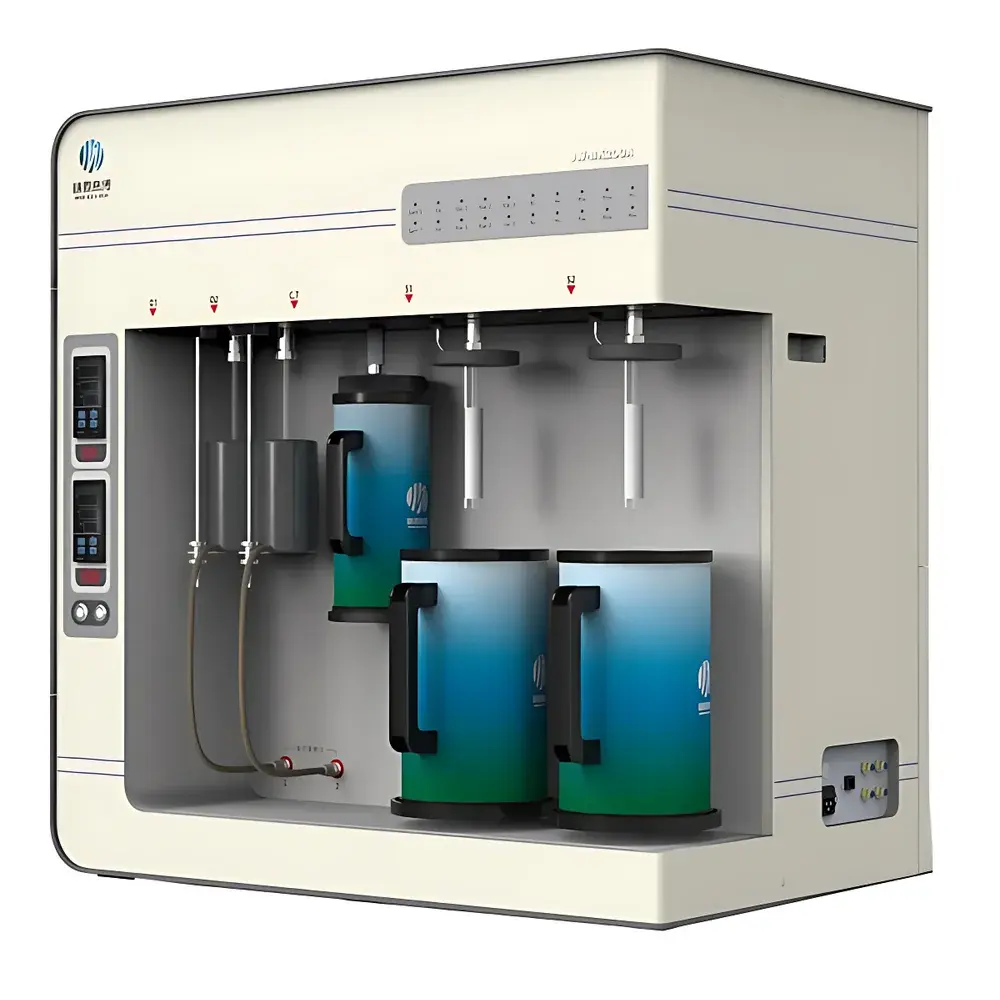
JW-BK132F High-Performance Automated Specific Surface Area and Micropore Analyzer
| Origin | Beijing, China |
|---|---|
| Manufacturer Type | Authorized Distributor |
| Origin Category | Domestic (China) |
| Model | BK132F |
| Price Range | USD 14,000–42,000 |
| Instrument Type | Specific Surface Area and Pore Size Analyzer |
| Number of Analysis Stations | 2 |
| Specific Surface Area Range | 0.005 m²/g to unlimited |
| Pore Size Range | 0.35 nm (micropores) to 5000 nm (macropores) |
| Pressure Range | P/P₀ = 10⁻⁹ to 1 |
| Measurement Principle | Gas Adsorption Method, Static Volumetric Technique |
| Repeatability | ≤ ±1.0% for surface area, ≤ ±0.1 nm for pore size |
| Analysis Time | 40–60 min (BET), 4–6 h (meso/macropores), 10–16 h (micropores) |
Overview
The JW-BK132F is a research-grade, fully automated specific surface area and micropore analyzer engineered for high-precision characterization of porous nanomaterials using the static volumetric gas adsorption method. It operates on the fundamental principles of physical adsorption thermodynamics—quantifying gas uptake (typically N₂, Ar, CO₂, or Kr) at cryogenic temperatures to derive Brunauer–Emmett–Teller (BET) surface area, t-plot external surface area (STSA), total pore volume, and pore size distribution across micro-, meso-, and macroporous regimes. Its dual-station architecture supports concurrent analysis and degassing, while integrated turbo-molecular pumping (base pressure ≤1×10⁻⁸ Pa) and multi-range pressure transducers (1000 torr / 10 torr / 1 torr, optionally 0.1 torr) enable accurate measurement down to 0.35 nm pore widths—meeting the stringent requirements for MOFs, zeolites, activated carbons, and templated silicas. The system complies with ISO 9277 (surface area), ISO 15901-2 (pore size distribution), and ASTM D3663 (BET surface area), and supports GLP/GMP-aligned data integrity via audit-trail-enabled software.
Key Features
- Dual independent analysis stations with simultaneous sample analysis and degassing capability—each station equipped with dedicated vacuum systems, pressure sensors, and liquid nitrogen level control.
- Integrated turbo-molecular pump + dual-stage rotary vane pump with anti-backstreaming technology; ultimate vacuum ≤1×10⁻⁸ Pa in both analysis and degassing stations.
- Triple-range pressure sensing (1000 torr / 10 torr / 1 torr) with optional 0.1 torr transducer for enhanced resolution in sub-1 nm micropore region.
- Real-time, in-situ P₀ measurement at each analysis station—eliminating reliance on stored or atmospheric P₀ values and improving BET accuracy.
- Automated, programmable degassing: temperature range 25–450 °C (±1 °C stability); two external degas stations support independent thermal protocols during active analysis.
- Modular, multi-channel parallel vacuum system with intelligent flow regulation (2–200 mL/s), anti-splash “stepwise” evacuation sequences, and built-in cold trap for volatile contaminant removal.
- NLDFT (Non-Local Density Functional Theory) and QSDFT models pre-installed; HK, SF, DR, DA, MP, BJH, t-plot, αs-plot, and DFT-based pore size distribution methods fully implemented.
- Ethernet-based data acquisition with <100 ms sampling interval; compatible with Windows 7/10 (32/64-bit); remote operation and multi-instrument control supported.
Sample Compatibility & Compliance
The JW-BK132F accommodates powdered, granular, and monolithic samples—including catalyst supports (γ-Al₂O₃, silica-alumina), adsorbents (activated carbon, molecular sieves), energy materials (MOFs, COFs, battery electrode powders), geological specimens (shale, coal, reservoir rocks), and advanced ceramics (SiC, Si₃N₄, Y₂O₃). All hardware and software modules conform to ISO/IEC 17025 calibration traceability standards. The instrument’s pressure control algorithm and equilibrium detection logic satisfy the repeatability criteria defined in ISO 9277 Annex B and USP . Data handling adheres to FDA 21 CFR Part 11 requirements when configured with electronic signature and audit trail modules—enabling use in regulated QC environments under GMP/GLP frameworks.
Software & Data Management
The proprietary JW-DA software provides guided workflow navigation, real-time isotherm visualization, and automated report generation compliant with ASTM D6567 and ISO 15901-2 templates. Raw pressure–volume data are stored in HDF5 format with embedded metadata (sample ID, operator, timestamp, calibration history, environmental conditions). Batch processing supports up to 16 samples per session with customizable pass/fail thresholds for BET linearity (R² ≥ 0.999), C-constant validity, and hysteresis classification. Export options include CSV, PDF, and XML for LIMS integration. All user actions—including method edits, parameter overrides, and result approvals—are logged with immutable timestamps and operator IDs, fulfilling ALCOA+ (Attributable, Legible, Contemporaneous, Original, Accurate, Complete, Consistent, Enduring, Available) data governance principles.
Applications
- Catalysis R&D: Quantifying active surface area and pore confinement effects in Pt/Al₂O₃, Cu-ZSM-5, and hierarchical zeolites.
- Environmental engineering: Evaluating adsorption capacity and pore accessibility of biochar and metal–organic frameworks for VOC or heavy metal capture.
- Battery materials: Characterizing interfacial area and ion-transport pathways in silicon anodes, sulfur cathodes, and solid-state electrolyte scaffolds.
- Petroleum geoscience: Determining specific surface area and nanopore geometry in shale kerogen and tight sandstone cores for permeability modeling.
- Pharmaceutical excipients: Assessing surface energetics and moisture-sensitive porosity of silica-based glidants and co-processed carriers per ICH Q5C guidelines.
FAQ
What gases can be used for analysis?
Nitrogen (77 K), argon (87 K), carbon dioxide (273 K), krypton (77 K), hydrogen (20 K), oxygen (90 K), methane (112 K), and water vapor are supported—with appropriate cryostat or thermostat configurations.
Is P₀ measured in real time during analysis?
Yes—each analysis station includes a dedicated P₀ port enabling concurrent saturation pressure measurement without interrupting the main isotherm acquisition.
Can the system perform heat of adsorption calculations?
Yes—via virial coefficient derivation from multi-temperature isotherms (e.g., 77 K, 87 K, 273 K), with Clausius–Clapeyron integration supported in post-processing.
Does the software support 21 CFR Part 11 compliance?
When deployed with optional electronic signature, role-based access control, and audit trail modules, full Part 11 compliance is achievable—including electronic records retention for ≥25 years.
What is the minimum detectable pore size?
With N₂ at 77 K and HK-2 model validation, the validated lower limit is 0.35 nm—verified against certified reference materials (CRM) including NIST SRM 2975 and 1898.



