
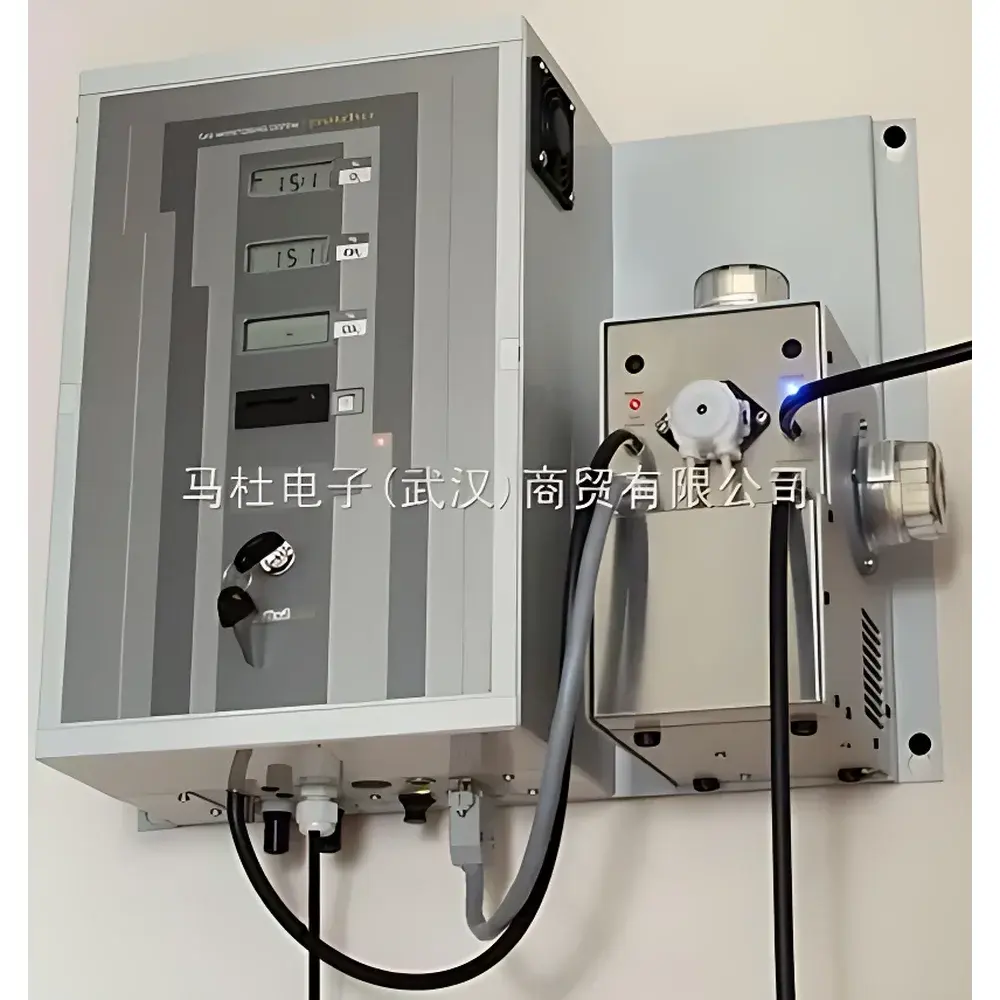
MAMOS 100-400 Online Multi-Component Flue Gas Analyzer
| Origin | Austria |
|---|---|
| Manufacturer Type | Authorized Distributor |
| Origin Category | Imported |
| Model | MAMOS 100-400 |
| Instrument Type | Continuous Emission Monitoring System (CEMS) |
| Measurement Accuracy | ≤ ±5% of reading |
| Repeatability | ≤ 2% |
| Response Time (T90) | ≤ 90 s |
| Long-Term Stability | ≤ 5% over 30 days |
| Sampling Pump Flow Rate | 1.5 L/min |
| Operating Humidity | 5–95% RH (non-condensing) |
| Ambient Temperature Range | 0–40 °C |
| Power Supply | 24 V AC |
| Power Consumption | ~8 W |
| Enclosure Rating | IP54 |
| Dimensions (H×W×D) | 380 × 300 × 140 mm |
| Weight | ~4 kg |
| Analog Outputs | 4–20 mA (linear), 0–10 V (programmable, linear) |
| Digital Interface | RS232C (TTL level) |
| Signal Averaging Time | 2–32 s (user-configurable) |
| Zero/Measurement Cycle | Fully automated, independently programmable |
Overview
The MAMOS 100-400 Online Multi-Component Flue Gas Analyzer is a fixed-installation, continuous emission monitoring system engineered for real-time, multi-gas quantification in industrial exhaust streams and biogas applications. It employs a hybrid sensing architecture—combining electrochemical (EC) and non-dispersive infrared (NDIR) detection technologies—to deliver simultaneous, selective measurement of up to four gas components. The instrument operates on the principle of electrochemical redox reactions for O2, CO, NO, NO2, SO2, H2S, Cl2, and H2, while NDIR spectroscopy enables high-selectivity, interference-resistant analysis of CO, CO2, CH4, and N2O across defined concentration ranges. Integrated sample conditioning—including particulate filtration, thermoelectrically cooled condensate removal, and peristaltic condensate evacuation—ensures representative, dry, particle-free gas delivery to sensors under varying stack conditions. Designed for compliance-grade operation, the MAMOS 100-400 meets functional requirements aligned with EN 15267-3, EN 14181, and ISO 12039 for stationary source emissions monitoring.
Key Features
- Modular sensor configuration: Supports 1–4 channels, mixable EC and NDIR sensors in a single chassis
- Pre-calibrated, field-replaceable electrochemical sensors—no post-installation calibration required; factory-traceable calibration certificates provided
- NDIR sensors require no periodic recalibration; optical path stability maintained via temperature-compensated detector design
- Integrated sample conditioning unit: Sintered metal particulate filter, Peltier-cooled dryer (dew point ≤ 5 °C), and auto-evacuating condensate pump
- Microprocessor-based control with user-configurable averaging time (2–32 s) and independent zero/measurement cycle timing
- Dual analog outputs per channel: Isolated 4–20 mA (linear) and programmable 0–10 V (linear) signals, compliant with industrial PLC/DCS input standards
- RS232C (TTL-level) interface for direct PC connection, enabling remote configuration, data logging, and firmware updates
- Two programmable dry-contact relays per channel for alarm or control actuation (e.g., burner shutdown, scrubber activation)
- IP54-rated ABS enclosure suitable for indoor industrial environments with moderate dust and humidity exposure
- Low-power design (≈8 W) optimized for 24 V AC operation in distributed CEMS architectures
Sample Compatibility & Compliance
The MAMOS 100-400 accepts sample gas at flow rates up to 1.5 L/min and tolerates ambient humidity from 5–95% RH (non-condensing). Its robust inlet train accommodates flue gases from combustion sources (e.g., cement kilns, glass furnaces, waste incinerators), biogas from anaerobic digesters (landfill, wastewater, agricultural), and syngas from thermal conversion processes. Sensor cross-sensitivity profiles are documented per IEC 62913-2, and all EC sensors comply with EN 50104 for toxic gas detection. While not certified as a QAL1 system per EN 14181, the analyzer satisfies QAL2 technical verification requirements when installed with appropriate sampling probes and conditioned lines. Data integrity is supported by timestamped internal logging and configurable audit trails—compatible with GLP/GMP-aligned record-keeping practices where electronic records are subject to 21 CFR Part 11 controls.
Software & Data Management
Configuration and diagnostics are managed via ASCII-command protocol over RS232, supporting integration into SCADA or MES platforms using standard Modbus RTU mapping (via optional converter). Local display provides real-time concentration values, sensor status, fault codes, and operational mode indicators. Internal memory stores ≥30 days of 1-minute averaged data (per channel) with time stamping. Export formats include CSV and plain-text log files. Firmware updates preserve user settings and calibration history. No proprietary runtime environment or cloud dependency is required—data sovereignty remains fully under end-user control.
Applications
- Continuous monitoring of O2, CO, CO2, CH4, and H2S in biogas upgrading and utilization systems
- Combustion efficiency optimization in boilers, thermal oxidizers, and industrial furnaces
- Emissions reporting for regulatory compliance in cement, steel, and municipal solid waste incineration facilities
- Process gas analysis in anaerobic digestion plants (food waste, sewage sludge, agricultural residues)
- Coal mine methane (CMM) and landfill gas (LFG) energy recovery projects requiring CH4/CO2/O2 ratio tracking
- Air quality surveillance for CO2 (0–2000 ppm) and CH4 (0–5% vol) in confined spaces and urban monitoring stations
- Research-grade gas composition profiling in laboratory-scale pyrolysis, gasification, and catalytic reforming experiments
FAQ
Is the MAMOS 100-400 certified for regulatory emissions reporting?
It is not QAL1-certified per EN 14181, but it fulfills QAL2 technical criteria and is widely deployed for indicative monitoring, process control, and pre-compliance screening in jurisdictions accepting supplementary CEMS instrumentation.
Can NDIR and electrochemical sensors be used simultaneously in one unit?
Yes—the analyzer supports mixed-sensor configurations (e.g., CO via NDIR + O2/SO2 via EC) without signal interference or hardware modification.
What maintenance intervals are recommended for the sample conditioning system?
The particulate filter should be inspected quarterly; the Peltier cooler and condensate pump require annual functional verification. No consumables beyond filter elements are needed under normal operating conditions.
Does the instrument support automatic zero calibration?
Yes—fully automated zero/gas measurement cycles are programmable per channel, with independent timing for each phase to minimize downtime during scheduled calibration events.
Are high-temperature sampling probes available as accessories?
Yes—optional stainless-steel probe assemblies with Teflon-lined sampling tubes are offered in lengths of 750 mm, 1000 mm, and 1500 mm, rated for continuous operation up to 800 °C, 1150 °C, or 1600 °C depending on configuration.







