
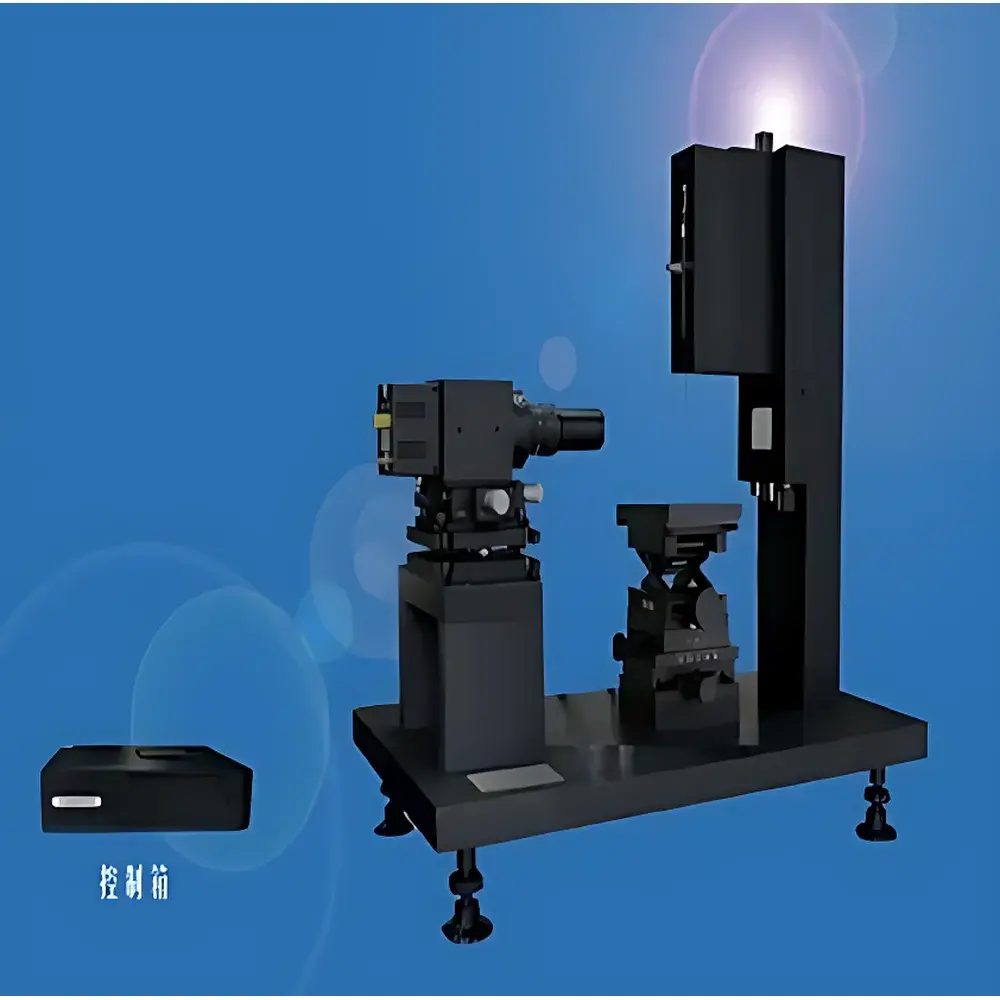
PowerView JC2000D2M Automated Video-Based Contact Angle Goniometer
| Origin | Beijing, China |
|---|---|
| Manufacturer Type | Authorized Distributor |
| Origin Category | Domestic (PRC) |
| Model | JC2000D2M |
| Price Range | USD 7,000–14,000 |
| Instrument Class | Video Optical Contact Angle Analyzer |
| Form Factor | Benchtop Laboratory System |
| Contact Angle Range | 0–180° |
| Contact Angle Accuracy | ±0.1° (θ/2 Method) |
| Sample Stage Dimensions | 70 × 70 mm |
| Optical Magnification | 0.7–5× (55–320 pixels/mm) |
| Surface/Interfacial Tension Range | 0–1000 mN/m |
Overview
The PowerView JC2000D2M is an automated, benchtop video-based contact angle goniometer engineered for high-precision quantification of solid–liquid interfacial wettability under controlled laboratory conditions. It operates on the principle of optical silhouette imaging combined with advanced edge-detection algorithms and mathematical contour fitting to determine the contact angle at the solid–liquid–vapor three-phase boundary. The system supports multiple measurement modes—including sessile drop, pendant drop, captive bubble, and tilting plate—enabling static, advancing/receding, and dynamic contact angle analysis. Designed for rigorous surface science applications, the instrument delivers traceable, reproducible measurements compliant with ASTM D7334 (Standard Practice for Surface Wettability of Coated Surfaces), ISO 19403-2 (Contact angle measurement — Part 2: Sessile drop method), and ISO 19403-4 (Pendant drop method). Its modular architecture integrates a motorized fluid dispensing subsystem, precision mechanical stage, industrial-grade low-light CCD imaging platform, and calibrated optical train—ensuring stability across long-duration experiments and multi-sample throughput.
Key Features
- Automated microdispensing system with 0.01 µL minimum step resolution and programmable multi-point deposition sequences
- Manual XYZ-adjustable sample stage (±50 mm XY travel, 45 mm Z travel) with 0.1 mm XY and 0.01 mm Z positioning accuracy
- Industrial continuous-zoom lens (0.7–5× magnification) providing 55–320 pixels/mm effective spatial resolution at 90 mm working distance
- Ultra-low-light CCD camera (0.0005 lux sensitivity, 750 TV lines horizontal resolution, 25 fps frame rate) with real-time AVI video capture capability
- Adjustable LED cold backlight with imported acrylic diffuser for uniform illumination and minimal thermal perturbation
- Six validated contact angle calculation methods: θ/2, circle/ellipse fitting, tangent, baseline correction, pendant drop fitting, and full-image auto-analysis
- Integrated surface energy estimation engine supporting nine theoretical models (Owens–Wendt, Fowkes, Wu, van Oss–Chaudhury–Good, Schultz, Zisman, Neumann, CAH, and Acid–Base)
- Comprehensive dynamic analysis suite: advancing/receding angles, roll-off angles, tilt-angle hysteresis, and time-resolved contact angle kinetics
Sample Compatibility & Compliance
The JC2000D2M accommodates flat, curved, fibrous, porous, and particulate substrates—including pressed powder compacts, woven textiles, polymer films, metal foils, ceramic tiles, and hydrogel membranes. Its 70 × 70 mm stage supports standard petri dishes, silicon wafers, glass slides, and custom fixtures. All hardware and software components meet CE marking requirements for electromagnetic compatibility (EMC Directive 2014/30/EU) and low-voltage safety (LVD Directive 2014/35/EU). Data acquisition workflows support audit-trail-enabled operation per FDA 21 CFR Part 11 guidelines when configured with optional user access control and electronic signature modules. Measurement uncertainty budgets are documented per ISO/IEC 17025:2017 Annex A.2 for accredited calibration laboratories.
Software & Data Management
PowerView Analyze™ software (v4.2+) provides a unified interface for acquisition, processing, and reporting. It features batch-mode analysis for up to 999 images per session, automatic outlier detection, and pixel-level edge refinement using sub-pixel interpolation. All results—including raw images, fitted contours, contact angle values, surface tension curves, and free energy matrices—are stored in a relational SQLite database with timestamped metadata. Export options include CSV, XLSX, PDF reports with embedded graphs, and annotated PNG/JPEG files containing overlays of measurement geometry and statistical summaries. Backup compression, version-controlled project archiving, and SQL-based query tools enable seamless integration into LIMS or ELN environments. Software validation documentation (IQ/OQ protocols) is available upon request for GLP/GMP-regulated facilities.
Applications
This instrument serves critical quality and R&D functions across industries where interfacial behavior dictates performance: coating adhesion and uniformity assessment in automotive OEM and display manufacturing; hydrophobic/hydrophilic surface characterization of filtration membranes and biomedical implants; CMC determination and surfactant efficacy screening in personal care formulations; wettability mapping of functionalized nanomaterials and MOF coatings; inkjet printability evaluation in flexible electronics; and surface aging studies in aerospace composites and solar panel anti-soiling coatings. Academic users apply it to fundamental investigations of Cassie–Baxter vs. Wenzel wetting transitions, electrowetting-on-dielectric (EWOD) actuation, and stimuli-responsive polymer swelling kinetics.
FAQ
What measurement methods does the JC2000D2M support?
Sessile drop (static, advancing/receding, tilt-induced roll-off), pendant drop (surface/interfacial tension), captive bubble (hydrophobicity of submerged surfaces), and immersed plate (solid–liquid contact angle under liquid phase).
Can it measure contact angles on rough or heterogeneous surfaces?
Yes—software includes dedicated corrections for convex/concave curvature and surface roughness via Young–Dupré and Wenzel model integration.
Is surface energy calculation included in the base software?
Yes—nine peer-reviewed surface energy models are pre-installed, with adjustable dispersion/polar component weighting and cross-validation against reference standards.
Does the system comply with regulatory data integrity requirements?
When deployed with optional audit trail and role-based access controls, it satisfies core principles of ALCOA+ (Attributable, Legible, Contemporaneous, Original, Accurate) and supports 21 CFR Part 11 compliance.
What is the warranty coverage for international customers?
Standard warranty covers parts and labor for 24 months from shipment date; extended service plans and remote diagnostics support are available globally through authorized technical partners.



