
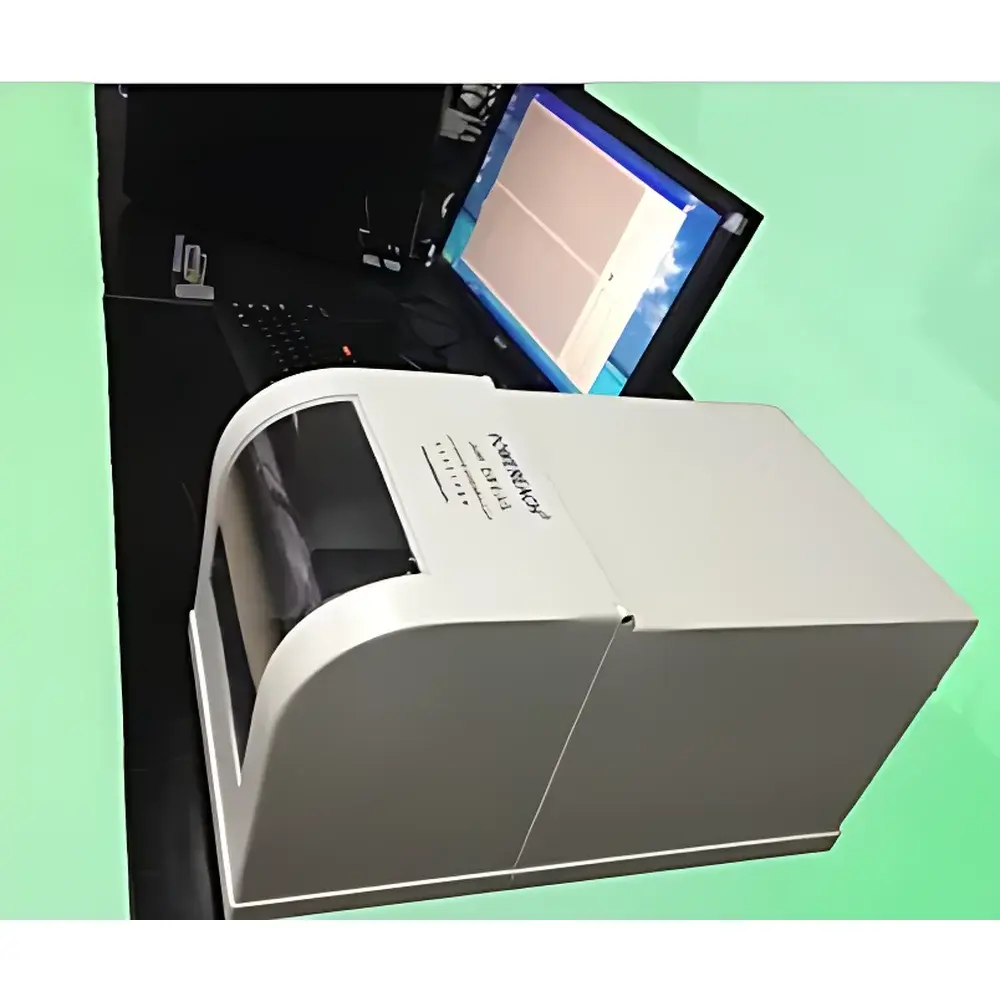
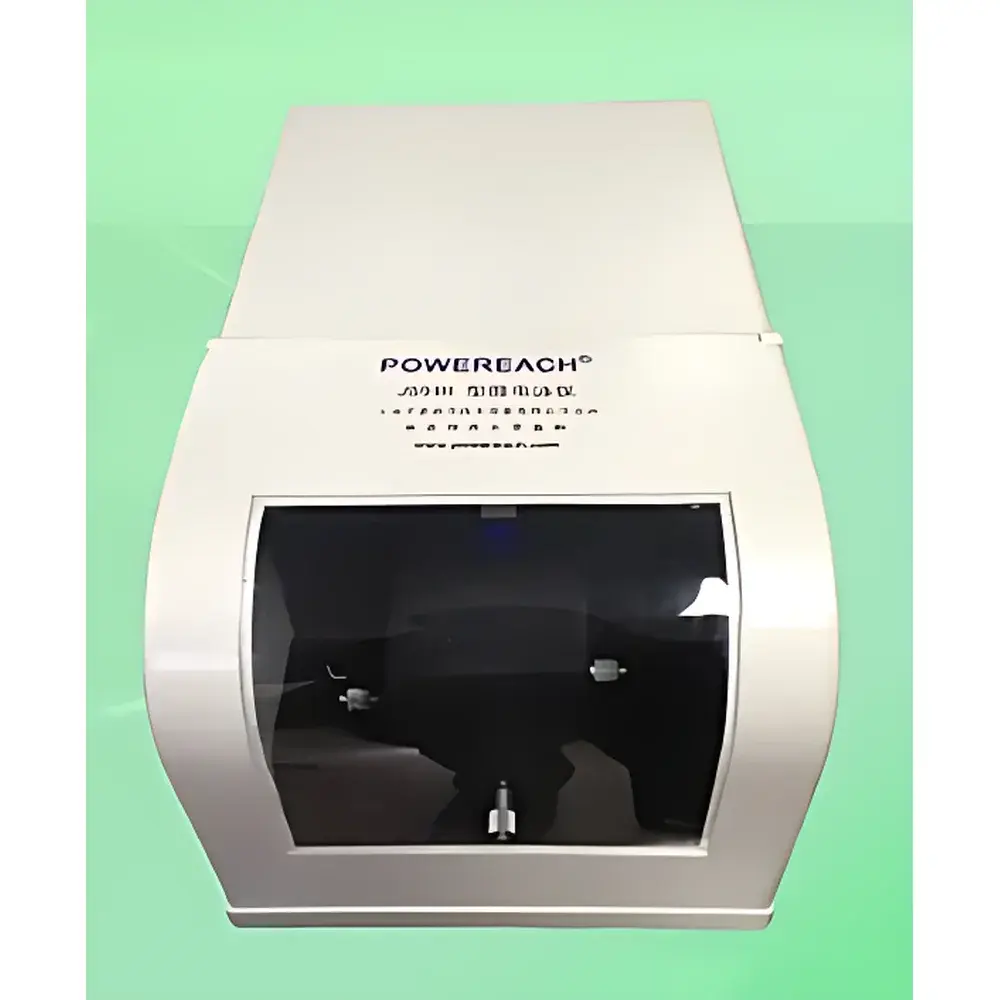
Zykx JS94K2M Fully Automated Zeta Potential Analyzer
| Brand | Zykx |
|---|---|
| Origin | Beijing, China |
| Manufacturer Type | Authorized Distributor |
| Country of Origin | China |
| Model | JS94K2M |
| Price Range | USD 7,000 – 14,000 |
| Zeta Potential Range | ±3000 mV |
| Measurement Accuracy | ±5% |
| pH Range | 0.00–14.00 |
| pH Resolution | 0.1 pH unit |
| Zeta Resolution | 1 mV |
| Temperature Range | −5.0 to 105.0 °C |
| Temperature Accuracy | ±0.1 °C |
| Optional Thermostatic Stage | −10 to 95 °C |
| Sample Volume per Measurement | 0.5 mL |
| Optical System | Semiconductor-based near-field blue/green LED illumination (λ ≈ 450–520 nm), 1200× digital magnification |
| Voltage Polarity Switching Time | Adjustable from 0.30 to 1.20 s |
| Measurement Cycle Time | 3–10 s |
| Power Supply | 220 V AC, 50 Hz |
| Power Consumption | 150 W |
Overview
The Zykx JS94K2M Fully Automated Zeta Potential Analyzer is an electrophoretic light scattering (ELS) instrument engineered for precise determination of zeta potential (ζ) in colloidal and dispersed systems. It operates on the principle of microelectrophoresis: under a controlled electric field, charged particles or droplets migrate at velocities proportional to their surface charge; these velocities are optically tracked via high-magnification video microscopy and converted into zeta potential values using the Henry equation and Smoluchowski approximation (valid for aqueous systems with low ionic strength and particle sizes >100 nm). The system supports both aqueous and non-aqueous dispersions within the 0.2–50 µm particle size range, making it suitable for routine characterization of nanoparticles, emulsions, liposomes, polymeric micelles, and functionalized colloids. Its design emphasizes reproducibility in academic teaching labs and industrial QC environments where surface charge analysis informs formulation stability, flocculation behavior, and interfacial reactivity—particularly during pH titration studies to identify isoelectric points (IEP).
Key Features
- Integrated microelectrophoresis cell with 0.5 mm-thick borosilicate glass walls and embedded Ag/AgCl, Pt, and Ti electrodes—engineered via computational fluid dynamics (CFD) modeling to minimize electro-osmotic flow and eliminate stagnant layer artifacts.
- Optimized near-field optical path using low-power (<100 µW) blue/green semiconductor LEDs, reducing thermal perturbation and enabling stable imaging of sub-500 nm particles at 1200× effective magnification.
- Automated bidirectional particle tracking: captures four synchronized grayscale frames per measurement cycle (two forward, two reverse field directions), eliminating directional bias and improving statistical robustness.
- Real-time temperature compensation: integrated Pt100 probe continuously feeds ambient and sample chamber temperature data to the acquisition software, dynamically adjusting viscosity and dielectric constant inputs in the zeta calculation algorithm.
- Programmable voltage polarity switching (0.30–1.20 s intervals) combined with low-frequency constant-voltage excitation minimizes electrode polarization and ensures stable field application across diverse electrolyte concentrations.
- Modular thermostatic stage option (−10 to 95 °C) enables kinetic studies of temperature-dependent surface charging behavior under ISO 13321:2020-compliant conditions.
Sample Compatibility & Compliance
The JS94K2M accommodates suspensions, emulsions, and colloidal dispersions in water, ethanol, isopropanol, and other low-conductivity solvents. It complies with core methodology standards including ASTM D6985 (Standard Test Method for Zeta Potential of Colloidal Dispersions), ISO 13099-1:2012 (Nanotechnologies — Methods for the Characterization of Colloidal Systems — Part 1: Zeta Potential), and USP (Light Scattering Methods for Subvisible Particle Analysis). Its operational workflow supports GLP documentation requirements: all raw image sequences, field parameters, temperature logs, and calculated ζ values are timestamped and stored with metadata (user ID, sample ID, date/time, instrument serial number). Audit trails meet FDA 21 CFR Part 11 criteria when deployed with validated networked storage and user-access controls.
Software & Data Management
The proprietary Zykx ZetaSoft v4.2 platform runs on Windows 10/11 and provides full control over measurement parameters, real-time visualization of electrophoretic mobility histograms, and automated IEP curve fitting. Data export is supported in CSV, TXT, and PDF formats—with embedded calibration certificates and uncertainty budgets per ISO/IEC 17025 guidelines. Batch processing mode allows sequential analysis of up to 24 samples with programmable pH ramping (via optional external titrator integration). All image datasets are retained in lossless TIFF format for third-party validation or reprocessing. Software validation documentation—including IQ/OQ protocols—is available upon request for regulated environments.
Applications
This analyzer serves critical roles across multiple sectors: in pharmaceutical development, it characterizes the colloidal stability of mRNA-LNP formulations and protein conjugates; in materials science, it evaluates surface functionalization efficiency of silica, titania, and carbon nanotubes; in environmental engineering, it assesses coagulant dosing thresholds for wastewater treatment slurries; and in cosmetics R&D, it correlates surfactant adsorption with emulsion shelf-life. Educational applications include hands-on instruction in colloid chemistry, interfacial thermodynamics, and electrokinetic theory—aligned with standard curricula in chemical engineering, physical chemistry, and nanoscience programs.
FAQ
What dispersion media are compatible with the JS94K2M?
Aqueous buffers (e.g., NaCl, KCl, phosphate), alcohols (ethanol, isopropanol), and low-viscosity organic solvents with conductivity <5 mS/m. High-salt or viscous media require method adaptation and may reduce resolution.
Does the system support automated pH titration?
Yes—when interfaced with a certified burette module (e.g., Metrohm 800 Dosino), ZetaSoft enables closed-loop pH-controlled zeta mapping per ISO 13099-3 Annex A.
Is calibration traceable to NIST standards?
Instrument alignment and magnification calibration use NIST-traceable stage micrometers; zeta calibration employs certified polystyrene latex standards (e.g., Duke Scientific 3000A series) with documented ζ-certificates.
Can data be exported for LIMS integration?
Yes—CSV exports include all raw mobility distributions, statistical confidence intervals (95%), and metadata fields compliant with ASTM E1482-22 for laboratory information management system ingestion.
What maintenance is required for long-term accuracy?
Quarterly verification of electrode offset voltage (<±2 mV), annual recalibration of temperature sensor against a certified RTD reference, and biannual cleaning of optical windows with spectroscopic-grade methanol per manufacturer SOP-EL-007.



