
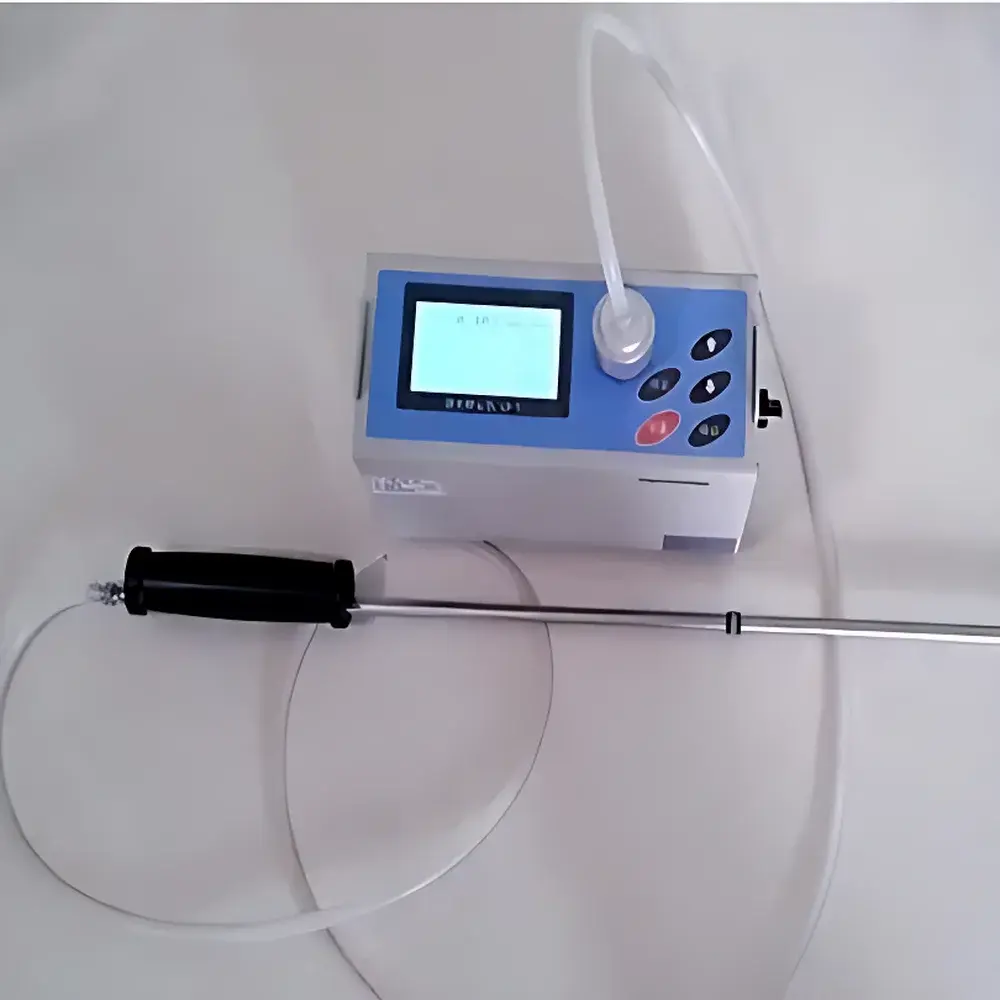
PortaScan PM Series Portable Automotive Exhaust Particulate Monitor
| Origin | Beijing, China |
|---|---|
| Manufacturer Type | Authorized Distributor |
| Origin Category | Domestic (China) |
| Model | PM2.5 |
| Instrument Type | Portable |
| Detection Principle | Laser Light Scattering |
| Maximum Permissible Error | ±10% |
| Zero Drift | ±1% FS |
| Span Drift | ±3% |
| Repeatability | ≤2% |
| Measurement Range | 0.001–10 mg/m³ or 0.001–100 mg/m³ |
| Sampling Flow Rate | 2.83 L/min (±2%) |
| Minimum Resolution | 0.001 mg/m³ |
| LOD | 2 µg/m³ |
| Data Interface | RS-232 |
| Display | Real-time LCD with large-format concentration readout |
| Calibration Method | NIST-traceable optical membrane standard |
| Humidity Compensation | Automatic correction under high-humidity conditions |
Overview
The PortaScan PM Series Portable Automotive Exhaust Particulate Monitor is an engineered field-deployable instrument designed for real-time, on-site quantification of airborne particulate matter emitted from internal combustion engines and mobile sources. Based on the well-established principle of multi-angle laser light scattering (MALS), the device measures particle number concentration and mass concentration across five standardized size fractions—PM₁, PM₂.₅, PM₅, PM₁₀, and Total Suspended Particulates (TSP)—within the aerodynamic diameter range of 0.5 µm to 15 µm. Unlike fixed-station analyzers requiring laboratory-grade infrastructure, this unit delivers lab-comparable reproducibility in roadside, fleet maintenance bay, inspection station, and regulatory enforcement scenarios. Its optical architecture complies with the physical basis of ISO 2591-1 and aligns with the measurement methodology referenced in WS/T 206–2001 (Public Health Standard for Inhalable Particulate Matter in Public Places), ensuring technical coherence with internationally recognized aerosol metrology frameworks.
Key Features
- Real-time, simultaneous reporting of PM₁, PM₂.₅, PM₅, PM₁₀, and TSP mass concentrations on a single high-contrast LCD display
- Compact handheld form factor (≤1.2 kg) with ergonomic grip and IP54-rated enclosure for dust and splash resistance during outdoor operation
- Laser-based optical detection system with adjustable scattering angle configuration to enhance size-class discrimination fidelity
- Integrated flow control module maintaining constant sampling at 2.83 L/min (±2%), traceable to ISO 13137 calibration protocols
- Automatic humidity compensation algorithm minimizing hygroscopic bias in ambient conditions up to 95% RH
- Three-button intuitive interface enabling zero calibration, span verification, and data logging without menu navigation overhead
- RS-232 serial interface supporting bidirectional communication for time-synchronized data export and remote firmware updates
Sample Compatibility & Compliance
The PortaScan PM Series is validated for use in heterogeneous exhaust streams from gasoline, diesel, and LPG-powered vehicles, including cold-start and transient operating modes. It meets the functional requirements of China’s HJ 618–2011 standard for ambient particulate monitoring and supports compliance verification against GB 18285–2018 (Emission Limits and Measurement Methods for Pollutants from Light-Duty Vehicles). While not certified for direct EPA Method 201A or EN 16454 equivalence, its optical performance characteristics—including ≤2% repeatability and ±10% maximum permissible error—fall within the acceptance criteria specified in ISO/IEC 17025 accredited laboratories for preliminary screening and trend analysis. All calibration procedures reference NIST-traceable polystyrene latex (PSL) microsphere standards and optical membrane references per WS/T 206–2001 Annex B.
Software & Data Management
The included AirQuality Desktop Suite (v3.2+) provides full audit-trail functionality compliant with GLP data integrity principles. Each measurement record embeds timestamp, GPS coordinates (when connected via optional Bluetooth adapter), instrument serial ID, operator code, and environmental metadata (temperature, RH, pressure). Data export options include CSV, XLSX, and XML formats compatible with LIMS integration. The software generates time-series plots with user-defined averaging intervals (1–9999 seconds), overlay-capable comparative charts for multi-location campaigns, and automated report templates aligned with municipal air quality reporting formats. All raw scatter pulse data are retained locally on-device SD card (optional) and support forensic reprocessing using updated Mie scattering inversion algorithms.
Applications
- Roadside emissions screening at vehicle inspection and maintenance (I/M) stations
- Onboard diagnostics validation for after-treatment systems (DPF, GPF, SCR) in fleet management operations
- Occupational exposure assessment in underground parking garages, bus depots, and tunnel environments
- Urban air quality hotspot mapping in conjunction with mobile monitoring platforms
- Verification of cabin air filtration efficiency in automotive R&D test cells
- Regulatory enforcement support for local environmental protection bureaus conducting mobile source audits
FAQ
Does this instrument measure black carbon or elemental carbon separately?
No. The PortaScan PM Series reports total aerosol mass concentration by aerodynamic size fraction. Elemental carbon quantification requires complementary techniques such as thermal-optical reflectance (TOR) or photoacoustic spectroscopy.
Can it be used for stack emission monitoring?
It is not rated for high-temperature, high-humidity, or corrosive flue gas applications. For stationary source compliance, refer to our fixed-stack PM monitor series compliant with EN 13284-1.
Is RS-232 the only communication interface?
Standard configuration includes RS-232. Optional Bluetooth 5.0 and USB-C modules are available for wireless telemetry and power delivery.
What calibration standards are required for routine verification?
Annual calibration against PSL reference aerosols (e.g., 1.0 µm and 2.5 µm) and optical membrane standards is recommended. Field zero checks using clean-air purge are performed before each operational session.
Does the device meet FDA 21 CFR Part 11 requirements?
While the software supports electronic signatures and audit trails, full Part 11 compliance requires site-specific validation documentation and controlled access configuration—available under enterprise licensing.
Related Products







