
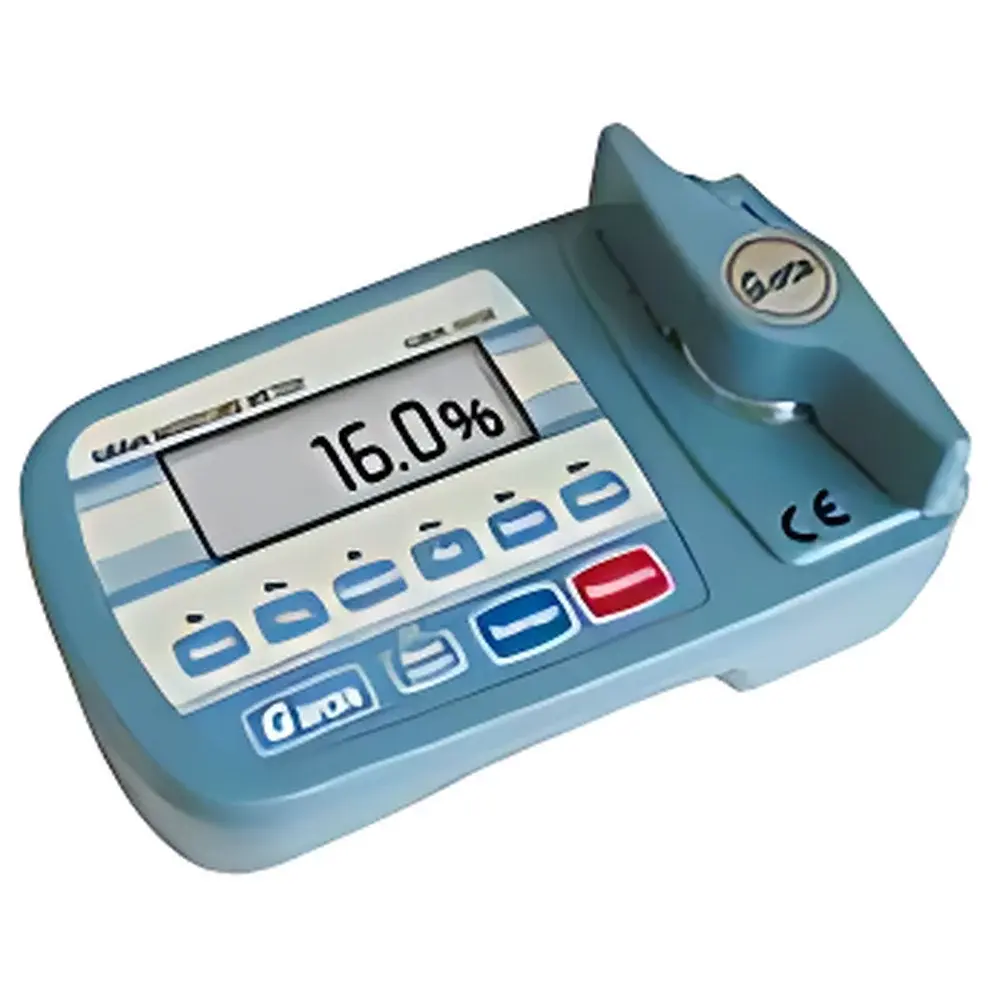
G-WON GMK-303F Capacitance-Based Grain Moisture Analyzer
| Brand | G-WON |
|---|---|
| Origin | South Korea |
| Model | GMK-303F |
| Measurement Principle | Capacitance Sensing |
| Accuracy | ±0.5% |
| Display | Digital LCD |
| Temperature Compensation | Automatic |
| Power Supply | 4 × 1.5 V AA batteries |
| Dimensions | 164 × 94 × 40 mm (L × W × H) |
| Weight | ~1.2 kg |
| Grain-Specific Calibration Ranges | Chestnut (9.7–25.4%), Paddy Rice (8.5–30.0%), Peas (9.7–21.5%), Rye (9.8–25.0%), Soybean (8.5–21.5%), Wheat (8.5–30.0%), Corn (8.7–22.8%) |
Overview
The G-WON GMK-303F is a portable, capacitance-based grain moisture analyzer engineered for rapid, non-destructive field and laboratory assessment of moisture content in bulk cereal grains and legumes. Unlike loss-on-drying (LOD) methods requiring thermal drying and extended wait times, the GMK-303F employs high-frequency capacitance sensing to measure dielectric permittivity changes correlated with water content in intact grain samples. This principle leverages the significant difference in dielectric constant between dry starch/protein matrices and free/bound water—enabling real-time measurement without sample grinding or oven conditioning. The instrument is calibrated against reference gravimetric standards per ISO 712:2022 (Cereals and cereal products — Determination of moisture content — Reference method) and supports traceable operation under GLP-compliant workflows when paired with documented calibration verification.
Key Features
- Capacitance-based sensing architecture optimized for heterogeneous granular materials, minimizing density and particle-size sensitivity through adaptive signal normalization.
- Digital LCD display with backlight for clear readability under variable ambient lighting conditions—including warehouse floors, harvest sites, and mobile inspection vehicles.
- Automatic temperature compensation algorithm corrects for seasonal and geographic thermal drift across operating ranges from 0 °C to 40 °C, ensuring consistent accuracy independent of environmental fluctuations.
- Lightweight, ergonomic housing (1.2 kg) with ruggedized ABS casing designed for daily handling in agri-logistics environments—resistant to dust ingress and mechanical shock per IP54-rated enclosure specifications.
- Four-AA battery power system provides >1,000 measurements per set under typical usage, supporting uninterrupted operation during multi-site quality audits without external power dependency.
- Pre-loaded, crop-specific calibration curves aligned to regional grain varieties and post-harvest conditioning practices—including paddy rice, wheat, corn, soybean, rye, peas, and chestnuts—each validated against ASTM D4940-21 (Standard Guide for Conducting Moisture Testing of Agricultural Commodities).
Sample Compatibility & Compliance
The GMK-303F is validated for direct insertion into representative grain lots conforming to ISO 24333:2009 (Cereals and cereal products — Sampling) protocols. Sample volume requirements are standardized at 150–200 g per test, with minimal preparation: grains must be free of surface moisture, chaff, and foreign material. No grinding, sieving, or pre-conditioning is required. Instrument compliance includes alignment with national metrological requirements for agricultural testing equipment in South Korea (KATS KS M ISO 712), EU Regulation (EC) No 882/2004 on official controls, and USDA-FAS moisture testing guidelines for export certification. While not FDA 21 CFR Part 11–compliant as a standalone device (lacking electronic audit trail functionality), it supports data integrity when integrated into validated QC workflows using external logging procedures.
Software & Data Management
The GMK-303F operates as a self-contained hardware unit with no embedded firmware update capability or USB/Bluetooth connectivity. All measurement data remain local to the device interface; however, results are structured for manual transcription into LIMS or Excel-based QA records. Users may implement standardized reporting templates compliant with ISO/IEC 17025:2017 clause 7.8 (Reporting of Results), including operator ID, lot number, sampling date/time, grain type, measured %MC, and ambient temperature. For enterprise-level traceability, third-party barcode scanners or mobile apps can be deployed alongside the analyzer to synchronize batch metadata with moisture readings during field inspections.
Applications
- On-farm moisture verification prior to storage or sale—preventing spoilage, mycotoxin development, and weight-loss disputes during grain handover.
- Feed mill intake inspection to ensure raw material compliance with contractual moisture limits (e.g., ≤14.0% for wheat, ≤13.5% for soybean meal).
- Grain elevator and port terminal quality control for export documentation, aligning with phytosanitary certificate requirements and international trade contracts (GAFTA, FOSFA).
- Research applications in post-harvest physiology studies evaluating drying kinetics, hermetic storage efficacy, and varietal moisture retention behavior.
- Extension service training modules demonstrating rapid, operator-independent moisture assessment techniques for smallholder cooperatives.
FAQ
Does the GMK-303F require periodic recalibration?
Yes—annual verification against NIST-traceable reference standards or certified reference materials (CRMs) is recommended per ISO/IEC 17025:2017 clause 6.4. Calibration checks should be performed before each shift when used in regulated environments.
Can the instrument measure moisture in milled or flaked grains?
No—the GMK-303F is calibrated exclusively for whole, unprocessed kernels. Milled products exhibit altered dielectric response due to increased surface area and air voids, invalidating factory calibrations.
Is the device suitable for use in high-humidity outdoor environments?
It is rated IP54 for dust and splash resistance; however, prolonged exposure to condensation or rain requires protective housing. Battery performance may decrease below 5 °C or above 35 °C.
How does capacitance-based measurement compare to NIR or LOD methods?
Capacitance offers superior portability and speed over LOD, and higher robustness against grain color/variety variation than NIR—but lacks the multi-analyte capability (protein, oil) of advanced spectrometers.
What documentation accompanies the instrument for regulatory audits?
Each unit ships with a factory calibration certificate (including serial-numbered traceability to Korean National Metrology Institute standards), user manual in English and Korean, and ISO 712:2022 conformance statement.




