
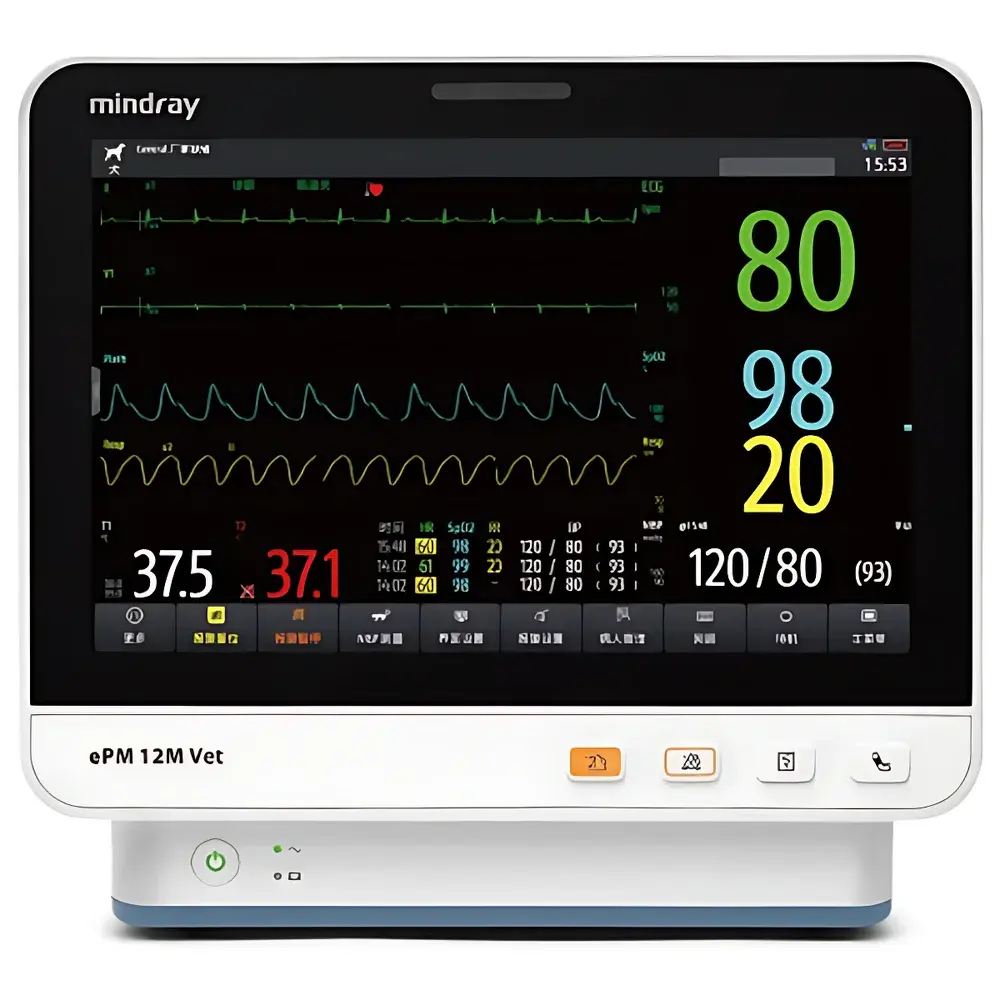
Mindray ePM 12M Vet Modular Veterinary Patient Monitor
| Brand | Mindray |
|---|---|
| Origin | Shanghai, China |
| Manufacturer Type | Authorized Distributor |
| Country of Origin | China |
| Model | ePM 12M Vet |
| Instrument Type | Electrocardiography (ECG)-Enabled Multi-Parameter Veterinary Monitor |
| NIBP Algorithm | Species-Specific Cuff-Based Blood Pressure Algorithm |
| SpO₂ Technology | Motion-Tolerant and Low-Perfusion Resistant Pulse Oximetry |
| ECG Analysis | Multi-Lead Digital Signal Processing with CrozFusion™ Signal Fusion |
| Expandable Modules | CO₂ (Capnography), IBP (Invasive Blood Pressure, up to 4 channels), Cardiac Output (C.O.), Anesthetic Gas (AG), O₂/CO₂ (Artema® Technology) |
| Display | 12.1-inch Capacitive Touchscreen with Gesture Support |
| Data Storage | Internal Flash Memory + USB Export Capability |
| Compliance | IEC 60601-1, IEC 60601-2-51 (for Veterinary Monitors), ISO 13485 Certified Manufacturing |
Overview
The Mindray ePM 12M Vet is a CE-marked, Class IIa veterinary patient monitor engineered for precision, reliability, and clinical adaptability in small-animal, large-animal, and exotic species care settings. Designed on a modular architecture, it employs validated physiological signal acquisition principles—including differential amplification for ECG, time-of-flight infrared absorption for capnography, and dual-wavelength photoplethysmography for SpO₂—to ensure measurement integrity across diverse anatomical and hemodynamic conditions. Its core measurement engine integrates CrozFusion™ multi-parameter signal fusion technology, which co-analyzes synchronized ECG and SpO₂ waveforms to maintain parameter stability during transient motion artifacts, lead impedance fluctuations, or low-perfusion states—common challenges in intraoperative and critical-care animal monitoring. The device meets essential safety and performance requirements outlined in IEC 60601-2-51, the international standard governing veterinary-specific electro-medical equipment, and supports traceable data handling aligned with GLP-compliant research workflows.
Key Features
- 12.1-inch high-resolution capacitive touchscreen with gesture-based navigation and flat UI architecture—enabling access to primary monitoring functions within two taps
- Modular expansion bay supporting up to five concurrent parameter modules: mainstream/end-tidal CO₂, invasive blood pressure (IBP) with four-channel capability, thermodilution or pulse-contour cardiac output (C.O.), anesthetic gas analysis (AG), and dual-gas O₂/CO₂ via Artema® sensor platform
- Species-adapted non-invasive blood pressure (NIBP) algorithm optimized for canine, feline, equine, and rodent cuff dynamics—including adaptive inflation control and artifact rejection logic
- Motion-robust SpO₂ with enhanced low-perfusion sensitivity (<0.3% perfusion index) and integrated plethysmographic waveform quality index
- Multi-lead ECG analysis with real-time arrhythmia detection (including VT/VF, PAC/PVC, bradycardia/tachycardia thresholds), ST-segment trend logging, and vector magnitude display
- Fanless thermal management system—eliminating hair ingestion risk and reducing cross-contamination potential in multi-species clinical environments
- Medical-grade enclosure compliant with resistance to 49 common veterinary disinfectants (per ISO 10993-5 cytotoxicity and ASTM F2059 surface compatibility testing)
Sample Compatibility & Compliance
The ePM 12M Vet is validated for continuous physiological monitoring across domesticated and laboratory species, including dogs, cats, rabbits, guinea pigs, rats, mice, horses, and swine. Electrode, probe, and cuff configurations are sized and calibrated per species-specific anatomical norms—e.g., micro-cuffs for rodents, pediatric cuffs for juvenile canines, and reinforced arterial catheter interfaces for equine IBP. All hardware and firmware comply with ISO 13485:2016 quality management standards, and software design follows IEC 62304 Class B medical device software lifecycle requirements. Data export formats (CSV, PDF, XML) support audit-ready documentation for AAALAC-accredited facilities and FDA-regulated preclinical studies under 21 CFR Part 58 (Good Laboratory Practice).
Software & Data Management
The embedded operating system provides configurable alarm escalation protocols with visual, audible, and tactile alerts—including color-coded priority levels and customizable alarm limits per species and life stage. Up to 25 user-defined configuration profiles may be saved locally or loaded via encrypted USB drive, each supporting independent parameter selection, waveform scaling, and alarm threshold sets. The system maintains full audit trails for all configuration changes, alarm acknowledgments, and manual interventions—meeting 21 CFR Part 11 electronic record requirements when deployed with validated network authentication and role-based access controls. Trend data is stored for ≥72 hours at 1-second resolution, with optional integration into hospital information systems (HIS) via HL7 v2.5 or DICOM-PS (DICOM Physiological Signals) interfaces.
Applications
This monitor serves as a central physiological surveillance platform in academic veterinary teaching hospitals, contract research organizations (CROs), pharmaceutical preclinical labs, and specialty surgical centers. Typical use cases include intraoperative hemodynamic tracking during orthopedic or oncologic procedures; post-anesthetic recovery monitoring with automated respiratory rate and end-tidal CO₂ trending; longitudinal cardiovascular assessment in chronic disease models (e.g., feline hypertrophic cardiomyopathy, canine dilated cardiomyopathy); and regulatory-compliant safety pharmacology studies requiring simultaneous ECG, BP, SpO₂, and temperature acquisition per ICH S7B guidelines.
FAQ
Does the ePM 12M Vet support FDA-submission–ready data export?
Yes—when configured with secure user authentication, electronic signature, and audit trail logging enabled, exported datasets meet 21 CFR Part 11 requirements for electronic records and signatures.
Can the NIBP algorithm be adjusted for avian or reptilian species?
No—current NIBP functionality is validated only for mammals; alternative monitoring strategies (e.g., Doppler ultrasound, IBP) are recommended for non-mammalian species.
Is the CrozFusion™ technology certified under any specific standard?
CrozFusion™ is internally validated per IEC 60601-2-51 Annex BB and referenced in Mindray’s technical file under EU MDR 2017/745 Annex II, Section 3.2, as a risk-mitigating signal processing methodology.
What is the maximum sampling rate for ECG waveform storage?
The system acquires ECG at 1 kHz with 16-bit resolution and stores full-waveform data at user-selectable rates (125 Hz, 250 Hz, or 500 Hz) for long-term trend analysis.
Are third-party transducers or sensors compatible with the modular expansion slots?
No—only Mindray-certified modules (e.g., ePM-CO₂, ePM-IBP-4) are supported to ensure calibration traceability, electromagnetic compatibility, and signal integrity assurance.





