
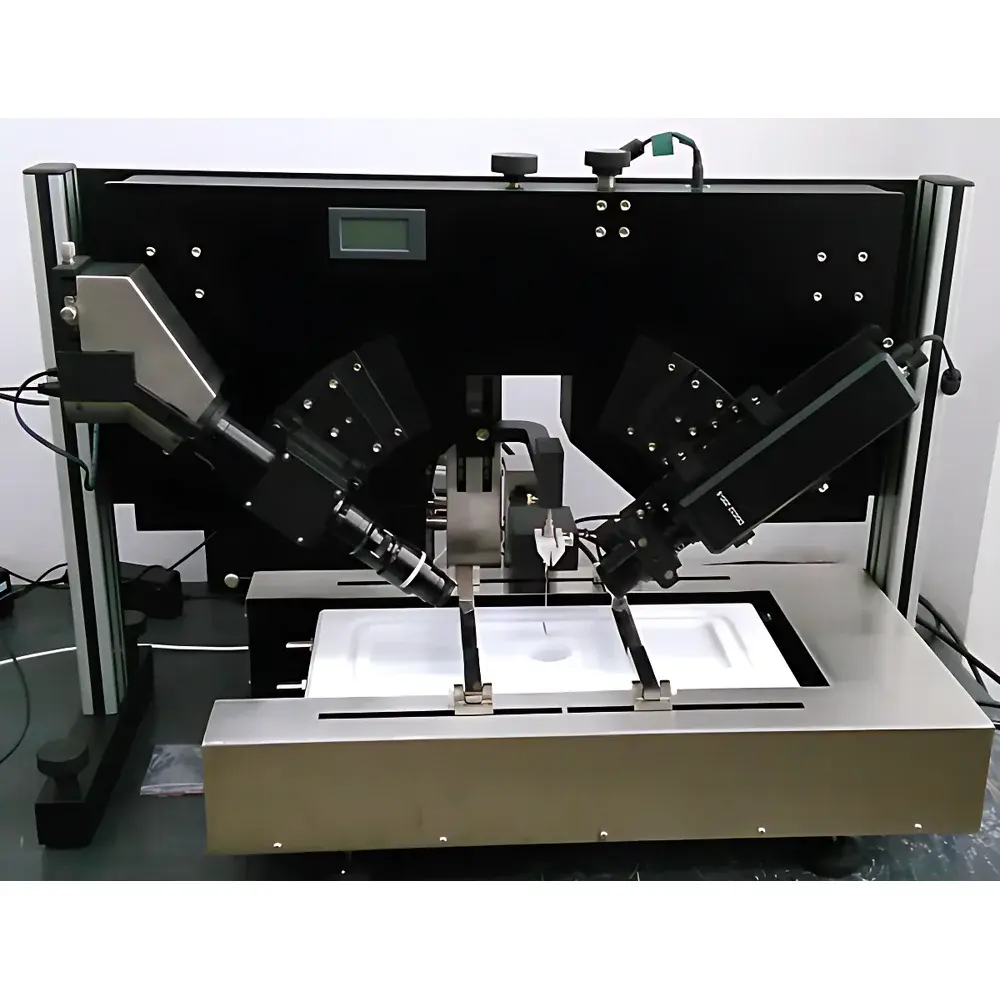
Zykx SCI-200 Langmuir-Blodgett Trough with Integrated Brewster Angle Microscopy System
| Brand | Zykx |
|---|---|
| Origin | Beijing, China |
| Manufacturer Type | Authorized Distributor |
| Country of Origin | China |
| Model | SCI-200 |
| Price Range | USD 28,000 – 71,000 |
| Surface Tension Range | 0–500 mN/m |
| Resolution | 0.05 mN/m |
| Measurement Principle | Wilhelmy Plate Method |
| Trough Material | PTFE (Teflon®) |
| Trough Area | 30 cm × 10 cm |
| Compression Ratio | Up to 90% |
| Barrier Speed | 0.48–97 mm/min |
| Deposition Speed | 0.22–45 mm/min |
| Deposition Modes | Upward, Downward, Leftward, Rightward |
| Temperature Control Range | 5–95 °C |
| Laser Source | Adjustable 532 nm Green Laser (20 mW / 50 mW) |
| Objective | Continuous Zoom, Working Distance 90 mm, Magnification Equivalent to 700–110 px/mm, Viewing Angle 45°–60° |
| Power Supply | AC 220 V ±10%, 50 Hz, Max. 150 W |
Overview
The Zykx SCI-200 Langmuir-Blodgett Trough with Integrated Brewster Angle Microscopy (BAM) System is a precision-engineered platform for the quantitative characterization of monolayer and multilayer molecular assemblies at the air–water interface. Based on classical Langmuir film balance principles, the system employs a Wilhelmy plate sensor to measure surface pressure (π) with high resolution (0.05 mN/m) across a broad dynamic range (0–500 mN/m). Coupled with real-time BAM imaging, it enables simultaneous thermodynamic and structural analysis of amphiphilic films—including phospholipids, fatty acids, block copolymers, and functionalized dendrimers—under controlled temperature (5–95 °C), compression rate, and deposition mode. The trough’s all-PTFE construction ensures chemical inertness and minimal background interference, while its large active area (30 cm × 10 cm) supports statistically robust measurements and facilitates compatibility with external analytical modules such as FTIR-ATR, fluorescence microscopy, and synchrotron X-ray reflectivity.
Key Features
- High-fidelity Wilhelmy plate-based surface pressure measurement with <0.05 mN/m resolution and long-term baseline stability
- Leakproof PTFE barrier mechanism enabling >90% compression ratio and sub-micron positional repeatability
- Motorized, programmable barrier with adjustable speed (0.48–97 mm/min) and four-directional deposition capability (up/down/left/right)
- Integrated Brewster angle microscope featuring a tunable 532 nm green laser (20/50 mW), continuous-zoom objective (90 mm working distance), and calibrated magnification (700–110 px/mm)
- Real-time π–A isotherm acquisition and automated generation of surface potential (ΔV)–A curves via optional Kelvin probe integration
- Temperature-controlled subphase system compatible with external water baths or integrated Peltier modules (operating range: +5 °C to +95 °C)
- Dual-mode operation: constant-area (for isotherm acquisition) and constant-pressure (for LB transfer under feedback-controlled barrier motion)
Sample Compatibility & Compliance
The SCI-200 accommodates a wide spectrum of amphiphilic materials, including but not limited to phosphatidylcholine (DPPC), stearic acid, poly(ethylene glycol)-lipid conjugates, porphyrin derivatives, and peptide–lipid hybrids. Its PTFE liquid trough eliminates metal ion leaching and organic solvent corrosion, ensuring reproducibility in aggressive subphases (e.g., pH-adjusted buffers, ionic liquids, or mixed aqueous–organic solvents). The system supports GLP-compliant workflows through timestamped data logging, user-access control, and audit-trail-enabled software (compliant with FDA 21 CFR Part 11 when deployed with validated configurations). All mechanical and optical components meet ISO 9001 manufacturing standards; the Wilhelmy plate sensor is traceably calibrated against NIST-certified reference surfactants.
Software & Data Management
Control and analysis are executed via a Windows-native application supporting multi-parameter synchronization (barrier position, surface pressure, temperature, laser intensity, and video frame capture). The software acquires π–A isotherms in real time, calculates compressibility modulus (Cs⁻¹ = −A·dπ/dA), identifies phase transition points (LE–LC, LC–SS), and exports ASCII-compatible datasets for post-processing in MATLAB, Origin, or Python-based analysis pipelines. Image sequences from the BAM module are stored in lossless TIFF format with embedded metadata (exposure time, laser power, magnification factor). Software versioning, electronic signature support, and automatic backup to network drives ensure data integrity and regulatory readiness.
Applications
- Quantitative phase behavior mapping of lipid bilayer mimics for membrane biophysics studies
- Optimization of LB-deposited layers for organic field-effect transistors (OFETs) and photonic crystals
- In situ monitoring of protein–lipid interactions and amyloidogenic peptide aggregation at interfaces
- Development of ultrathin sensing films for electrochemical and optical biosensors
- Fundamental investigation of chiral symmetry breaking and domain nucleation kinetics in Langmuir monolayers
- Preparation of template-supported nanostructured thin films for catalysis and energy storage
FAQ
What subphase volume does the SCI-200 trough accommodate?
The standard trough holds approximately 280 mL of subphase, sufficient for stable thermal equilibration and low evaporation rates during extended isotherm scans.
Can the system be upgraded for X-ray reflectivity coupling?
Yes—the trough features standardized kinematic mounts and vacuum-compatible flanges, enabling integration with grazing-incidence X-ray scattering (GIXS) beamlines upon consultation with Zykx Application Engineering.
Is third-party software control supported?
The instrument provides documented TCP/IP and RS-232 communication protocols, allowing custom scripting in LabVIEW, Python, or MATLAB for fully automated experimental sequences.
How is calibration verified over time?
Calibration is performed using certified surfactant standards (e.g., octanol, hexadecanol) following ASTM D1331 and ISO 6889 protocols; annual recalibration services are available through Zykx-certified service centers.
Does the BAM module support polarization-resolved imaging?
The base configuration includes linearly polarized illumination; optional quarter-wave plates and rotating analyzers enable circular dichroism contrast for chiral domain analysis.



