
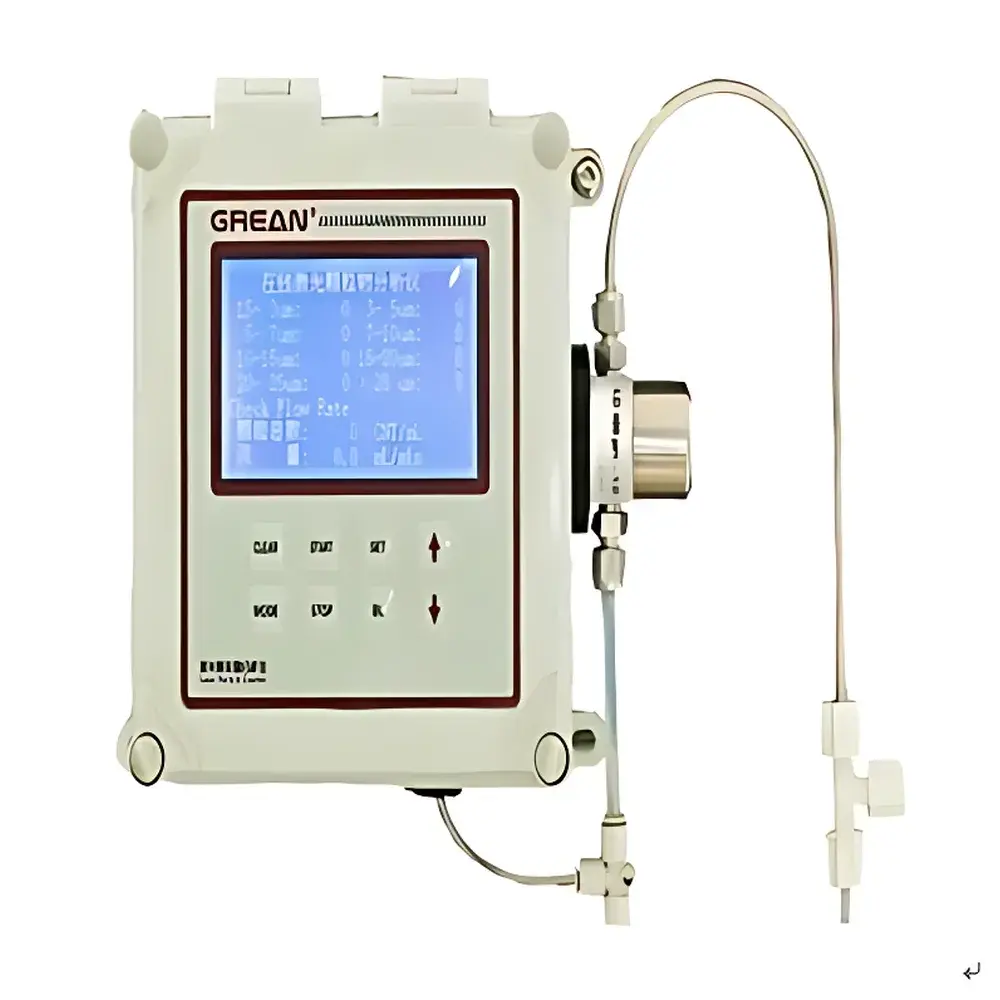
GR1500 Online Laser-Based Particulate Analyzer
| Origin | Beijing |
|---|---|
| Manufacturer Type | Distributor |
| Origin Category | Domestic |
| Model | GR1500 |
| Quotation | Upon Request |
| Instrument Type | Online |
| Measurement Principle | Laser Light Absorption / Obstruction |
| Particle Size Range | 1.5–400 µm |
| Number of Adjustable Channels | 8 |
| Sensitivity | 1.5 µm |
| Resolution | ≤9% @2 µm |
| Signal-to-Noise Ratio | 3:1 |
| Detection Efficiency | ≥50% @1 µm |
| Max. Particle Concentration | 18,000 counts/mL |
| Counting Loss Rate | 10% at max. concentration |
| Flow Accuracy | ≤2% |
| Light Source | Laser Diode |
| Sample Flow Rate | 60 mL/min |
| Flow Control | Overflow Tube + Hydraulic Pressure Regulation |
| Cleaning Mode | Semi-Automatic |
| Sensor MTBF | 60,000–80,000 hours |
| Communication Interfaces | RS-485 (4-wire), Modbus RTU, 4–20 mA (optional) |
| Baud Rate | 9600 bit/s |
| Display Capacity | Up to 9,999,999 cumulative counts |
| Data Output Modes | Cumulative or Segmented Values |
Overview
The GR1500 Online Laser-Based Particulate Analyzer is an industrial-grade, real-time monitoring instrument engineered for continuous measurement of suspended particulate matter in potable water, process water, and membrane filtration streams. It operates on the principle of laser light obstruction (also known as single-particle optical sensing), where a collimated laser diode beam intersects the sample flow perpendicularly. As particles traverse the beam, they attenuate incident light proportionally to their cross-sectional area—generating discrete voltage pulses in a photodiode detector. Pulse amplitude correlates with particle size, while pulse count reflects particle number concentration. Unlike turbidity meters—which provide only integrated optical scattering intensity—the GR1500 delivers quantitative, size-resolved particle counts across eight user-defined channels within the 1.5–400 µm range. This enables direct assessment of physical particle characteristics: total particle count (particles/mL), size distribution profile, and dynamic changes during coagulation, sedimentation, filtration, or membrane integrity events.
Key Features
- Real-time, online operation with no sample extraction or dilution required—designed for permanent installation in water treatment plant process lines.
- Laser diode source ensures stable beam geometry and long-term photometric consistency over >60,000 hours of operational life.
- Eight programmable size channels allow flexible configuration for application-specific thresholds (e.g., ≥2 µm for Cryptosporidium risk assessment per US EPA guidance).
- Patented de-bubbling optical path design minimizes false counts from entrained air, critical for low-turbidity finished water applications.
- Integrated hydraulic flow regulation via overflow tube and pressure-controlled inlet maintains constant 60 mL/min sample velocity—ensuring reproducible transit time and detection efficiency.
- Semi-automatic cleaning cycle reduces maintenance frequency while preserving sensor alignment and optical clarity.
- Flow-compensated counting algorithm corrects for minor flow fluctuations, improving data fidelity under variable hydraulic conditions.
- Optimized inlet filter placement prevents clogging without introducing shear-induced particle breakup or settling bias.
Sample Compatibility & Compliance
The GR1500 is validated for use with clarified, filtered, and membrane-treated drinking water streams (pH 6–9, temperature 5–40 °C, non-corrosive, low organic load). It complies with fundamental metrological requirements outlined in ISO 7027-1:2016 (turbidity-related particle detection principles) and supports regulatory decision-making aligned with US EPA Guidance Manual for the Validation of Particle Counting Methods (2005) and WHO Guidelines for Drinking-water Quality (4th ed., 2017). While not certified to GLP or 21 CFR Part 11 out-of-the-box, its Modbus RTU and 4–20 mA outputs enable integration into validated SCADA or LIMS environments where audit trails, user access control, and electronic signature protocols are externally managed.
Software & Data Management
Data acquisition and configuration are performed via embedded firmware supporting dual output modes: cumulative counts (totalized since last reset) or segmented values (per measurement interval). The RS-485 interface implements standard Modbus RTU protocol (function codes 03/04/06), allowing seamless integration with PLCs, DCS systems, or custom HMI dashboards. Optional analog 4–20 mA output maps selected channel(s) or total count to industrial current loops. Internal memory stores up to 30 days of 1-minute interval summary data (counts/channel/time stamp). No proprietary software is required; configuration and diagnostics may be performed using standard terminal emulators or third-party Modbus master tools. All communication parameters—including baud rate (9600 bps), parity, and stop bits—are field-configurable.
Applications
- Coagulation/flocculation optimization: Quantifying shifts in particle size distribution pre- and post-coagulant dosing to determine optimal chemical dosage and mixing energy.
- Filtration performance monitoring: Detecting breakthrough of >2 µm particles as an early indicator of filter media failure or ripening inefficiency.
- Membrane integrity assurance: Identifying sudden increases in sub-2 µm particle counts signaling fiber breakage or seal leakage in MF/UF systems.
- Distribution system surveillance: Comparing particle counts between plant effluent and remote network nodes to localize contamination ingress points.
- Filter backwash timing validation: Correlating particle release profiles during backwash cycles with differential pressure and flow data to refine rinse duration and water use.
- Bench-scale jar testing support: Providing granulometric feedback for rapid evaluation of alternative coagulants or pH adjustment strategies.
FAQ
What particle size resolution does the GR1500 achieve?
The instrument resolves particles from 1.5 µm to 400 µm across eight user-defined channels. Calibration verification shows ≤9% sizing uncertainty at 2 µm and ≤5% at 10 µm (per ISO 22412:2017 methodology).
Can the GR1500 replace conventional turbidity meters?
It complements—but does not substitute—turbidity measurement. Turbidity reflects bulk optical properties; the GR1500 delivers discrete particle counts and size bins, enabling mechanistic interpretation of treatment performance.
Is the sensor suitable for wastewater applications?
No. It is designed exclusively for low-solids, low-viscosity aqueous streams typical of drinking water treatment. High organic content, grease, or abrasive solids will compromise optical path integrity and calibration stability.
How often does the optical path require cleaning?
Under typical finished water conditions, semi-automatic cleaning is recommended every 7–14 days. Frequency increases with higher particle loading or seasonal algae blooms.
Does the GR1500 meet regulatory reporting requirements?
It provides raw, traceable particle count data suitable for internal process control and trend analysis. Regulatory submission depends on site-specific validation protocols and data governance infrastructure—not instrument certification alone.







