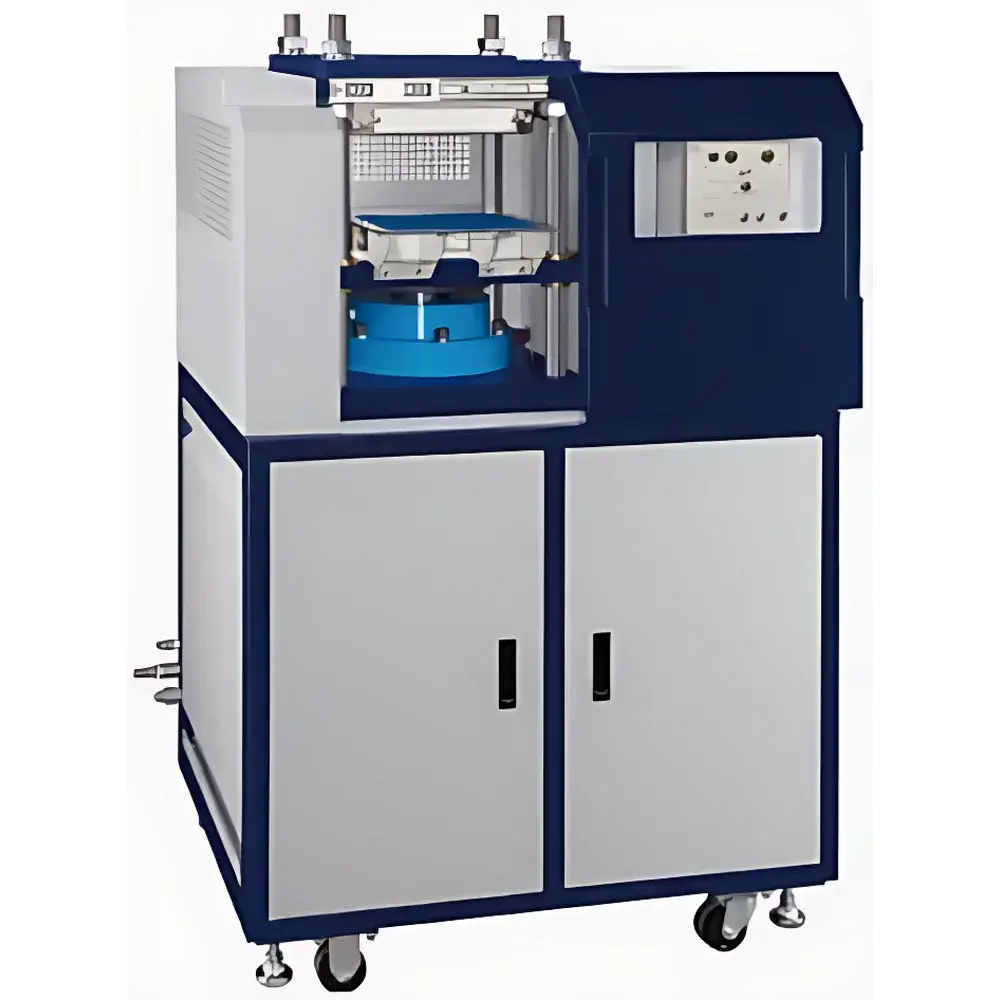
Cometech QC-674A Programmable Electrically Actuated Hot Press Vulcanizer
| Brand | Cometech |
|---|---|
| Model | QC-674A |
| Origin | Taiwan |
| Heating Range | Ambient to 300 °C |
| Platen Size | 300 × 300 mm |
| Platen Gap Adjustment | 60–120 mm |
| Heating/Cooling Rate | 50 → 150 °C in ≤18 min |
| Cooling Method | Circulating Water with Forced Platen Cooling |
| Pressure Control Range | 20–90% of Full Scale (Calibrated Electronic Pressure Display) |
| Display Units | Temperature (°C/°F), Area (m²/cm²/mm²/ft²/in²), Force (Kgf/gf/tonf-long/tonf-short/lbf/ozf/kN/N/ton-SI), Pressure (bar/kgf/cm²/kPa/MPa/mm-H₂O@4 °C/psi) |
| Interface | 7″ Touchscreen HMI with Real-time P-T-t Curve Visualization |
| Safety | Full-Enclosure Interlocked Safety Door + Emergency Stop |
| Power Supply | 3-Phase 220 V, 50/60 Hz, 30 A |
| Dimensions (W×D×H) | 120 × 74 × 152 cm |
| Weight | 680 kg |
| Compliance | Designed for ASTM D5345, ISO 34-1, ISO 6502, and USP <1031> vulcanization protocol execution |
Overview
The Cometech QC-674A Programmable Electrically Actuated Hot Press Vulcanizer is an ISO-compliant laboratory-scale vulcanization system engineered for precise, repeatable thermoset polymer curing under controlled temperature, pressure, and time parameters. It operates on the fundamental principle of compression molding—applying uniform hydraulic pressure between heated platens while maintaining programmable thermal profiles—to simulate industrial vulcanization conditions for rubber compounds, thermoplastic elastomers (TPEs), and composite prepregs. Unlike pneumatic or manual hot presses, the QC-674A utilizes electrically driven servo-hydraulic actuation, enabling fine-grained control over platen approach speed, dwell force ramping, and pressure hold stability—critical for generating reproducible crosslink density profiles in ASTM D5345-compliant scorch and cure testing. Its integrated water-cooled platen architecture ensures rapid thermal equilibration and minimizes thermal lag during multi-step cycles, supporting both R&D formulation development and QC batch validation.
Key Features
- Electrically actuated hydraulic system delivering precise, programmable pressure application from 20% to 90% of full-scale capacity, with real-time digital pressure feedback via high-accuracy electronic transducer (±0.25% FS)
- Dual-zone, independently controlled electric heating plates (300 × 300 mm) capable of stable operation from ambient to 300 °C, with ±0.5 °C thermal uniformity across platen surface per ISO 6502 Annex B
- Forced water-cooling circuit integrated into upper and lower platens, enabling controlled cooling rates up to 10 °C/min (150 → 50 °C in ≤10 minutes) and eliminating post-cure thermal drift
- 7-inch capacitive touchscreen HMI with intuitive wizard-driven workflow navigation, supporting both fully automated sequence execution and granular manual override modes
- Real-time synchronized visualization of pressure–temperature–time (P-T-t) curves during cycle execution, with user-configurable axis scaling and data export in CSV format
- Multi-unit configurability for force (Kgf, lbf, kN, tonf), pressure (bar, psi, MPa), area (cm², in²), and temperature (°C/°F)—eliminating manual unit conversion during report generation
- Full-enclosure safety interlock system compliant with ISO 13857 and IEC 60204-1, including light-curtain monitored access door and dual-channel emergency stop circuitry
Sample Compatibility & Compliance
The QC-674A accommodates standard ASTM D3182 and ISO 34-1 test specimens—including 6-mm-thick dumbbell, ring, and disk geometries—as well as custom molds up to 300 × 300 mm footprint and 60–120 mm cavity depth. Its pressure calibration traceability aligns with ISO/IEC 17025 requirements when used with NIST-traceable reference standards. The system supports full-cycle execution per ASTM D5345 (Standard Test Method for Determination of Scorch Time and Cure Characteristics of Rubber Compounds Using Moving Die Rheometers—adapted for compression cure simulation), ISO 6502 (Vulcanization characteristics—determination using oscillating disc or moving die rheometers), and USP (Elastomeric Closures for Injections). All operational parameters—including setpoints, actual values, timestamps, and alarm events—are logged with GLP/GMP-ready audit trails, satisfying FDA 21 CFR Part 11 requirements when paired with validated software configuration.
Software & Data Management
The embedded firmware provides non-volatile storage for up to 200 user-defined process recipes, each configurable with up to six discrete stages: pre-compression, heat-up ramp, cure dwell, pressure hold, cool-down ramp, and mold release. Each stage allows independent specification of target temperature, pressure percentage, duration, and rate limits. Data logging occurs at 100 ms intervals, with timestamped records stored internally and exportable via USB 2.0 to external PCs. Optional Ethernet interface enables remote monitoring and integration into LIMS environments. All exported datasets include metadata headers (operator ID, recipe name, lot number, environmental conditions) to support 21 CFR Part 11 electronic signature workflows when deployed with validated identity management protocols.
Applications
- Accelerated cure kinetics profiling for SBR, NR, EPDM, FKM, and silicone formulations
- Scorch safety margin evaluation under simulated processing conditions (e.g., extrusion head or calender nip residence time)
- Optimization of accelerator package dosage and sulfur-to-accelerator ratios
- Quality assurance of incoming raw materials (e.g., polymer viscosity, filler dispersion, curative activity)
- Production of standardized test plaques for tensile, hardness, compression set, and aging studies per ASTM D412, D2240, D395, and D573
- Development of thermoplastic vulcanizates (TPVs) and dynamically vulcanized alloys
- Validation of mold design parameters prior to tooling investment
FAQ
What standards does the QC-674A support for vulcanization testing?
It is configured to execute test protocols aligned with ASTM D5345, ISO 6502, ISO 34-1, and USP , with hardware-level thermal and pressure tolerances meeting the precision requirements of these methods.
Can the system be integrated into a centralized lab data management system?
Yes—via optional Ethernet connectivity and CSV/Excel-compatible data export, the QC-674A supports seamless ingestion into LIMS, MES, or ELN platforms when deployed with documented interface validation.
Is the pressure display calibrated and traceable?
The electronic pressure transducer is factory-calibrated against NIST-traceable deadweight testers; calibration certificates are supplied with each unit and annual recalibration is recommended per ISO/IEC 17025 guidelines.
What safety certifications apply to the machine’s enclosure and controls?
The full-enclosure interlock system complies with ISO 13857 (safety distances) and IEC 60204-1 (electrical equipment of machines); CE marking documentation is available upon request.
Does the QC-674A support variable platen approach speed?
Yes—the electric actuation system allows user-defined approach velocity (mm/s) during pre-compression, critical for minimizing air entrapment in low-viscosity compounds.