
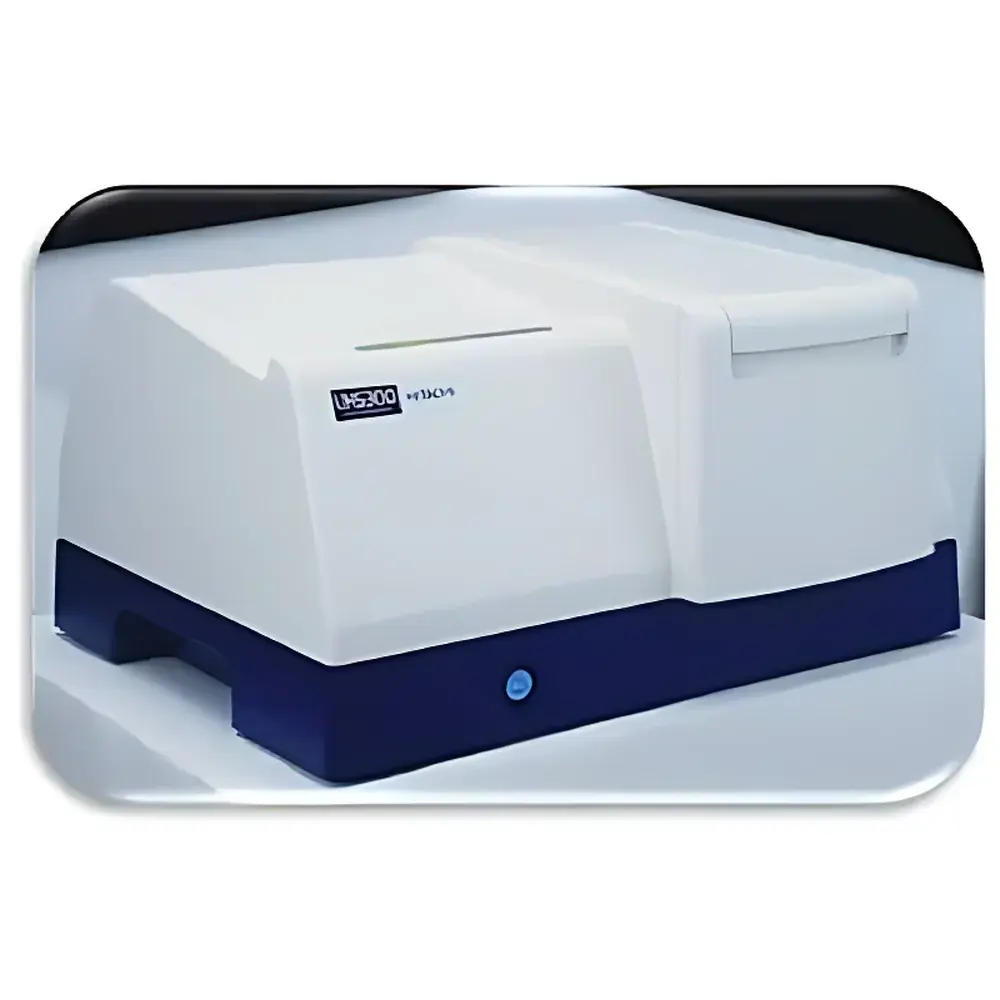
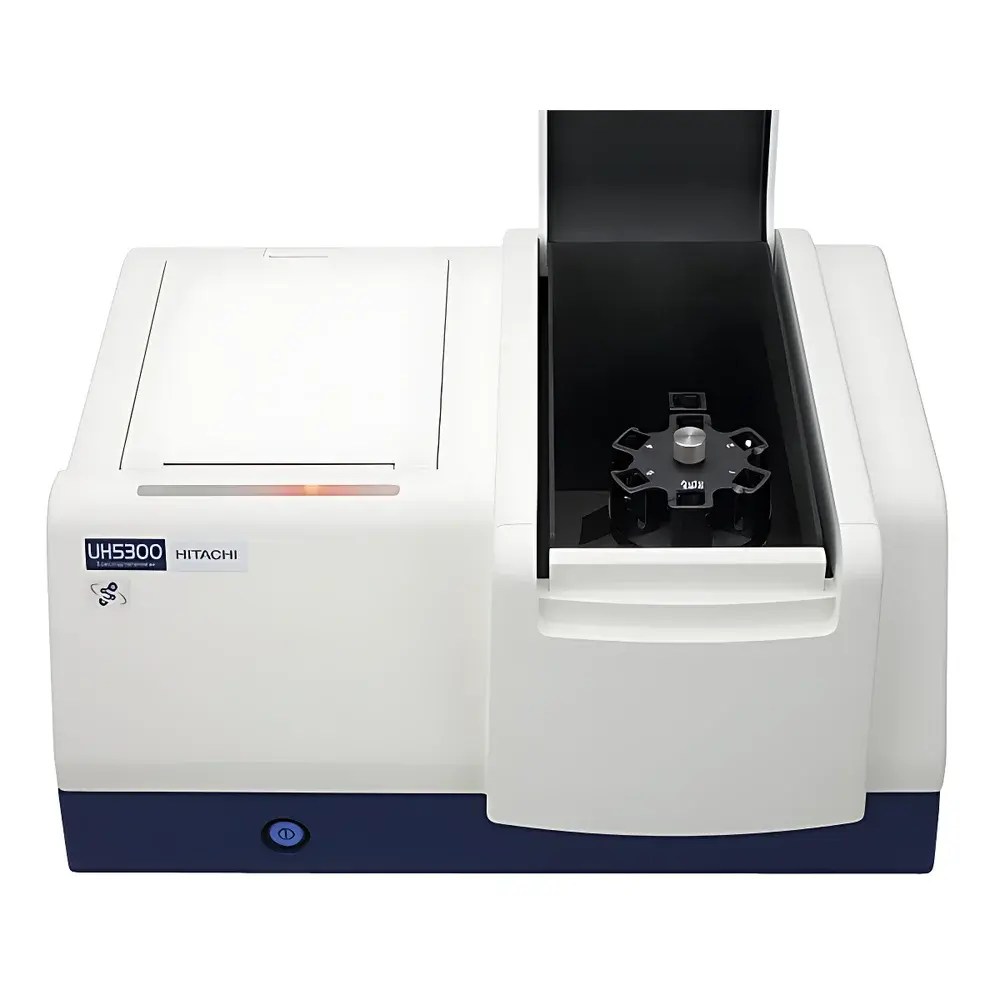
Hitachi UH5300 Dual-Beam Ultraviolet-Visible Spectrophotometer
| Brand | Hitachi |
|---|---|
| Origin | Japan |
| Manufacturer Type | Original Equipment Manufacturer (OEM) |
| Instrument Configuration | Dual-Beam |
| Detector Type | Photodiode Array (PDA) |
| Wavelength Range | 190–1100 nm |
| Wavelength Accuracy | ±0.3 nm |
| Spectral Bandwidth | 1 nm |
| Automation Level | Automatic Wavelength Scanning |
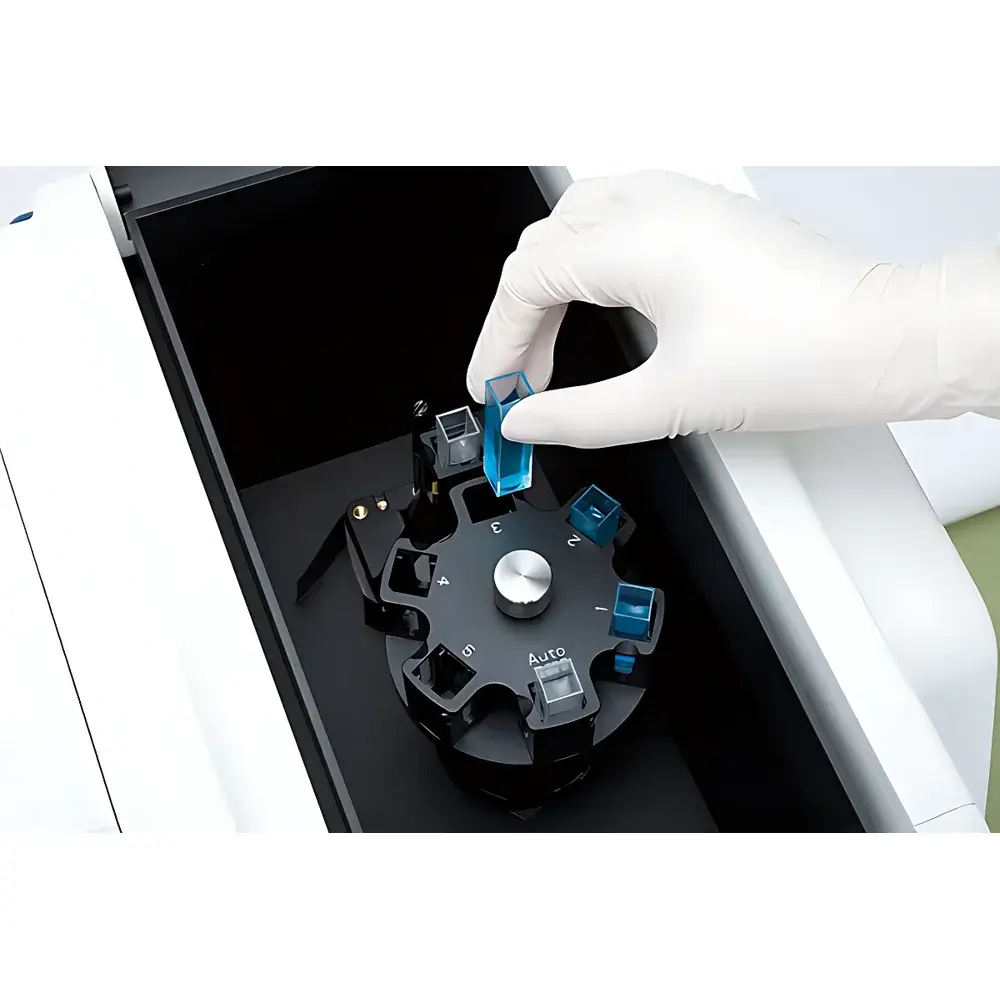
| Standard Sample Changer | Integrated 6-Position Auto-Cuvette Holder |
| Light Source | Long-Life Pulsed Xenon Lamp (7-Year Limited Warranty, Subject to Usage Conditions) |
Overview
The Hitachi UH5300 Dual-Beam Ultraviolet-Visible Spectrophotometer is an engineered solution for high-fidelity absorbance, transmittance, and reflectance measurements across the full UV-Vis spectral region (190–1100 nm). Based on a true dual-beam optical architecture—where sample and reference beams are simultaneously monitored by a single photodiode array detector—the UH5300 eliminates time-dependent drift and compensates for source intensity fluctuations in real time. This design ensures superior photometric stability and long-term baseline reproducibility, critical for regulatory-compliant quantitative analysis in pharmaceutical QC, academic research, and environmental testing laboratories. Unlike single-beam systems requiring sequential reference and sample scans, the UH5300’s balanced beam path delivers inherent correction for lamp aging, solvent evaporation, and cuvette positioning variability—enabling reliable kinetic studies, multi-wavelength assays, and high-throughput screening without recalibration between runs.
Key Features
- Dual-beam optical system with real-time reference compensation, minimizing baseline drift and enhancing measurement repeatability over extended operation cycles
- Pulsed xenon lamp light source rated for ≥7 years of service life under defined usage profiles (e.g., 20 wavelength scans/day at 200 nm/min over 240 operational days/year), significantly reducing consumable replacement frequency and total cost of ownership
- 1 nm spectral bandwidth optimized for resolution-sensitive applications such as protein quantification (A280), nucleic acid purity assessment (A260/A280), and colorimetric enzyme kinetics
- Wavelength accuracy of ±0.3 nm—verified per ISO 9001-aligned internal calibration protocols—ensuring traceability for method validation and regulatory submissions
- Integrated 6-position motorized cuvette holder enabling unattended sequential analysis of standards, blanks, and samples; supports standard 10-mm pathlength quartz or glass cuvettes
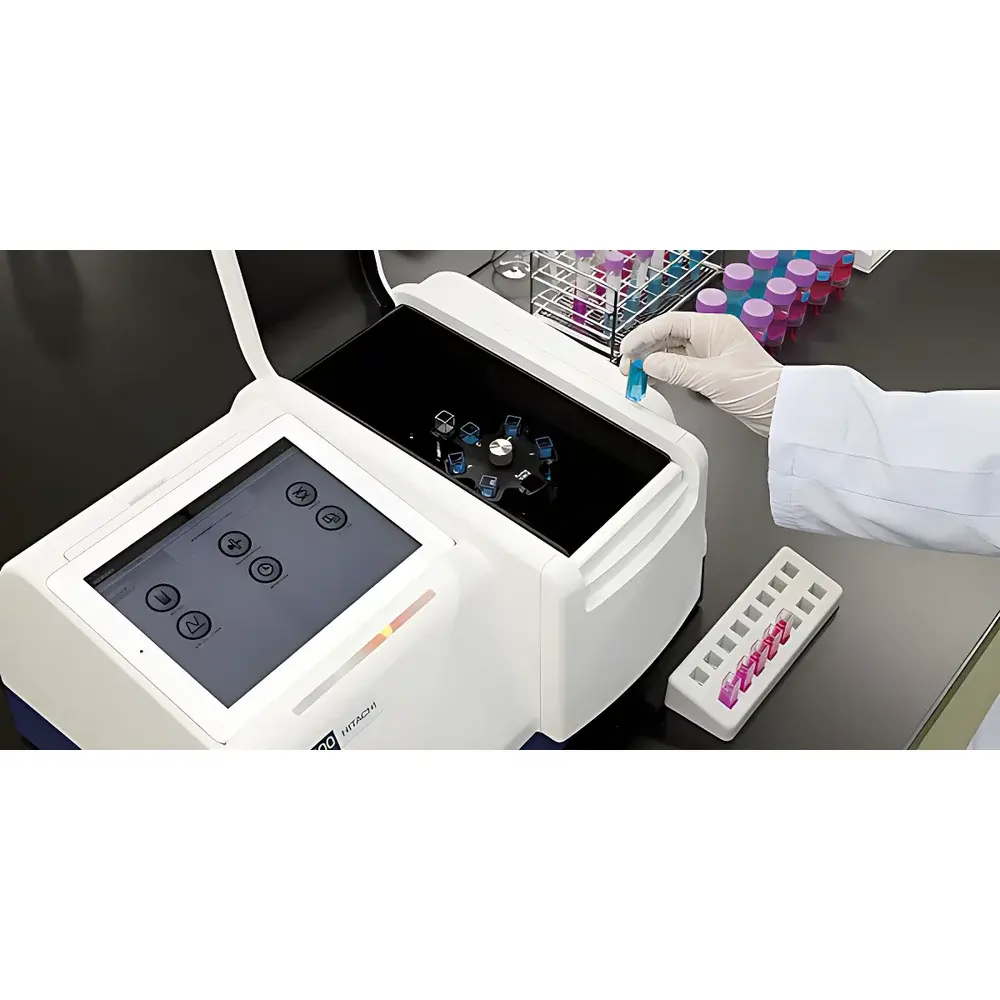
- Touchscreen-driven user interface accessible via built-in 10.1-inch LCD display or remotely through compatible iOS tablets (iPad) using secure Wi-Fi connectivity
Sample Compatibility & Compliance
The UH5300 accommodates liquid, suspension, and thin-film samples in standard 10-mm square or rectangular cuvettes (including UV-grade quartz for measurements below 220 nm). Optional accessories include solid-sample holders, integrating spheres for diffuse reflectance, and temperature-controlled cuvette jackets (±0.1 °C stability). The instrument complies with core international performance standards including ISO 17025:2017 (for laboratory competence), ASTM E275–22 (standard practices for UV-Vis spectrophotometer verification), and USP (Spectrophotometry and Light-Scattering). Data integrity is supported by audit-trail-enabled software compliant with FDA 21 CFR Part 11 requirements when operated in validated environments—facilitating GLP and GMP workflows.
Software & Data Management
Control and analysis are executed through Hitachi’s proprietary UH5300 Measurement Software, pre-installed and fully embedded within the instrument’s Linux-based operating system. The GUI follows ICH Q5A-aligned human factors principles: workflow-driven menus guide users from initialization and wavelength calibration to kinetic acquisition, spectral overlay, and quantitative curve fitting (linear, quadratic, or 4-parameter logistic). All raw spectra, method parameters, and operator metadata are stored in vendor-neutral .csv and .jdx formats. Exported data retain full traceability—including timestamp, lamp usage percentage, and calibration history—for integration into LIMS or ELN platforms. Remote operation via iPad includes AirPrint-compatible report generation and screenshot capture without requiring additional client software.
Applications
- Pharmaceutical quality control: Assay of active pharmaceutical ingredients (APIs), excipient identification, dissolution testing, and stability-indicating methods per ICH Q1–Q5 guidelines
- Life sciences: Protein concentration determination (Bradford, BCA, Lowry), DNA/RNA quantification and purity evaluation, enzyme activity assays (e.g., LDH, ALP), and cell culture density monitoring
- Environmental analysis: Nitrate, phosphate, and heavy metal speciation (e.g., Cr(VI) via diphenylcarbazide method) in water and wastewater matrices
- Materials science: Bandgap estimation of semiconductor nanoparticles, dye degradation kinetics, and thin-film optical thickness modeling
- Academic teaching labs: Foundational spectroscopy experiments emphasizing Beer–Lambert law validation, interference correction, and multicomponent analysis
FAQ
What is the expected lifetime of the xenon lamp, and how is it monitored?
The pulsed xenon lamp is covered by a limited 7-year warranty contingent upon cumulative operational thresholds. Lamp usage is tracked in real time as a percentage (%) in the Maintenance menu—calculated based on pulse count and scan duration. Full warranty coverage applies if usage remains within specified limits (e.g., ≤20 full-range scans/day over 240 days/year).
Does the UH5300 support compliance with 21 CFR Part 11?
Yes—when deployed with enabled user authentication, electronic signatures, and audit-trail logging, the system meets foundational requirements for electronic records and signatures in regulated environments. Validation documentation and IQ/OQ protocols are available upon request.
Can the instrument perform kinetic measurements at multiple wavelengths simultaneously?
Yes—the photodiode array detector captures full spectra (190–1100 nm) in a single scan, enabling post-acquisition extraction of time-resolved absorbance values at any user-defined wavelength(s) without re-scanning.
Is external PC connectivity required for routine operation?
No—the UH5300 operates autonomously with its integrated touchscreen interface and embedded OS. A PC is optional for advanced data export, LIMS integration, or remote system administration via Ethernet.
What calibration standards are recommended for routine performance verification?
NIST-traceable holmium oxide (Ho₂O₃) and didymium filters are recommended for wavelength accuracy verification; potassium dichromate in 0.005 M H₂SO₄ is used for photometric accuracy checks at 235, 257, 313, and 350 nm per USP .




