
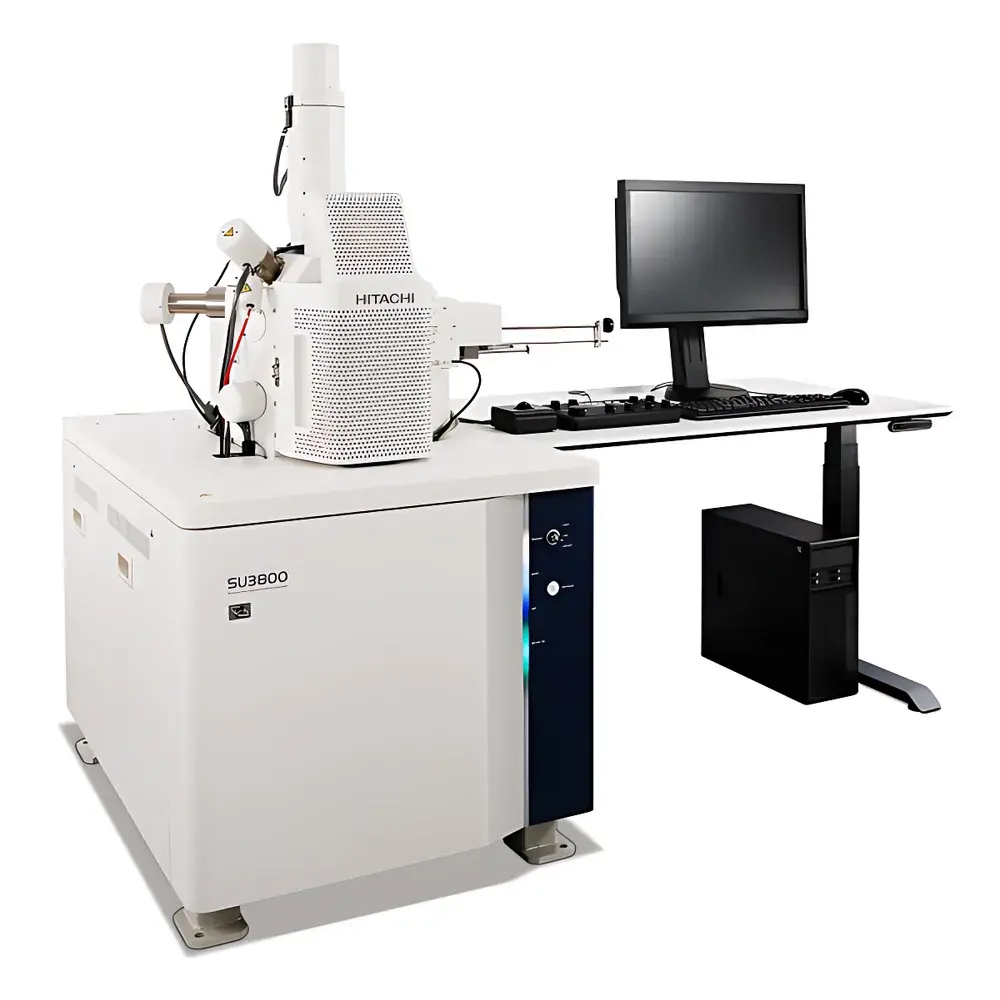
Hitachi SU3800 Scanning Electron Microscope
| Brand | Hitachi |
|---|---|
| Origin | Japan |
| Manufacturer Type | Original Equipment Manufacturer (OEM) |
| Import Status | Imported |
| Model | SU3800 |
| Electron Source | Tungsten Filament |
| Secondary Electron Resolution | 3.0 nm at 30 kV |
| Magnification Range | 5–300,000× (low mode), 7–800,000× (high mode) |
| Accelerating Voltage | 0.3–30 kV (standard mode) |
| Backscattered Electron Resolution | 4.0 nm at 30 kV (low-vacuum mode) |
| Maximum Sample Diameter | 200 mm |
| Maximum Sample Height | 80 mm |
| Maximum Sample Weight | 2 kg |
| Navigation System | SEM MAP |
| Automated Imaging | Multi Zigzag Stitching |
| Filament Monitoring | Intelligent Filament Technology (IFT) |
Overview
The Hitachi SU3800 is a mid-sized, high-performance scanning electron microscope (SEM) engineered for robust routine analysis and advanced materials characterization in industrial quality control, academic research, and failure analysis laboratories. Operating on the principle of electron-sample interaction—where a focused beam of electrons scans across a conductive or metallized specimen surface—the SU3800 generates high-fidelity secondary electron (SE) and backscattered electron (BSE) signals to produce topographic and compositional contrast images. Its tungsten thermionic electron source delivers stable beam current over extended acquisition periods, balancing cost-efficiency with reproducible imaging performance suitable for labs requiring reliable daily operation without cryogenic or field-emission infrastructure. Designed for operational flexibility, the SU3800 integrates vacuum-compatible mechanical stage motion, variable pressure capability (low-vacuum mode), and modular detector architecture—enabling seamless transition between conventional high-vacuum imaging and charge-compensated observation of non-conductive or hydrated specimens.
Key Features
- Large-chamber architecture accommodating specimens up to 200 mm in diameter, 80 mm in height, and 2 kg in mass—ideal for bulk metallurgical samples, electronic assemblies, geological cores, and prototype components.
- Dual-mode magnification system supporting both wide-field survey (5–300,000×) and ultra-high-resolution detail inspection (7–800,000×), optimized for multi-scale structural analysis.
- Intelligent Filament Technology (IFT): Real-time monitoring of tungsten filament emission characteristics, predictive lifetime estimation, and automated alerts—reducing unscheduled downtime during long-duration particle size distribution studies or automated batch imaging.
- SEM MAP navigation interface: A real-time thumbnail map generated from low-magnification overview scans allows point-and-click positioning of regions of interest (ROIs), eliminating manual stage repositioning errors and accelerating workflow throughput.
- Multi Zigzag automated stitching: Enables programmable acquisition of overlapping high-magnification frames across user-defined rectangular or irregular fields, followed by pixel-accurate alignment and seamless mosaic reconstruction—delivering gigapixel-class composite images without manual post-processing.
- Low-vacuum imaging mode (up to 130 Pa) with dedicated BSE detection, supporting direct observation of insulating materials (e.g., polymers, ceramics, biological tissues) without sputter coating—compliant with ASTM E1508 and ISO 16700 guidelines for non-destructive SEM evaluation.
Sample Compatibility & Compliance
The SU3800 supports diverse sample geometries and material classes—including metallic alloys, semiconductors, composites, powders, and coated substrates—without requiring extensive preparation. Its large specimen chamber and motorized 5-axis stage (X/Y/Z/tilt/rotation) enable precise orientation control for cross-sectional analysis and angular contrast optimization. The system complies with IEC 61000-6-3 (EMC emissions) and IEC 61010-1 (safety requirements for electrical equipment), and its software architecture supports audit trails, user access levels, and electronic signatures per FDA 21 CFR Part 11 when configured with optional compliance packages. Routine calibration procedures align with ISO/IEC 17025 requirements for testing laboratories performing morphological metrology.
Software & Data Management
Hitachi’s proprietary SEM operating software provides intuitive workflow management—from automated alignment and focus routines to batch image acquisition, measurement annotation, and report generation. All acquired images are stored with embedded metadata (kV, WD, mag, detector type, date/time, operator ID), ensuring traceability. Export formats include TIFF (16-bit), JPEG, and CSV for dimensional data; integration with third-party image analysis platforms (e.g., ImageJ/Fiji, MATLAB, Thermo Scientific Avizo) is supported via standardized file protocols. Optional networked deployment enables centralized instrument monitoring and remote diagnostics through secure HTTPS-based web interfaces.
Applications
- Failure analysis of PCB traces, solder joints, and MEMS devices under high-magnification BSE imaging.
- Particle morphology and size distribution quantification in catalysts, pharmaceutical excipients, and battery electrode materials.
- Fractography of fracture surfaces in aerospace alloys and additive-manufactured components.
- Coating thickness verification and interfacial delamination assessment in multilayer thin-film systems.
- Geological textural analysis of sedimentary rocks and mineral assemblages using compositional contrast from BSE intensity mapping.
- Educational SEM training—leveraging rapid setup, intuitive navigation, and built-in tutorials for undergraduate and graduate microscopy courses.
FAQ
What vacuum modes does the SU3800 support?
The SU3800 operates in high-vacuum mode (≤1 × 10⁻³ Pa) for maximum resolution and low-vacuum mode (up to 130 Pa) for charge-free imaging of uncoated insulators.
Is the tungsten filament user-replaceable?
Yes—the filament cartridge is designed for field replacement with standard tools and alignment fixtures; IFT guidance minimizes misalignment risk during maintenance.
Can the SU3800 be integrated into a laboratory LIMS or ELN?
Via optional API modules and DICOM/SEMI E57-compliant data export, the system supports bidirectional communication with validated laboratory information management systems.
Does the SU3800 meet GLP or GMP documentation requirements?
When equipped with the Compliance Edition software package, it provides full electronic record retention, role-based permissions, and 21 CFR Part 11–compliant audit logs.
What is the typical service interval for preventive maintenance?
Hitachi recommends biannual PM visits for vacuum system validation, detector calibration, and electron optical alignment—aligned with ISO/IEC 17025 maintenance schedules.




