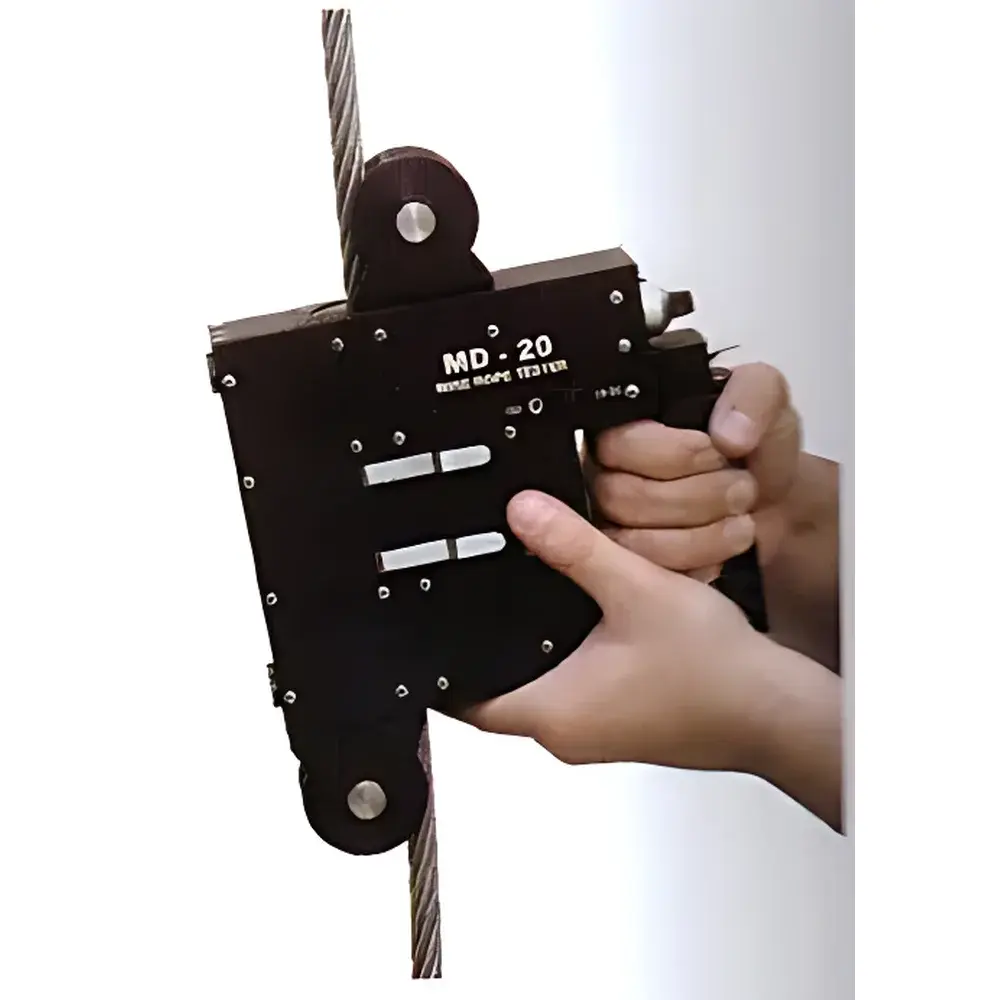
Magnetic Dynamics MD-20 / MD-25 Portable Wire Rope Tester (WRT)
| Origin | Poland |
|---|---|
| Distribution Model | Authorized Distributor |
| Import Status | Imported |
| Model | MD-20 / MD-25 |
| Price | Upon Request |
| Rope Diameter Range | MD-20: 8–22 mm |
| MD-25 | 10–25 mm |
| Operating Speed | 0.1–2.5 m/s |
| Sensitivity Adjustment | 10-level potentiometer |
| Indicators | LB (red, low battery), OK (green, no defect), D (yellow, defect detected, flashing), DM (red, defective rope, steady) |
| Audible Alarm | Yes |
| Power Supply | Rechargeable 9 V battery |
| Operating Temperature | Standard models: −10 °C to +40 °C |
| MD-20L variant | −25 °C to +40 °C |
| Dimensions (L×W×H) | 205 × 46 × 280 mm (with roller guide) |
| Weight | MD-20: 4.5 kg |
| MD-25 | 4.9 kg |
Overview
The Magnetic Dynamics MD-20 and MD-25 Portable Wire Rope Testers (WRT) are compact, hand-held electromagnetic inspection instruments engineered for rapid, on-site detection of localized flaws—including broken wires, pitting corrosion, and cross-sectional loss—in steel wire ropes. Based on the principle of magnetic flux leakage (MFL), these devices generate a controlled magnetic field across the rope cross-section; discontinuities disrupt the field, inducing measurable leakage flux that is captured by integrated Hall-effect sensors. Unlike ultrasonic or eddy-current methods, MFL-based detection provides high sensitivity to subsurface and internal defects without requiring direct contact with individual strands or surface preparation. The MD-20/25 is designed for field deployment in lifting, mining, cableway, and offshore applications where immediate pass/fail assessment is critical to operational safety and regulatory compliance.
Key Features
- True portable architecture: Weighing only 4.5 kg (MD-20) or 4.9 kg (MD-25), with ergonomic handle and balanced center of gravity for fatigue-free handheld operation over extended periods.
- Dual-mode deployment: Supports both manual scanning (with roller guide assembly, height 280 mm) and fixed-mount installation (using optional guide blocks or low-friction base configurations).
- Real-time multimodal feedback: Simultaneous visual indication via four LED status lights (LB, OK, D, DM) and audible alarm—enabling unambiguous interpretation even in noisy industrial environments.
- Adjustable sensitivity: Ten-step potentiometer allows fine-tuning of detection threshold to accommodate varying rope construction (e.g., 6×19 vs. 8×36 IWRC), coating condition, and ambient electromagnetic noise levels.
- Speed-invariant measurement: Validated performance across rope travel velocities from 0.1 to 2.5 m/s (6–150 m/min); signal processing compensates for Doppler-induced waveform distortion.
- Interoperable design: Analog output interfaces (defect alarm signal and raw sensor voltage) enable integration with MD-120 advanced rope analyzers for synchronized data logging, spatial mapping, and traceable reporting.
Sample Compatibility & Compliance
The MD-20 accepts wire ropes with nominal diameters from 8 mm to 22 mm; the MD-25 extends upper range to 25 mm—covering common hoist, suspension, and guy-wire specifications used in EN 12385-5, ISO 4309, and ASTM A1023. Both models comply with IEC 61000-6-2 (immunity) and IEC 61000-6-4 (emission) standards for industrial environments. While not certified as a standalone NDT method per ISO 9712, the MD-20/25 serves as a Tier-1 screening tool aligned with ASME B30.5 and OSHA 1926.251 requirements for periodic rope integrity verification. Its output signals meet the electrical interface specifications for integration into third-party condition monitoring systems compliant with IEC 61850 or Modbus RTU protocols.
Software & Data Management
Standalone operation requires no software—the device functions as a self-contained go/no-go indicator. When interfaced with the MD-120 analyzer, raw sensor outputs are digitized at 10 kHz sampling rate and time-stamped using internal RTC. All defect events (D and DM states) are logged with positional metadata (derived from encoder-coupled rope speed input), enabling generation of ASTM E2375-compliant inspection reports. Audit trails include operator ID, calibration timestamp, battery level history, and sensitivity setting—supporting GLP/GMP traceability under FDA 21 CFR Part 11 when deployed in regulated material handling environments (e.g., pharmaceutical cleanroom cranes or nuclear fuel transfer systems).
Applications
- Routine pre-shift rope checks on tower cranes, mobile hydraulic cranes, and personnel lifts.
- Periodic inspection of mine shaft hoisting ropes during maintenance windows—without disassembly or downtime.
- Verification of rope integrity following impact events (e.g., snagging, kinking, or thermal exposure).
- Field triage prior to formal NDT: MD-20/25 alerts operators to suspect sections warranting follow-up with magnetic particle testing (MT) or radiographic examination (RT).
- Training aid for new riggers and maintenance technicians—intuitive visual/audible response accelerates competency development per ANSI/ASSE Z490.1 guidelines.
FAQ
Does the MD-20/25 require calibration before each use?
No—factory calibration is stable over temperature and time. Users perform a functional check using the built-in reference magnet before each shift; full recalibration is recommended annually or after physical impact.
Can it detect internal wire breaks not visible on the rope surface?
Yes. Magnetic flux leakage penetrates the rope core; internal breaks in inner strands produce measurable field distortion, provided the break exceeds ~15% of a single wire’s cross-section.
Is the device suitable for stainless steel ropes?
Limited applicability. Austenitic stainless steels (e.g., 304, 316) exhibit low magnetic permeability, reducing MFL signal amplitude. Testing is only advised for martensitic or duplex grades with verified μr > 30.
What does a steady DM (red) light indicate?
A continuous DM illumination signifies cumulative defect severity exceeding predefined safety thresholds—typically ≥3 broken wires within one lay length or >10% metallic cross-sectional area loss—as defined in ISO 4309 Annex C.
How is battery life monitored during operation?
The LB (low battery) red LED activates when terminal voltage drops below 7.2 V; runtime averages 8 hours per charge under typical usage conditions (25 °C, moderate sensitivity setting).