
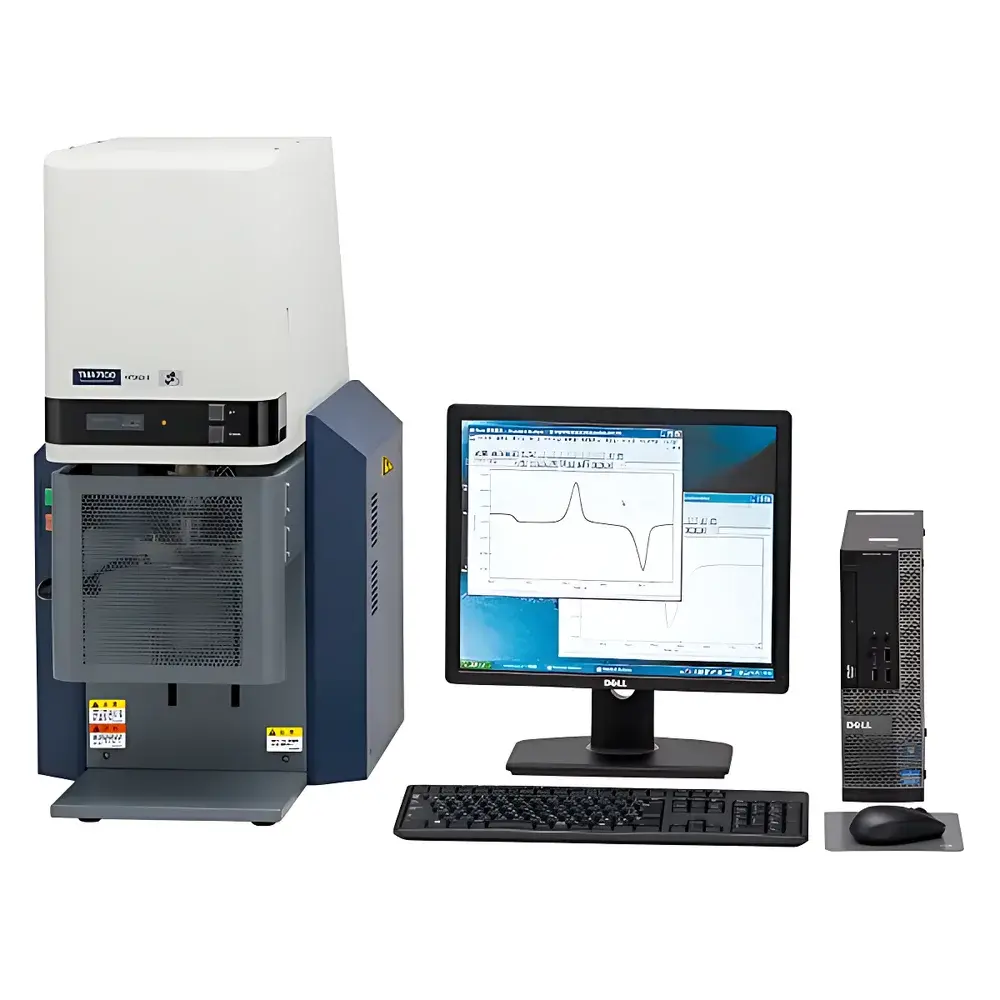
Hitachi TMA7000 Series Thermomechanical Analyzer
| Brand | Hitachi |
|---|---|
| Model | TMA7100 / TMA7300 |
| Temperature Range | TMA7100: −170 °C to 600 °C |
| TMA7300 | Ambient to 1500 °C |
| Displacement Range | ±5 mm |
| RMS Noise / Sensitivity | 0.005 μm / 0.01 μm |
| Load Range (Resolution) | ±5.8 N (9.8 μN) |
| Heating Rate | 0.01–100 °C/min |
| Sample Max Dimensions | Ø10 mm × 25 mm (TMA7100/TMA7300) |
| Probe Mounting | Cantilever-type |
| Atmosphere Control | Ambient air, inert gas, vacuum (~1.3 Pa) |
| Load Control Modes | Fixed load, constant-rate loading (9.8×10⁻²–9.8×10⁶ mN/min), frequency sweep (0.001–1 Hz), multi-step program (up to 40 steps) |
| Displacement Control Modes | Fixed displacement (±5000 μm), constant-rate displacement (0.01–10⁶ μm/min), frequency sweep (0.001–1 Hz), multi-step program (up to 40 steps) |
| Optional Accessories | Automated liquid nitrogen cooling system (−150 °C to 600 °C), electronic cooler (−60 °C to 450 °C), fan-assisted ambient cooling (RT to 600 °C or 1500 °C), LN₂ Dewar kit (−170 °C to 600 °C), mass flow controller, humidity control module, expansion/compression/penetration/tensile/bending probes (quartz or alumina), sapphire dilatometry fixture |
Overview
The Hitachi TMA7000 Series Thermomechanical Analyzer is a high-precision, modular instrument engineered for quantitative measurement of dimensional changes in solid materials under controlled thermal and mechanical stimuli. Based on the fundamental principle of thermomechanical analysis—applying a defined static or dynamic load while monitoring sample displacement as a function of temperature—the TMA7000 delivers exceptional sensitivity and operational flexibility across diverse material classes. Its core architecture employs a cantilever-mounted probe system with sub-micron resolution, enabling detection of linear expansion, contraction, softening, creep, and stress relaxation phenomena with RMS noise as low as 0.005 μm. Unlike conventional fixed-sample-tube designs, the TMA7000 implements a true “full-expansion” configuration: both sample and probe are thermally isolated from the furnace environment, eliminating thermal lag and mechanical constraint artifacts. This design ensures uniform thermal response and eliminates shape-dependent calibration drift—critical for reproducible measurements of films, fibers, powders, ceramics, composites, and irregular fragments.
Key Features
- Ultra-High Displacement Sensitivity: Achieves 0.01 μm resolution—twice the sensitivity of prior-generation Hitachi TMA systems—enabling reliable detection of subtle transitions such as glass transition onset, crystallization kinetics, and coefficient of thermal expansion (CTE) inflections in thin-film coatings.
- Multi-Mode Mechanical Testing Capability: A single instrument supports expansion, compression, penetration, tensile, bending, and dilatometric measurements via interchangeable quartz or alumina probes—no hardware reconfiguration required beyond probe exchange.
- Extended Thermal Range Coverage: The TMA7100 operates from −170 °C to 600 °C using liquid nitrogen cryogenics and quartz sample tubes; the TMA7300 extends to 1500 °C with alumina furnace components and high-temperature probes—suitable for refractory metals, advanced ceramics, and aerospace alloys.
- Advanced Load & Displacement Control: Supports fixed-load, ramped-load, oscillatory, and multi-segment programmed profiles (up to 40 discrete steps), compliant with ASTM E831, ISO 11359-2, and USP <1210> guidelines for thermal expansion and viscoelastic characterization.
- Automated Environmental Management: Integrated atmosphere control allows precise regulation of ambient air, inert gas (N₂, Ar), or vacuum (~1.3 Pa), with optional mass flow controllers and humidity modules for hygrothermal studies per ISO 29463 and ASTM D5229.
Sample Compatibility & Compliance
The TMA7000 accommodates geometrically unconstrained samples up to Ø10 mm × 25 mm (or 5 mm × 1 mm × 25 mm for films and ribbons). Its full-expansion geometry eliminates reliance on sample tube conformity—enabling direct measurement of irregular geometries, brittle fragments, and low-modulus polymers without mounting artifacts. All probe types share common calibration constants and sample tube interfaces, simplifying method transfer and reducing inter-operator variability. The system complies with GLP/GMP documentation requirements through audit-trail-enabled software (optional 21 CFR Part 11 compliance package available). Data integrity is reinforced by real-time metadata logging—including temperature ramp rate, load history, gas flow rates, and environmental setpoints—aligned with ISO/IEC 17025 traceability frameworks.
Software & Data Management
Hitachi’s proprietary TMA Analysis Station software provides intuitive workflow-driven experiment setup, real-time visualization of displacement vs. temperature/load/time curves, and automated peak identification for CTE, Tg, and softening point determination. Raw data are stored in vendor-neutral ASCII and HDF5 formats, supporting third-party integration with MATLAB, Python (via PyTMA), and LIMS platforms. Batch processing tools enable comparative analysis across multiple samples and thermal cycles. For regulated environments, optional 21 CFR Part 11-compliant modules deliver electronic signatures, role-based access control, and immutable audit trails—fully aligned with FDA, EMA, and PMDA validation expectations.
Applications
- Thermal expansion coefficient (CTE) profiling of polymer composites, semiconductor packaging substrates, and MEMS devices
- Creep and stress-relaxation behavior of thermoplastics and elastomers under isothermal and non-isothermal conditions
- Softening point and deformation onset of amorphous pharmaceutical excipients and hot-melt extrusion formulations
- Phase transition mapping in shape-memory alloys and ferroelectric ceramics
- Hygrothermal expansion quantification in fiber-reinforced laminates under controlled RH environments
- Dilatometric characterization of sintering kinetics in oxide and carbide ceramics (TMA7300 with sapphire fixture)
FAQ
What is the difference between full-expansion TMA and conventional TMA?
Full-expansion TMA decouples the sample and probe from the furnace thermal mass using thermally insulated mounts, ensuring that dimensional changes reflect intrinsic material behavior—not mechanical constraint or thermal lag. Conventional TMA systems often rely on rigid sample tubes that impose boundary conditions, limiting accuracy for low-stiffness or irregular samples.
Can the TMA7100 and TMA7300 use the same software and analysis protocols?
Yes. Both models operate under identical firmware and software architecture. Method files, calibration parameters, and report templates are fully interchangeable—facilitating seamless cross-platform validation and technology transfer.
Is vacuum operation compatible with low-temperature measurements on the TMA7100?
Yes. The TMA7100 supports simultaneous vacuum (<1.3 Pa) and cryogenic operation (down to −170 °C) using the LN₂ Dewar kit, enabling outgassing studies and moisture-free thermal contraction analysis of hygroscopic polymers.
What maintenance is required for the TMA7300 at temperatures above 1300 °C?
Prolonged operation >1300 °C accelerates tungsten heating element evaporation. Hitachi recommends periodic visual inspection of the furnace assembly and offers paid refurbishment services—including heater replacement and recalibration—to maintain metrological integrity per ISO 17025 standards.
Are probe calibrations traceable to national standards?
Yes. Quartz and alumina probe assemblies are calibrated using NIST-traceable interferometric displacement standards, with certificates documenting uncertainty budgets per ISO/IEC 17025 Annex A.3.



