
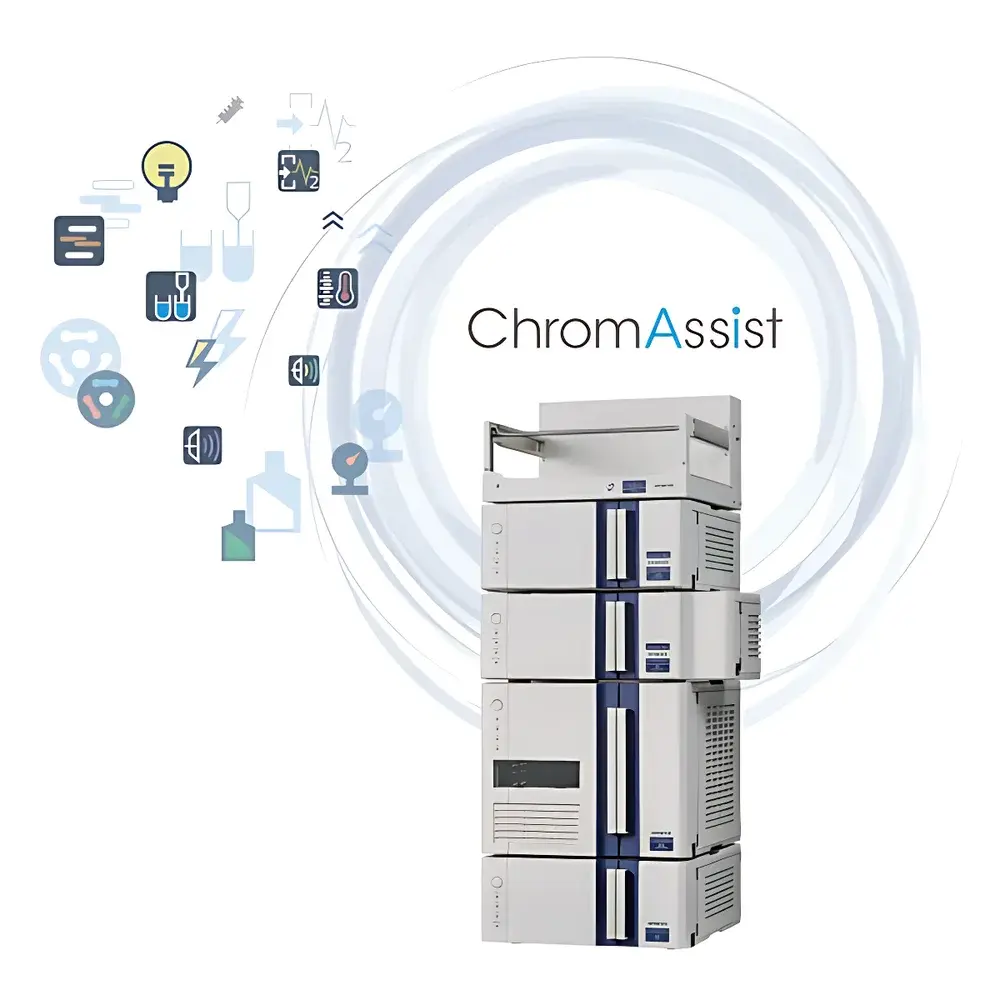
Hitachi ChromAssist Database Edition Chromatography Data System
| Brand | Hitachi |
|---|---|
| Origin | Japan |
| Manufacturer Type | Original Equipment Manufacturer (OEM) |
| Product Category | Imported Instrument |
| Model | ChromAssist Database Edition |
| Instrument Type | Conventional High-Performance Liquid Chromatograph (HPLC) System Software |
| Deployment Options | Standalone & Networked |
| Regulatory Compliance | FDA 21 CFR Part 11, ALCOA+ Principles, ISO/IEC 17025 Annex A.3, ICH GCP, USP <1058> Analytical Instrument Qualification |
Overview
The Hitachi ChromAssist Database Edition is a validated, enterprise-grade Chromatography Data System (CDS) engineered for regulatory compliance and operational integrity in regulated laboratory environments—particularly pharmaceutical quality control (QC), quality assurance (QA), and contract research organizations (CROs). Unlike legacy file-based CDS platforms, ChromAssist Database Edition implements a fully relational PostgreSQL database architecture to enforce data traceability, immutability, and structural consistency across the entire analytical lifecycle. Its core measurement integration is designed exclusively for Hitachi’s Chromaster PLUS and Primaide PLUS HPLC systems, enabling bidirectional communication for instrument control, real-time status monitoring, method deployment, and raw data acquisition. The system operates on a deterministic client-server model, where all acquisition metadata, processed results, audit trails, user actions, and electronic signatures are persistently stored within the centralized database—not local file systems—ensuring alignment with FDA 21 CFR Part 11 Subpart B requirements for electronic records and signatures.
Key Features
- PostgreSQL-backed relational database architecture supporting ACID-compliant transactions, referential integrity, and scalable schema evolution
- Comprehensive user lifecycle management: role-based access control (RBAC), multi-factor authentication (MFA)-ready login, password policy enforcement, and session timeout configuration
- Granular permission hierarchy: system-level, project-level, and instrument-level permissions assignable by user group or individual
- Full audit trail implementation: immutable, time-stamped, and user-attributed records of all critical actions—including method edits, result reprocessing, report generation, and instrument parameter changes—with configurable retention policies
- Electronic signature workflow compliant with 21 CFR Part 11 §11.200: dual-authorization signing, biometric or token-based identity verification, and signature justification fields
- Lock-screen protection with automatic session suspension and tamper-evident timestamp locking
- Automated and manual database backup/restore functions with compression, encryption, and offsite replication support
- Project archiving and version-controlled restoration: full snapshot capture of methods, sequences, calibration curves, and associated metadata
- USB device control policy engine: configurable whitelist/blacklist for peripheral devices used during analysis
- Built-in System Suitability Test (SST) evaluation module aligned with USP , EP 2.2.46, and JP 6.03 standards
Sample Compatibility & Compliance
ChromAssist Database Edition is qualified for use with Hitachi Chromaster PLUS and Primaide PLUS HPLC platforms only. It supports standard HPLC detection modalities including UV-Vis, PDA, fluorescence, and conductivity detectors. All software components undergo periodic revalidation per GAMP 5 guidelines and are documented to support IQ/OQ/PQ protocols. The system meets the data integrity principles defined under ALCOA+ (Attributable, Legible, Contemporaneous, Original, Accurate, Complete, Consistent, Enduring, Available) and supports inspection readiness for FDA, EMA, PMDA, and WHO pre-approval inspections. Full compliance documentation—including validation master plan (VMP), risk assessment (RA), and traceability matrix—is provided upon installation and maintained through software update cycles.
Software & Data Management
The system employs a tiered architecture: a central database server (Windows Server 2016/2019/2022) hosts the PostgreSQL instance and application services; thin-client workstations run the ChromAssist GUI with zero local data caching. All data—raw chromatograms (.chd), processed results (.res), method files (.mth), sequence tables (.seq), and audit logs—are stored exclusively in the database with cryptographic hashing for integrity verification. Remote monitoring and control are enabled via secure TLS 1.2–encrypted connections; administrators can view real-time instrument status (flow rate, pressure, detector lamp hours, autosampler tray position), initiate remote start/stop commands, and push updated methods across the network without physical access. Reporting leverages customizable XSL-FO templates supporting PDF/A-1b, CSV, Excel (.xlsx), and XML output formats—all embedded with digital signatures and audit trail references.
Applications
- Pharmaceutical stability-indicating assays and release testing under cGMP
- Impurity profiling and forced degradation studies per ICH Q1–Q5 guidelines
- Reference standard qualification and working standard assignment workflows
- Contract laboratory data submission to sponsors under data-sharing agreements
- Multi-site QC laboratories requiring harmonized CDS deployment and centralized governance
- Method transfer and validation projects requiring full traceability from development to routine use
FAQ
Does ChromAssist Database Edition support third-party HPLC instruments?
No. It is exclusively validated and supported for Hitachi Chromaster PLUS and Primaide PLUS systems.
Can audit trail data be exported for regulatory review?
Yes—audit logs are exportable in CSV and PDF formats with digital signature binding and hash verification.
Is the PostgreSQL database included in the license?
Yes. A licensed, hardened PostgreSQL 13+ runtime is bundled and preconfigured as part of the system installation.
How is electronic signature integrity enforced?
Each signature includes user identity, timestamp, reason-for-signing text, and cryptographic hash of the signed object—stored immutably in the database.
What validation support is provided post-installation?
Hitachi provides a complete validation package including URS, FRS, DQ/IQ/OQ/PQ protocols, test scripts, and summary reports—fully editable for site-specific customization.




