
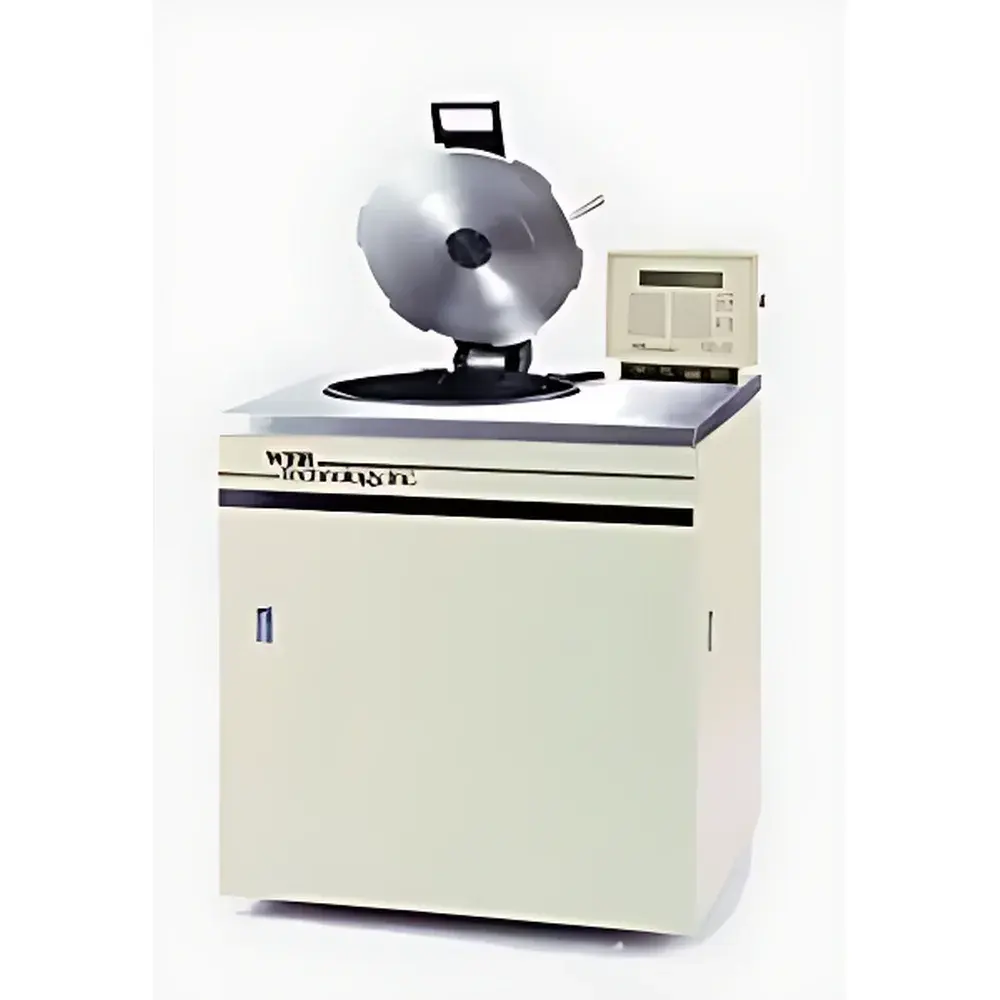
WEB Technology Model 9070 High-G Semiconductor Centrifuge
| Brand | WEB |
|---|---|
| Origin | USA |
| Manufacturer Type | Authorized Distributor |
| Origin Category | Imported |
| Model | 9070 |
| Pricing | Available Upon Request |
| Max Speed | 22,000 rpm |
| Max RCF | 70,000 × g |
| Dimensions (W×D×H) | 38 in × 34 in × 40 in |
| Weight | 545 kg |
| Input Voltage | 230 V AC, Single Phase |
| Display | 4-line × 40-character LCD |
| Interface | RS232 |
| Safety Enclosure | Ballistic-grade steel chamber |
| Rotor–Fixture Integration | Universal compatibility with industry-standard centrifugal test fixtures |
| Compliance | MIL-STD-883C Method 2001, JEDEC JESD22-B103, AEC-Q100 Annex G |
Overview
The WEB Technology Model 9070 is a high-gravity, microprocessor-controlled centrifuge engineered specifically for accelerated mechanical stress testing of semiconductor devices under constant acceleration conditions. Unlike general-purpose laboratory centrifuges used for biological or chemical separation, the Model 9070 operates on the principle of controlled radial acceleration to induce mechanical stress at the die–package interface, wire bonds, and internal interconnects—enabling detection of latent defects such as delamination, solder fatigue, or bond lift-off prior to field deployment. Its design adheres to the physical requirements of MIL-STD-883C Method 2001 (“Constant Acceleration”) and aligns with JEDEC JESD22-B103 and AEC-Q100 Annex G for automotive-grade reliability validation. The system delivers up to 70,000 × g (RCF) at 22,000 rpm, with precision rotor dynamics enabled by a low-vibration DC motor, active belt tensioning, and a rigid, ballistic-grade steel enclosure rated for containment under worst-case failure scenarios.
Key Features
- Microprocessor-based control architecture with real-time closed-loop monitoring of speed, RCF, vacuum level (if equipped), and dynamic imbalance (via integrated vibration transducers)
- Patented flexible shaft assembly minimizing mechanical resonance and acoustic emissions during high-speed operation
- Brushed DC motor optimized for high-RPM stability: reduced armature current at peak speed extends carbon brush service life and improves thermal management
- Self-adjusting motor belt tensioning system—eliminates manual recalibration intervals and ensures consistent torque transmission over extended operational cycles
- Ballistic steel inner chamber compliant with ANSI/UL 61010-1 safety requirements for Class I, Division 1 hazardous location-rated instrumentation
- Large-format 4×40-character backlit LCD display showing simultaneous readouts of gravitational acceleration (×g), rotational speed (rpm), chamber vacuum (mbar), and lateral oscillation amplitude (µm peak-to-peak)
- RS232 serial interface supporting ASCII command protocol for integration into automated test systems (ATE), data logging, and remote parameter scripting
Sample Compatibility & Compliance
The Model 9070 accepts standardized centrifugal test fixtures—including those conforming to JEDEC MO-152, JEDEC MO-178, and custom-designed carriers for QFN, BGA, CSP, SOIC, and flip-chip packages. Fixture mounting interfaces are mechanically indexed to ensure repeatable alignment and minimal runout (<10 µm TIR). All operational parameters—including dwell time, acceleration ramp rate, and hold duration—are programmable within limits defined by MIL-STD-883C Method 2001. The system supports full traceability per FDA 21 CFR Part 11 when paired with validated third-party software; audit trails, electronic signatures, and user access controls are configurable. Routine calibration follows ISO/IEC 17025-accredited procedures using NIST-traceable tachometers and gravimetric reference standards.
Software & Data Management
While the Model 9070 operates autonomously via front-panel controls, its RS232 interface enables bidirectional communication with host systems running Windows/Linux-based test management software. Supported protocols include SCPI-like command sets for initiating runs, querying status registers, and exporting timestamped datasets (speed, ×g, vibration RMS, elapsed time). Raw sensor outputs are delivered at 100 Hz sampling resolution, allowing post-test spectral analysis of bearing harmonics or rotor mode shapes. Data files export in CSV format compatible with MATLAB, Python (pandas), and JMP for statistical process control (SPC) and Weibull reliability modeling. Optional firmware updates maintain backward compatibility with legacy 9000-series fixture libraries and support future compliance expansions (e.g., ISO 16750-3 for automotive shock/vibration correlation).
Applications
- Qualification testing of IC packages for aerospace avionics, where MIL-STD-883C Method 2001 is mandatory for flight-critical components
- Screening of high-reliability ASICs and FPGAs destined for downhole oil/gas instrumentation exposed to sustained vibrational loads
- Failure analysis root-cause investigation: correlating centrifuge-induced fractures with SEM cross-sections and acoustic microscopy results
- Process validation of new encapsulation materials or underfill formulations—quantifying interfacial adhesion strength via acceleration-to-failure thresholds
- Supporting AEC-Q100 stress testing for automotive electronics, particularly power modules and radar SoCs requiring >10,000 h field lifetime assurance
FAQ
Does the Model 9070 comply with MIL-STD-883C Method 2001?
Yes—the system is configured and calibrated to meet all procedural, environmental, and reporting requirements specified in MIL-STD-883C, Method 2001, including acceleration profile fidelity, dwell time accuracy (±0.5%), and documentation of test conditions per paragraph 4.3.
Can third-party centrifuge fixtures be used with this unit?
Yes—the rotor flange interface conforms to ANSI/ISA-71.04 mechanical specifications, enabling interoperability with fixtures from Teradyne, Cohu, and other vendors certified for high-G testing.
Is vacuum capability standard or optional?
Vacuum assist is an optional configuration used to suppress air resistance at ultra-high speeds and mitigate thermal drift; it is not required for standard Method 2001 testing but recommended for >60,000 × g qualification runs.
What maintenance schedule is recommended for the DC motor brushes?
Under typical usage (≤2 hrs/day at ≥18,000 rpm), brush inspection is advised every 1,200 operating hours; replacement intervals average 2,500–3,000 hours depending on ambient temperature and duty cycle.
Is GLP/GMP-compliant electronic recordkeeping supported?
When integrated with validated LIMS or MES platforms via RS232, the system supports ALCOA+ data integrity principles—including attributable, legible, contemporaneous, original, accurate, complete, consistent, enduring, and available records—as required under FDA 21 CFR Part 11 and EU Annex 11.



