WEB Technology 6000 Series Cracking Tester
| Brand | WEB |
|---|---|
| Origin | USA |
| Manufacturer Type | Authorized Distributor |
| Origin Category | Imported |
| Model | 6000 |
| Pricing | Upon Request |
| Test Principle | Fluorinated Oil Immersion with Visual Bubble Detection |
| Compliance | MIL-STD-883C, MIL-STD-750 Method 202 |
| Max Operating Temperature | 165 °C |
| Fluorocarbon Oil Reservoir Capacity | 1.5 US gallons |
| Test Tray Dimensions | 10 in × 4 in |
| Magnification Options | Standard adjustable 1× or optional 3× lens |
| Illumination | Dual-source, >15,000 foot-candles |
| Evaporation Control | Integrated cooling ring |
Overview
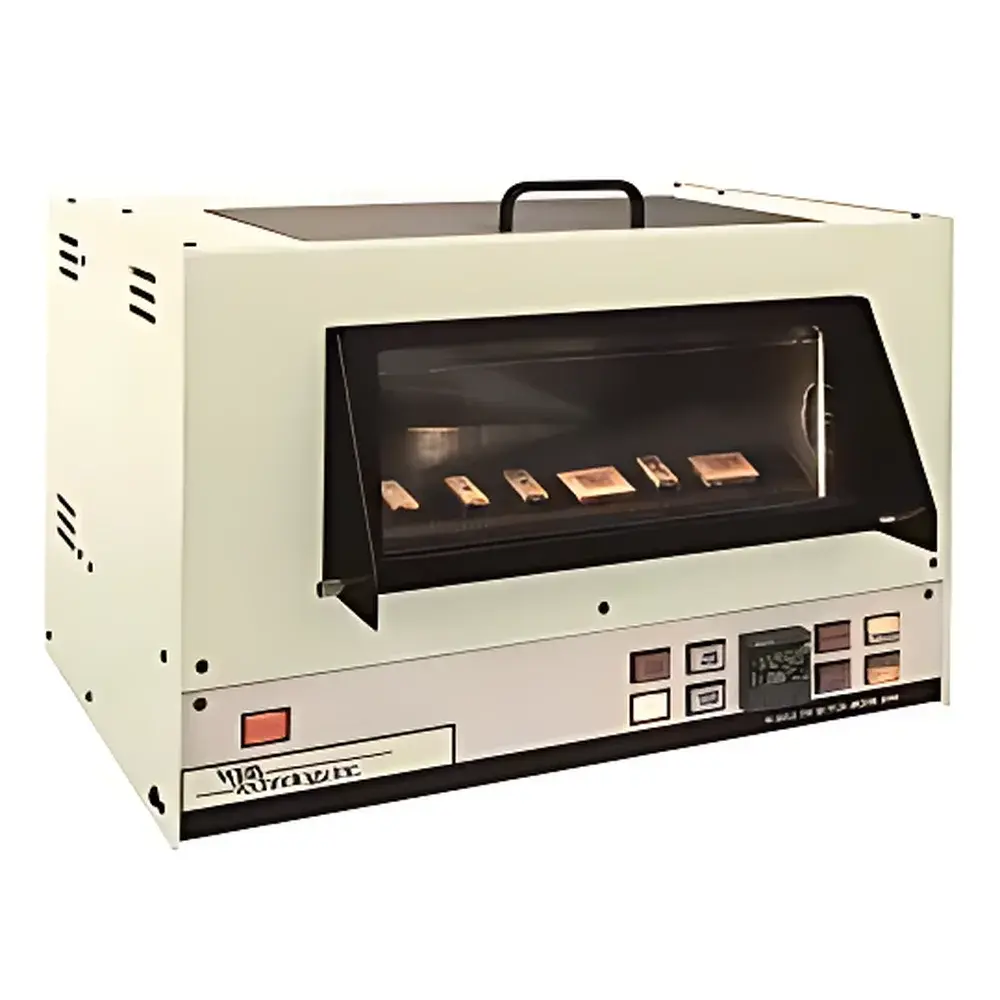
The WEB Technology 6000 Series Cracking Tester is a purpose-built, thermally stable immersion-based leak detection instrument engineered for coarse hermeticity screening of semiconductor devices and microelectronic packages. It operates on the well-established fluorocarbon oil immersion principle: sealed components are submerged in heated fluorinated liquid (e.g., FC-72 or equivalent), and the presence of persistent gas bubbles—originating from internal voids or seal defects—is visually observed under high-intensity illumination through an optically adjustable magnifying lens. This method provides rapid, non-destructive, and repeatable pass/fail assessment aligned with military-grade reliability protocols. Designed and manufactured in Texas, USA since 1982, the 6000 Series reflects decades of refinement in semiconductor package integrity testing infrastructure—particularly for ceramic, metal, and glass-sealed devices used in aerospace, defense, and high-reliability industrial applications.
Key Features
- Thermally robust construction rated for continuous operation up to 165 °C—enabling accelerated leak detection via thermal expansion differentials in encapsulated cavities.
- Integrated cooling ring surrounding the fluorocarbon oil reservoir minimizes volatile loss during extended high-temperature testing cycles, ensuring consistent fluid level and test repeatability.
- Adjustable optical assembly allows precise positioning of the viewing lens relative to the test tray—optimizing ergonomic observation angles for operators across varying height and posture requirements.
- Dual high-output lighting system delivers uniform, shadow-free illumination exceeding 15,000 foot-candles at the viewing plane—critical for detecting sub-millimeter bubble nucleation and distinguishing transient outgassing from true leakage events.
- Standard 1× magnification lens with optional 3× upgrade kit—certified compatible with MIL-STD-750 Method 202 and MIL-STD-883C Test Method 1014.1 requirements for visual crack and seal integrity verification.
- Stainless-steel test tray (10 in × 4 in) designed for batch processing of discrete ICs, TO-cans, DIPs, and small-outline packages; compatible with standard handling fixtures and ESD-safe workflows.
Sample Compatibility & Compliance
The 6000 Series accommodates a broad range of hermetically sealed semiconductor packages—including but not limited to ceramic dual-in-line (CDIP), metal-can (TO-3, TO-5, TO-8), and glass-metal feedthrough assemblies. Its design conforms to the procedural and environmental stipulations defined in MIL-STD-883C Test Method 1014.1 (Fine and Gross Leak Testing) and MIL-STD-750 Method 202 (Visual Inspection of Seals). While not a quantitative mass-flow instrument, it serves as a validated first-tier screening tool within GLP-compliant reliability laboratories. The unit supports traceable calibration documentation per ISO/IEC 17025 guidelines when integrated into formal quality management systems. No software-based data logging is embedded; however, manual test records—including operator ID, lot number, soak time, temperature setpoint, and pass/fail determination—are structured to satisfy FDA 21 CFR Part 11 audit-trail readiness when maintained in controlled paper or electronic logbooks.
Software & Data Management
The WEB 6000 Series is a hardware-only, analog-operated instrument with no onboard firmware, touchscreen interface, or digital connectivity. All operational parameters—including temperature setpoint, dwell time, and visual observation criteria—are manually controlled and recorded externally. This architecture eliminates cybersecurity risks, reduces validation overhead, and ensures long-term operational continuity without dependency on proprietary drivers or OS updates. Laboratories implementing this tester commonly integrate it into broader MES or LIMS environments via standardized SOPs and paper-based or scanned logsheet capture. Optional accessories include calibrated temperature probes (NIST-traceable) and certified fluorocarbon oil replenishment kits—both supporting documented chain-of-custody practices required under ISO 9001 and AS9100 quality frameworks.
Applications
- Pre-burn-in screening of military-grade ICs prior to temperature cycling and life testing.
- Final acceptance testing of hybrid microcircuits and RF modules destined for avionics platforms.
- Process qualification support for ceramic substrate brazing, glass frit sealing, and cold-weld closure operations.
- Root-cause analysis of early-life failures linked to hermeticity degradation in MEMS sensors and optoelectronic housings.
- Supplier qualification audits where visual leak detection remains the contractual compliance benchmark per JESD22-B111 or AEC-Q200 Annex G specifications.
FAQ
What fluorocarbon fluids are compatible with the 6000 Series?
FC-72 (3M Novec 7200), FC-40, and similar low-vapor-pressure, thermally stable perfluoropolyethers are recommended. Fluid selection must comply with device material compatibility assessments and local EHS regulations.
Can the 6000 be used for fine leak detection per MIL-STD-883C Method 1014.1?
No—it is designated for gross and coarse leak screening only. Fine leak quantification requires helium mass spectrometry or pressure-decay instrumentation per the same standard’s subsections.
Is the cooling ring field-serviceable?
Yes—the stainless-steel cooling ring is mechanically fastened and can be removed for cleaning or replacement without tools; maintenance intervals are specified in the OEM service manual.
Does WEB provide NIST-traceable calibration certificates?
Calibration documentation for optional temperature probes and light intensity meters is available upon request and complies with ANSI/NCSL Z540-1 and ISO/IEC 17025 requirements.
How is operator training delivered?
WEB offers on-site or virtual application workshops covering MIL-STD interpretation, bubble morphology recognition, temperature stabilization protocols, and recordkeeping best practices—all aligned with internal QA auditor expectations.