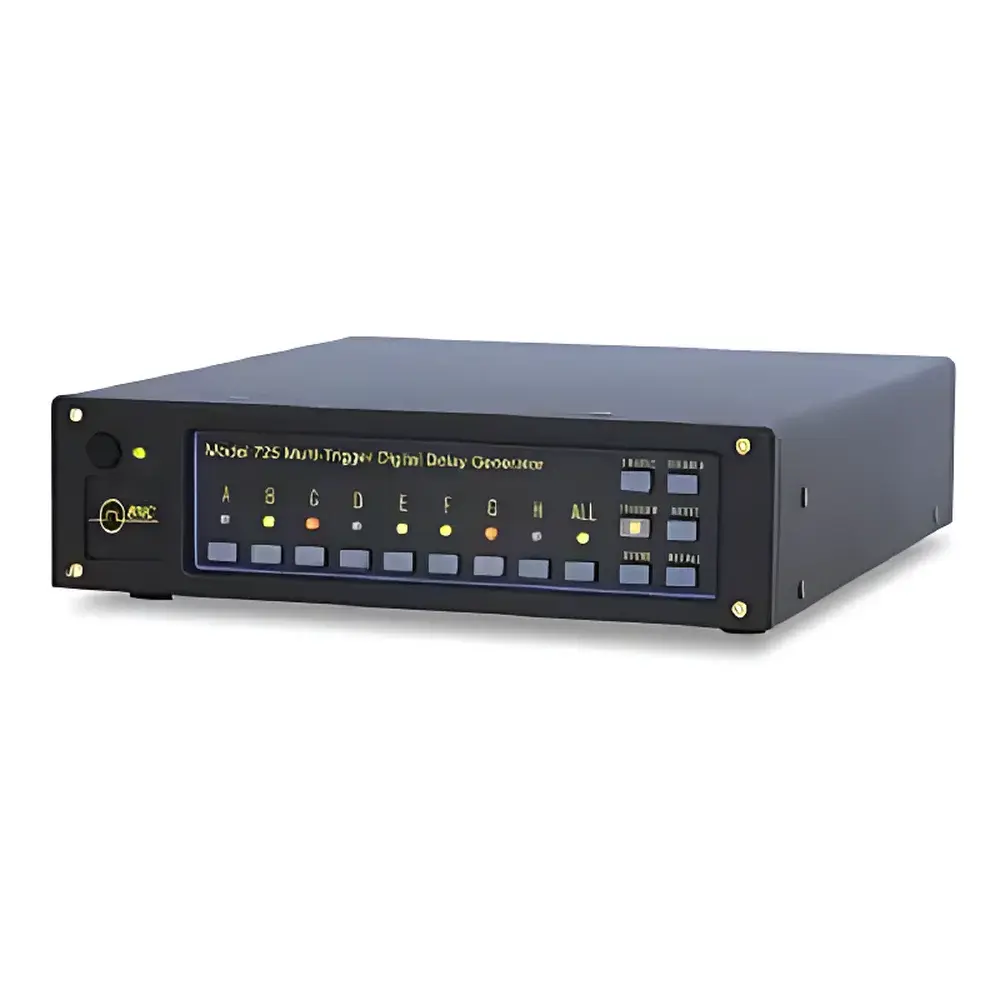
BNC Model 725 Digital Pulse Delay Generator
| Brand | BNC |
|---|---|
| Origin | USA |
| Manufacturer Type | Authorized Distributor |
| Import Status | Imported |
| Model | 725 |
| Pricing | Upon Request |
| Resolution | 10 ns |
| External Trigger Inputs | 8 |
| Internal Trigger Inputs | 7 |
| Logic Output Voltage Range | 0.1–4.5 V |
Overview
The BNC Model 725 Digital Pulse Delay Generator is a high-precision, programmable timing instrument engineered for deterministic synchronization and precise temporal control in demanding scientific and industrial environments. Operating on digital delay generation principles, it delivers nanosecond-level timing accuracy by digitally synthesizing delay intervals with fixed 10 ns resolution—enabling repeatable, low-jitter pulse sequencing without analog drift or thermal hysteresis. Unlike analog delay lines or FPGA-based timers lacking traceable calibration, the Model 725 employs a temperature-compensated crystal oscillator (TCXO) referenced clock architecture, ensuring long-term stability and compliance with metrological requirements for time-interval measurement. It is widely deployed in laser pump-probe experiments, time-of-flight mass spectrometry, particle accelerator beam gating, quantum optics setups, and automated test systems where sub-100 ns trigger alignment across multiple instruments is critical.
Key Features
- Digital delay resolution of 10 ns across full delay range (0–1000 s), calibrated and traceable to NIST standards
- Eight independent external trigger inputs accepting TTL, CMOS, ECL, and LVDS logic levels; each configurable for edge detection (rising/falling) and debounce filtering
- Seven internal trigger sources including self-trigger, gated repetition, burst mode, and software-initiated events
- Eight synchronized output channels with programmable logic levels (0.1–4.5 V), rise/fall times < 2.5 ns, and load-independent timing fidelity
- Full remote control via USB 2.0, Ethernet (TCP/IP & UDP), and optional GPIB interface; SCPI-compliant command set for seamless integration into LabVIEW, Python, MATLAB, and TestStand environments
- On-board non-volatile memory stores up to 100 user-defined delay configurations with timestamped versioning and checksum validation
Sample Compatibility & Compliance
The Model 725 imposes no intrinsic sample limitations—it functions exclusively as a timing controller and does not interface directly with physical specimens. Its outputs drive electronic instrumentation such as Q-switches, Pockels cells, photomultiplier tube gates, oscilloscope triggers, and data acquisition modules. The device complies with IEC 61000-4 electromagnetic compatibility standards (including ESD, surge, and radiated immunity testing), meets UL 61010-1 safety requirements for laboratory electrical equipment, and supports audit-ready operation under GLP and ISO/IEC 17025 quality management frameworks. Firmware logs all configuration changes with timestamps and user identifiers, satisfying traceability mandates under FDA 21 CFR Part 11 when used in regulated analytical workflows.
Software & Data Management
BNC provides the free, cross-platform BNC Control Center application for intuitive graphical configuration, real-time monitoring, and batch scripting. All delay parameters—including channel enable states, delay values, polarity inversion, and trigger source assignments—are exportable in CSV and XML formats. The instrument supports IEEE 1588 Precision Time Protocol (PTP) slave mode for network-synchronized operation in distributed timing architectures. Configuration backups include cryptographic hashes to verify integrity; firmware updates are digitally signed and validated prior to installation. Audit trails record every parameter modification, including operator ID (when authenticated via LDAP or local credentials), timestamp (with UTC synchronization), and pre-/post-change values—enabling full reproducibility and regulatory documentation.
Applications
- Laser-matter interaction studies requiring synchronized pump (Q-switch trigger) and probe (detector gate) pulses with jitter < 50 ps RMS
- Time-resolved fluorescence lifetime imaging (FLIM) systems using gated ICCD or SPAD arrays
- Multi-channel coincidence counting in positron emission tomography (PET) phantom calibration
- Automated burn-in and functional testing of high-speed digital ICs with stimulus-response latency verification
- Particle beam diagnostics in synchrotron light sources, where RF cavity phase locking demands sub-ns timing repeatability
- Calibration of time-interval analyzers (TIAs) and time-to-digital converters (TDCs) against known delay references
FAQ
What is the maximum delay range supported by the Model 725?
The instrument supports delays from 0 ns to 1,000 seconds in 10 ns increments, with no interpolation or extrapolation required.
Can multiple Model 725 units be synchronized over a network?
Yes—using IEEE 1588 PTP or GPS-disciplined 10 MHz reference inputs, enabling multi-unit phase coherence within ±2 ns across LAN-connected systems.
Does the Model 725 support programmable pulse width and repetition rate?
Yes—each output channel allows independent configuration of delay, width (10 ns–1000 s), polarity, and repetition rate (single-shot to 10 MHz continuous).
Is calibration documentation provided with shipment?
Every unit ships with a NIST-traceable calibration certificate covering delay accuracy, channel skew, and output jitter performance at 23 °C ±2 °C.
How is firmware updated, and is rollback supported?
Firmware updates are performed via secure HTTPS upload through the web interface; prior versions are retained on-device and selectable via boot menu for verified rollback.