
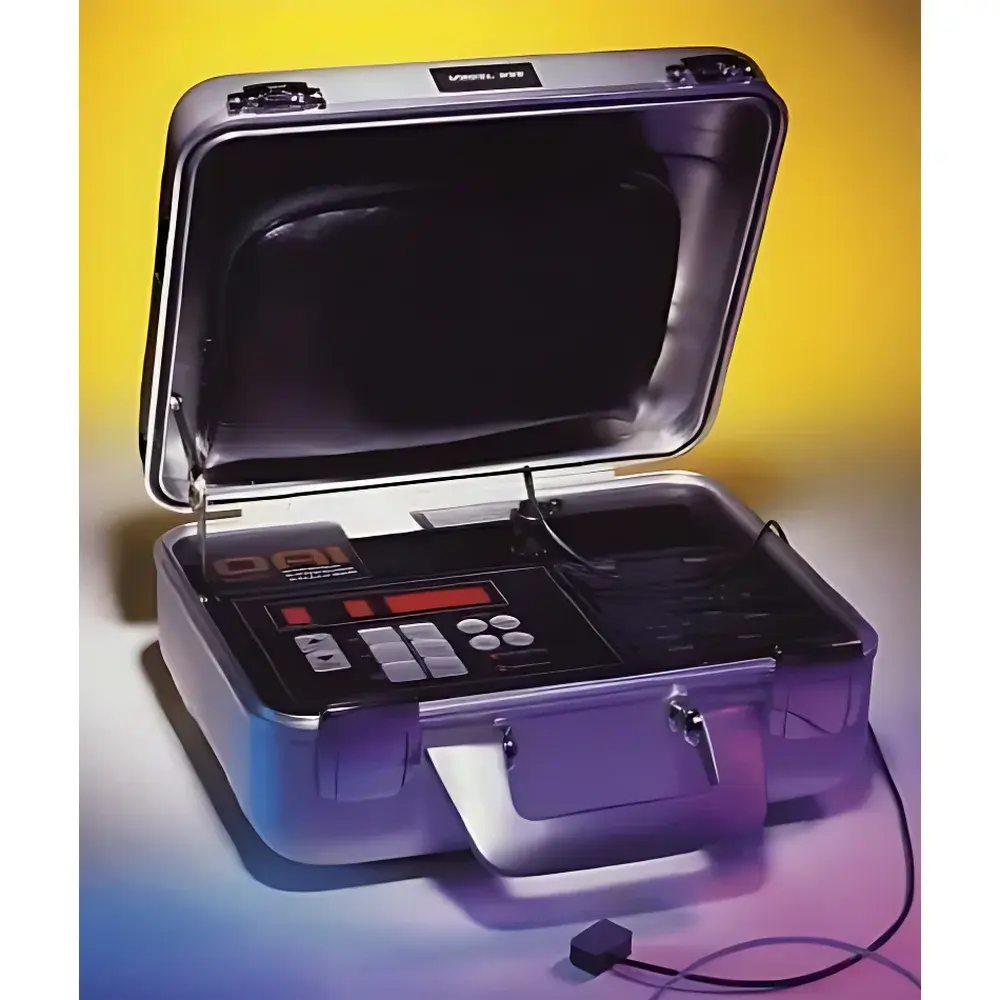
OAI Model 358 UV Exposure Analyzer
| Brand | OAI |
|---|---|
| Origin | USA |
| Manufacturer Type | Authorized Distributor |
| Origin Category | Imported |
| Model | MODEL 358 |
| Price | Upon Request |
| Measurement Range (Intensity) | Up to 1600 mW/cm² |
| Energy Range | Up to 4000 mJ/cm² |
| Time Range | Up to 2.5 s |
| Wavelengths | 365 nm, 400 nm, 420 nm, 436 nm (custom wavelengths available) |
| Calibration Traceability | NIST-traceable |
| Interface | RS-232 |
| Probe | Detachable, spectrally matched to common photoresists |
| Display | Digital LCD with freeze function and front-panel prompts |
| Housing | Rugged anodized aluminum with integrated handle and probe pouch |
Overview
The OAI Model 358 UV Exposure Analyzer is a microprocessor-controlled optical measurement instrument engineered for high-precision quantification of ultraviolet (UV) irradiance, radiant exposure (energy), and exposure duration in photolithography and semiconductor manufacturing environments. It operates on the principle of calibrated photodiode detection, where incident UV photons generate a photocurrent proportional to spectral irradiance—converted and displayed as intensity (mW/cm²), energy (mJ/cm²), and time (s). Designed specifically for integration with high-intensity wafer steppers—including ASM, Canon, Nikon, and Ultratech platforms—the Model 358 delivers repeatable, traceable measurements critical for process control in mask alignment, resist exposure, and stepper qualification. Its architecture supports real-time monitoring and post-exposure analysis of UV dose consistency across multiple exposure cycles, directly supporting ISO 9001-compliant process validation and GLP-aligned documentation workflows.
Key Features
- NIST-traceable digital display ensures metrological confidence and audit-ready calibration lineage
- Simultaneous acquisition and storage of nine independent exposure series, each comprising intensity, energy, and time values
- % deviation calculation across sequential exposures enables rapid identification of drift or lamp degradation
- Probe wavelength indicator prevents misconfiguration by confirming spectral band selection (365, 400, 420, or 436 nm) prior to measurement
- One-button operation minimizes operator error and supports unambiguous SOP execution in cleanroom settings
- RS-232 serial interface allows direct data transfer to laboratory information management systems (LIMS) or statistical process control (SPC) software
- Detachable, application-specific probes feature tailored spectral responsivity curves aligned with industry-standard photoresists (e.g., Shipley S1800, AZ series, TOK resist families)
- Display freeze function permits stable readout during manual inspection or photography of measurement results
- Front-panel contextual reminders guide users through calibration verification, probe connection, and exposure mode selection
- Rugged anodized aluminum enclosure meets MIL-STD-810G shock and vibration requirements; includes ergonomic carry handle and integrated probe storage pouch
Sample Compatibility & Compliance
The Model 358 is compatible with planar UV sources used in contact/proximity aligners and projection steppers operating within the near-UV spectrum. Its calibrated photodiode probes are optimized for broadband and narrowband emission profiles typical of mercury-vapor (Hg) and metal-halide lamps. The instrument complies with ANSI Z87.1 for optical safety labeling and supports adherence to semiconductor industry standards including SEMI E10 (Specification for Definition and Measurement of Equipment Reliability, Availability, and Maintainability) and JEDEC JESD22-A108 (Environmental Stress Screening of Qualification Samples). While not FDA-cleared as a medical device, its NIST-traceable calibration chain satisfies metrological requirements for ISO/IEC 17025-accredited laboratories conducting UV process validation per ASTM E2075–22 (Standard Practice for Determining the Effectiveness of UV Disinfection Systems) and USP (Plastic Packaging Systems for Pharmaceutical Use).
Software & Data Management
The Model 358 does not require proprietary software for basic operation but leverages standard terminal emulation (e.g., Tera Term, PuTTY) via its RS-232 port to export ASCII-formatted measurement logs. Each record includes timestamp (internal real-time clock), exposure sequence ID, wavelength setting, measured intensity (mW/cm²), accumulated energy (mJ/cm²), exposure duration (s), and calculated % deviation relative to user-defined reference values. Exported datasets are compatible with Excel, MATLAB, and Python-based analysis pipelines for trend analysis, control charting (X-bar/R), and automated pass/fail reporting. Audit trails are maintained manually via printed reports or digitally archived logs—supporting 21 CFR Part 11 compliance when paired with validated LIMS configurations that enforce electronic signature and change-control protocols.
Applications
- Photomask alignment and stepper throughput optimization in 150–300 mm wafer fabrication lines
- UV lamp aging studies and preventive maintenance scheduling based on intensity decay trends
- Photoresist sensitivity profiling across multiple exposure doses and wavelengths
- Qualification of UV-curable adhesives, coatings, and encapsulants in microelectronics packaging
- Validation of UV sterilization parameters in cleanroom HVAC ductwork and surface disinfection systems
- Calibration cross-checking of integrating sphere-based radiometers in metrology labs
- Process window characterization for deep-UV (DUV) lithography tool matching and fleet uniformity assessment
FAQ
Is the Model 358 suitable for measuring excimer laser sources (e.g., KrF, ArF)?
No—the Model 358 is designed for continuous or pulsed broadband UV sources with repetition rates below 10 Hz and average power densities within its specified range. Excimer lasers require specialized calorimetric or pyroelectric sensors with nanosecond temporal resolution.
Can I use third-party probes with this analyzer?
Only OAI-certified detachable probes are supported; non-OAI probes lack calibrated spectral correction factors and invalidate NIST traceability.
Does the unit include factory calibration documentation?
Yes—each shipped unit includes a calibration certificate listing date, NIST reference standard ID, uncertainty budget, and measurement points at all four standard wavelengths.
What maintenance is required for long-term accuracy?
Annual recalibration is recommended; optical surfaces should be cleaned with spectroscopic-grade methanol and lint-free wipes; battery replacement (9 V alkaline) is required every 12 months under typical usage.
How is traceability to NIST verified during calibration?
OAI performs calibration using transfer standards calibrated against NIST SRM 2241 (UV Radiometer) and SRM 2242 (UV Irradiance Standard), with full uncertainty propagation documented per GUM (JCGM 100:2008).





