SpectrumTEQ-EL Electroluminescent Quantum Efficiency Measurement System
| Brand | Ocean Optics |
|---|---|
| Origin | USA |
| Model | SpectrumTEQ-EL |
| Spectrometer Options | QE Pro or QE65 Pro |
| Spectral Range | 350–1100 nm |
| Signal-to-Noise Ratio | 1000:1 (QE Pro) |
| Optical Resolution (FWHM) | 2.5 nm |
| Dynamic Range | 85,000:1 (QE Pro, single acquisition) |
| 25,000 | 1 (QE65 Pro, single acquisition) |
| ADC Resolution | 18-bit (QE Pro) |
| Integrating Sphere Diameter | 3.3" |
| Sphere Coating Material | Spectralon® |
| Source Measure Unit | Keithley 2400 |
Overview
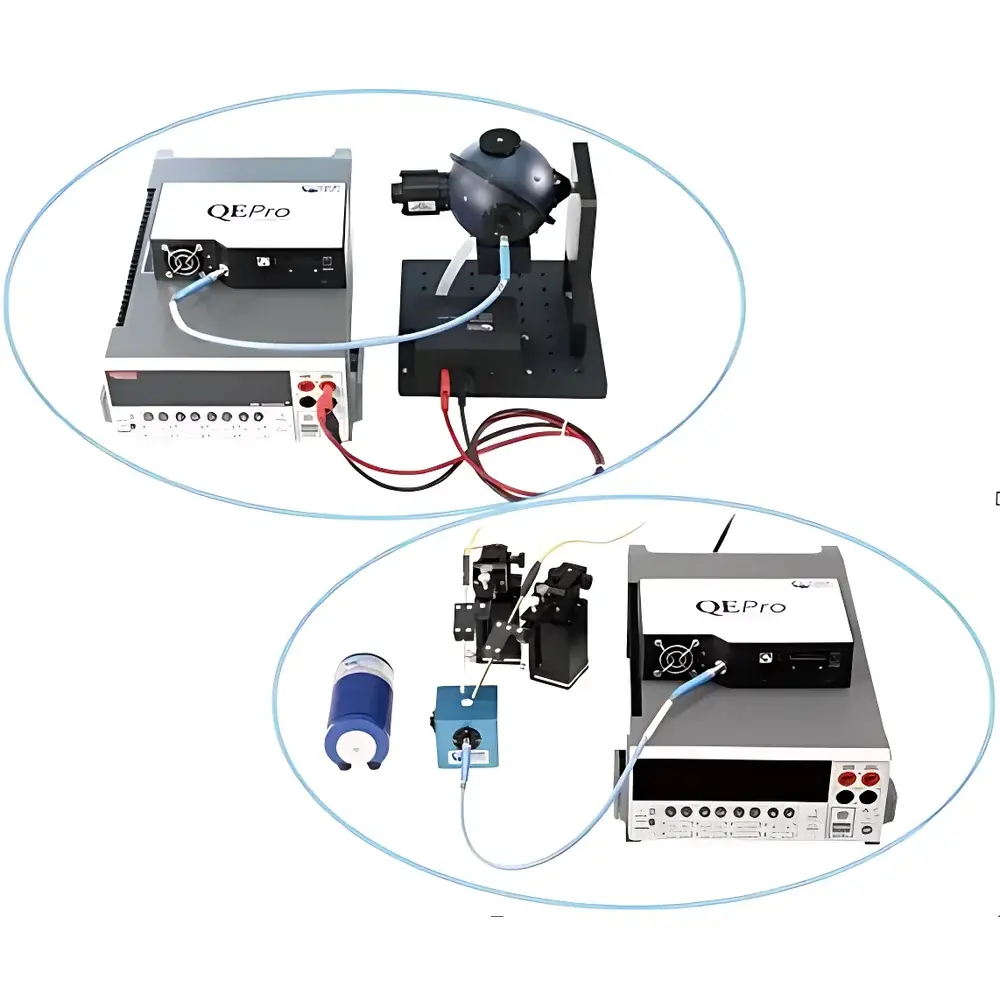
The SpectrumTEQ-EL Electroluminescent Quantum Efficiency Measurement System is a turnkey optical instrumentation platform engineered for the absolute external quantum efficiency (EQE) and luminous efficacy characterization of electroluminescent (EL) devices under operational bias. Built around the industry-standard Ocean Optics QE Pro or QE65 Pro spectrometers—both renowned for high signal fidelity, ultra-low stray light (99% diffuse reflectance material from 250–2500 nm). Measurement principle follows the absolute method: simultaneous acquisition of electroluminescent spectral power distribution (SPD) and electrical input (voltage/current) enables direct calculation of EQE (%) = (photons emitted per second) / (electrons injected per second), traceable to NIST-calibrated photodiode standards. The system operates without optical referencing during routine measurement, minimizing drift and enabling stable long-term monitoring—critical for OLED, PeLED, QD-LED, and inorganic EL device R&D.
Key Features
- Integrated source-measure unit (Keithley 2400 SMU) for synchronized voltage sweep, current sourcing, and four-quadrant operation—enabling full J-V-L and EQE-V curves
- Modular spectrometer architecture: QE Pro (18-bit ADC, TE-cooled, 85,000:1 dynamic range) or QE65 Pro (16-bit ADC, 25,000:1 dynamic range) selectable based on sensitivity and speed requirements
- Compact footprint (≤45 × 35 × 25 cm) optimized for glovebox integration—supports in-situ EL characterization under inert atmosphere (N₂ or Ar)
- Pre-aligned optical path with fixed-focal-length fiber coupling and calibrated sphere geometry—eliminates routine optical realignment and reduces operator dependency
- Thermally stabilized integrating sphere housing with low-thermal-expansion mounting—ensures mechanical and spectral repeatability across ambient temperature fluctuations (±0.5 °C)
- Factory-installed NIST-traceable irradiance calibration (350–1100 nm) with uncertainty <±2.5% (k=2) at 550 nm
Sample Compatibility & Compliance
The SpectrumTEQ-EL accommodates planar emissive devices with active areas ranging from 0.1 mm² to 25 mm²—including small-molecule OLEDs, polymer LEDs (PLEDs), perovskite LEDs (PeLEDs), quantum dot LEDs (QD-LEDs), and thin-film inorganic EL structures (e.g., ZnS:Mn). Device contact is achieved via spring-loaded probe stations or custom vacuum chuck fixtures (optional). All optical components comply with ISO 9001 manufacturing controls; spectral calibration adheres to CIE Publication 127:2007 (Measurement of LEDs) and ASTM E308-19 (Standard Practice for Computing the Colors of Objects by Using the CIE System). Data acquisition and storage meet GLP audit requirements through timestamped metadata embedding and configurable user access levels.
Software & Data Management
Control and analysis are performed via SpectrumTEQ software (Windows 10/11, 64-bit), featuring a wizard-driven interface for automated EQE, luminous efficacy (lm/W), CIE chromaticity (x,y), CCT, and color rendering index (CRI) extraction. Raw spectra are stored in HDF5 format with embedded instrument configuration, calibration history, and environmental metadata (temperature, humidity, date/time). Export options include CSV, XML, and CIE S026-compliant .ies files. Software supports 21 CFR Part 11 compliance modules—including electronic signatures, audit trails, and role-based permissions—upon request for regulated environments.
Applications
- Quantitative EQE benchmarking of novel emitter materials (e.g., TADF, HLCT, hyperfluorescence systems)
- Operational stability assessment via time-resolved EQE tracking under constant-current stress
- Angular emission profile analysis using optional goniometric stage integration
- Correlation of electrical degradation mechanisms (e.g., Joule heating, electrode diffusion) with spectral shift and efficiency roll-off
- Process optimization feedback for vacuum thermal evaporation and solution-processing fabrication lines
- Support for IEC 62341-6-2 (OLED display testing) and JEDEC JESD22-A108 (reliability testing) protocols
FAQ
Does the system require periodic recalibration?
No—optical alignment is factory-fixed and mechanically locked; only annual NIST-traceable spectral irradiance recalibration is recommended for metrological continuity.
Can the system measure devices under pulsed bias?
Yes—Keithley 2400 supports pulse width down to 1 ms; synchronization with spectrometer trigger ensures jitter-free spectral acquisition during transient EL response.
Is vacuum-compatible operation supported?
The base system is glovebox-ready (standard O-ring sealed feedthroughs); optional stainless-steel vacuum chamber integration (10⁻³ mbar) is available with custom flange mounting.
What spectral resolution is achievable for narrowband emitters (e.g., QDs)?
At 2.5 nm FWHM (with slit-limited configuration), the QE Pro resolves full-width half-maxima ≥3.0 nm; sub-nm resolution requires external monochromator coupling (not included).
How is electrical leakage current handled during low-brightness measurement?
The Keithley 2400’s 10 fA current resolution and guarded triax connections suppress noise; software implements dark-current subtraction using zero-bias reference scans.