
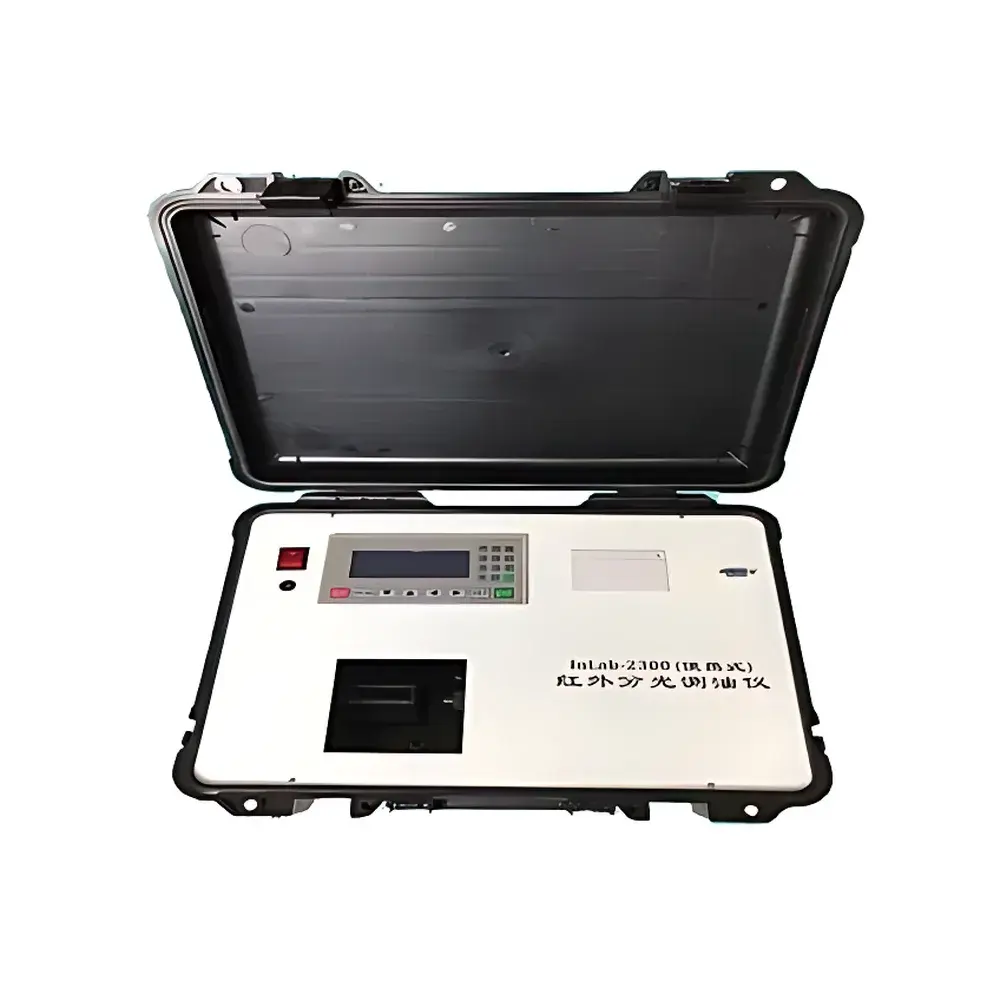
InLab-2300 Portable Infrared Oil-in-Water Analyzer
| Origin | Beijing, China |
|---|---|
| Manufacturer Type | Authorized Distributor |
| Origin Category | Domestic (China) |
| Model | InLab-2300 |
| Price Range | USD 1,400 – 7,200 |
| Instrument Type | Portable |
| Measurement Principle | Infrared Spectrophotometry (Dual-Wavelength & Full-Spectrum Scanning) |
| Measurement Range | 0.00–800 mg/L (in extract, using 0.5–4 cm pathlength cells) |
| Detection Limit | <0.4 mg/L (in CCl₄ extract) |
| <0.004 mg/L (in water sample, 40 | 1 extraction ratio, 4 cm quartz cell) |
| Accuracy | ±0.8 mg/L (C < 10 mg/L), ±4% (10 ≤ C ≤ 80 mg/L) |
| Repeatability | ≤3% (for 20 & 40 mg/L oil standards) |
| Resolution | 0.1 mg/L (in tetrachloroethylene) |
| Wavenumber Range | 3400–2400 cm⁻¹ (±1 cm⁻¹ repeatability) |
| Absorbance Range | 0.0000–2.000 AU |
| Baseline Drift | <0.001 AU/60 min |
| Sampling Frequency | 7 measurements/min |
| Power Supply | 220 V ±10%, 50 Hz, 40 VA |
| Dimensions & Weight | 470 × 380 × 210 mm, ~13 kg |
| Operating Environment | 5–35 °C, 20–90% RH |
| Battery Life | ~6 h (integrated Li-ion) |
| Interface | RS-232 or USB (configurable) |
| Compliance | HJ 637–2018 (China), ISO 9377-1:2000 (Petroleum Hydrocarbons), ASTM D7066–22 (Oil in Water by IR) |
Overview
The InLab-2300 Portable Infrared Oil-in-Water Analyzer is an engineered solution for field-deployable and laboratory-based quantification of total petroleum hydrocarbons (TPH), mineral oil, animal and vegetable oils, and total oil content in aqueous matrices. It operates on the principle of mid-infrared absorption spectroscopy, specifically targeting the asymmetric and symmetric C–H stretching vibrations near 2960 cm⁻¹, 2930 cm⁻¹, and 2860 cm⁻¹ — spectral regions defined in HJ 637–2018 and aligned with ISO 9377-1:2000 for petroleum hydrocarbon analysis. Unlike non-dispersive infrared (NDIR) systems, the InLab-2300 employs a high-stability, detachable optical module featuring post-dispersion absorption detection — ensuring optimal signal fidelity, minimal thermal drift, and compliance with Lambert–Beer law linearity (R > 0.999). Its dual-mode operation supports both rapid single-point NDIR-style measurement (≤2 s/sample) and full-spectrum scanning (≈120 s) across 3400–2400 cm⁻¹, enabling interference identification via spectral fingerprinting.
Key Features
- Detachable integrated optical system with post-dispersion absorption architecture — enhances long-term photometric stability and signal-to-noise ratio (SNR).
- Electrically modulated IR source eliminates mechanical chopper wear, reduces thermal load, and improves system longevity.
- Phase-sensitive lock-in amplifier circuitry for detector signal processing — extends detection capability to sub-ppb levels in pre-concentrated samples.
- Real-time baseline correction and automatic zero adjustment — compensates for environmental drift and solvent batch variability.
- Universal cell holder accommodating 0.5–5 cm pathlength quartz or glass cuvettes — supports method flexibility per HJ 637–2018 calibration requirements.
- Onboard 7-inch TFT LCD touchscreen with embedded OS — enables standalone operation without external computing hardware.
- Integrated rechargeable lithium-ion battery (6 h typical runtime) — certified for Class II, Division 2 field use in wastewater treatment plants, offshore platforms, and emergency response scenarios.
- Dual-method validation: simultaneous support for infrared spectrophotometric (full-spectrum) and non-dispersive (three-band) quantification — results are mathematically decoupled and cross-verifiable.
- Extractant purity verification protocol — built-in spectral library comparison identifies CCl₄ or C₂Cl₄ contamination (e.g., carbonyl or alcohol impurities) prior to analysis.
Sample Compatibility & Compliance
The InLab-2300 is validated for direct analysis of liquid-phase extracts prepared from water, soil, sediment, and swabbed surface samples using standardized EPA Method 1664B-compatible protocols. It accommodates common extraction solvents including tetrachloroethylene (non-ozone-depleting alternative), hexane, and CCl₄ — with automated solvent compatibility checks embedded in firmware. The instrument meets functional equivalency requirements for HJ 637–2018 (China), ISO 9377-1:2000 (petroleum hydrocarbons in water), and ASTM D7066–22 (oil-in-water by infrared). For regulated environments, audit trails, user access control, and electronic signature support can be enabled to align with GLP/GMP documentation practices and FDA 21 CFR Part 11 readiness when paired with optional PC software.
Software & Data Management
The optional InLab-Analyze Pro software (Windows 10/11 compatible) provides full spectral visualization, peak deconvolution, multi-point calibration curve generation (linear, quadratic, or cubic), and QC flagging per ICH Q2(R2) guidelines. All raw interferograms, absorbance spectra, and processed concentration values are stored in vendor-neutral .csv and .spc formats. Software features include automated baseline subtraction, spectral library matching (reference oils: diesel, lubricating oil, fish oil), and report generation compliant with ISO/IEC 17025 documentation standards. Data export supports LIMS integration via ODBC drivers, and all measurement sessions retain timestamped metadata (operator ID, cell pathlength, solvent lot, ambient temperature/humidity).
Applications
- Regulatory monitoring of effluent discharge from petrochemical facilities, refineries, and metalworking industries per national discharge permits.
- Field screening of groundwater plumes at brownfield sites and UST (underground storage tank) leak investigations.
- Wastewater treatment plant influent/effluent oil & grease (O&G) compliance testing under GB 8978–1996 and local municipal ordinances.
- Marine pollution assessment — detection of bilge water contamination and ballast water hydrocarbon loading.
- Food industry hygiene validation — quantification of edible oil residues on production line surfaces and CIP rinse waters.
- Environmental forensics — differentiation of biogenic vs. petrogenic hydrocarbons using spectral shape analysis.
- Research applications in bioremediation kinetics, sorption studies, and emulsion stability profiling.
FAQ
Does the InLab-2300 comply with HJ 637–2018? Why is this important?
Yes — it implements the exact wavenumber bands (2960, 2930, 2860 cm⁻¹), extraction ratios, and calibration protocols specified in HJ 637–2018. This ensures legally defensible data for Chinese environmental reporting and third-party verification.
Can I use tetrachloroethylene instead of carbon tetrachloride?
Yes — the instrument includes preloaded spectral reference libraries for both solvents, and its software automatically corrects for differential molar absorptivity. Solvent purity verification is mandatory before analysis.
What is the lowest measurable concentration in untreated water?
With 40:1 liquid–liquid extraction and a 4 cm quartz cell, the practical detection limit is 0.004 mg/L — sufficient for drinking water source monitoring and low-level seepage detection.
Is the battery pack replaceable in the field?
Yes — the Li-ion module is user-swappable without tools and qualifies for UN 38.3 transport certification.
How does the instrument handle spectral interferences from surfactants or organic solvents?
Its full-spectrum scan mode enables visual identification of anomalous peaks (e.g., ester C=O at 1740 cm⁻¹); the software flags deviations >5% from reference oil spectra and recommends re-extraction or matrix spike recovery testing.
Related Products







