
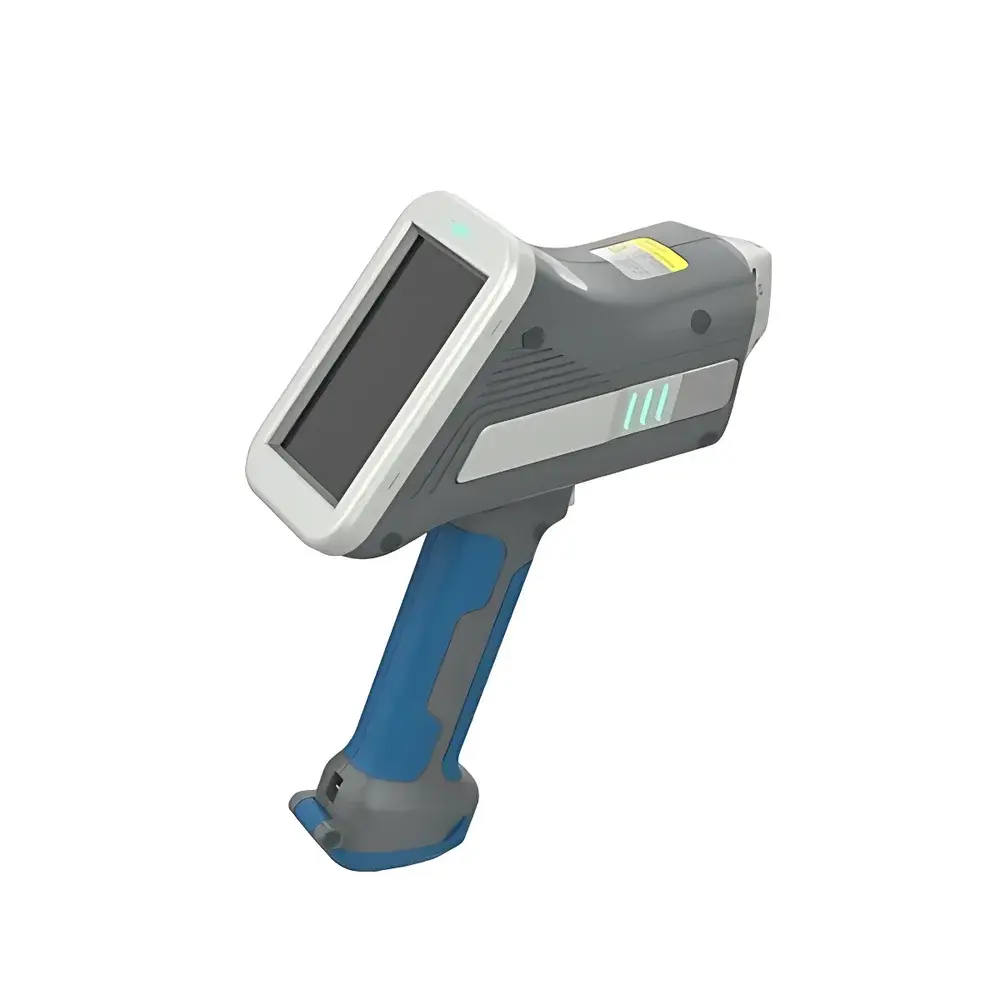
Jiapu Portable-S450 Handheld X-ray Fluorescence (XRF) Soil Heavy Metal Analyzer
| Origin | Beijing, China |
|---|---|
| Manufacturer Type | Authorized Distributor |
| Origin Category | Domestic (China-made) |
| Model | Portable-S450 |
| Price Range | USD 2,800 – 7,000 |
| Detector | High-Performance Silicon Drift Detector (SDD) |
| X-ray Tube | 45 kV / 200 µA Ag-anode End-window Microfocus Tube with Integrated HV Supply |
| Elemental Range | Mg (Z=12) to U (Z=92) |
| Detectable Elements | Al, S, K, Ca, Sc, Ti, V, Cr, Mn, Fe, Co, Ni, Cu, Zn, Ga, Ge, As, Se, Rb, Sr, Y, Zr, Nb, Mo, Ag, Cd, Sn, Sb, I, Ba, Eu, Yb, Lu, Hf, Hg, Pb, Bi (37 elements standard, expandable) |
| Sample Forms | Solid, Powder, Liquid |
| Analysis Method | Fundamental Parameters (FP) + Direct Reading |
| Weight | ≤1.75 kg (with battery) |
| Display | 5″ Industrial Semi-Transflective Touchscreen (1080×720) |
| Storage | 4 GB internal + microSD up to 16 GB |
| Battery | Rechargeable Li-ion, 6800 mAh, 7.2 V, ≥12 h runtime |
| Connectivity | Wi-Fi, Bluetooth 4.2, USB-C, 3G/4G (optional) |
| Safety | Auto X-ray shutoff when no sample detected |
| Operating Environment | −20 °C to +60 °C, ≤90% RH (non-condensing) |
Overview
The Jiapu Portable-S450 is a field-deployable, handheld energy-dispersive X-ray fluorescence (ED-XRF) analyzer engineered for rapid, non-destructive quantification of heavy metals in soil, sediment, dust, coatings, and liquid matrices. Based on the physical principle of characteristic X-ray emission—where primary X-rays excite inner-shell electrons in target atoms, inducing fluorescent photons whose energies are element-specific—the Portable-S450 delivers laboratory-grade precision under real-world environmental conditions. Its optimized optical path, high-resolution silicon drift detector (SDD), and Ag-target microfocus X-ray tube enable detection limits in the low ppm range for key regulatory elements (e.g., As, Cd, Cr, Pb, Hg, Ni) without sample digestion or chemical preparation. Designed explicitly for environmental site assessment, the instrument complies with ASTM D6729 (soil screening), EPA Method 6200 (field XRF), and ISO 12847 (in-situ metal analysis), supporting Tier 1–2 site characterization workflows in accordance with RCRA, CERCLA, and EU Soil Thematic Strategy requirements.
Key Features
- Non-destructive testing (NDT): No sample grinding, acid digestion, or consumables required—preserves sample integrity and eliminates lab turnaround delays.
- Real-time elemental quantification: Simultaneous detection and quantification of up to 37 elements (Mg–U) in ≤2 seconds for soil identification; full quantitative report generation in <5 s.
- Robust field hardware: IP54-rated industrial enclosure with shock-absorbing tri-proof carrying case; integrated 5 MP autofocus camera for geotagged spectral documentation.
- Smart operational safeguards: Proximity sensor activates only upon sample contact; auto X-ray tube shutdown during idle or empty-beam conditions; real-time status LED (red flashing = measurement active; green steady = sample present).
- Optimized excitation geometry: 2 mm / 3 mm collimated beam with zero-filter configuration—minimizes spectral background via software-based scatter subtraction instead of mechanical filter switching.
- Thermal-stable electronics: Active temperature compensation ensures reproducible peak resolution across −20 °C to +60 °C ambient ranges, critical for outdoor deployment in diverse climatic zones.
Sample Compatibility & Compliance
The Portable-S450 accepts heterogeneous solid samples (soils, sediments, sludges, filter media, paint chips), loose powders, and homogenized liquids (filtered wastewater, leachates). Its 9 mm × 5 mm elliptical test window accommodates irregular surfaces while maintaining consistent take-off geometry. Calibration models are traceable to NIST SRM 2710a (Montana Soil), 2711a (Montana II Soil), and ERM®-CC141 (contaminated soil), enabling compliance with ISO/IEC 17025-accredited field methods. Instrument performance meets the analytical criteria specified in EPA SW-846 Method 6200 for field portable XRF, including precision (RSD <15% at 10× detection limit), accuracy (±10% bias vs. ICP-MS reference), and interference correction robustness (e.g., matrix effects from Fe/Ca/Si). All firmware and calibration files support audit-ready GLP/GMP metadata logging per FDA 21 CFR Part 11 requirements.
Software & Data Management
TECSYNC™ cross-platform software provides unified control and data governance across instrument firmware, Windows desktop, Android mobile, and secure cloud repositories. Each analysis captures full spectral raw data (energy channel counts), calibrated concentrations (ppm and wt%), statistical uncertainty (k = 2), acquisition parameters (tube voltage/current, live time), and embedded geolocation/timestamp metadata. Reporting modules generate PDF/CSV outputs compliant with ISO 14001 environmental management systems and EU REACH Annex XVII reporting formats. Email report dispatch, Bluetooth sync to portable printers, and encrypted Wi-Fi upload to configurable SFTP or Microsoft Azure Blob Storage ensure seamless integration into enterprise LIMS or GIS platforms. Remote diagnostics, over-the-air firmware updates, and multi-level user authentication (admin/operator/viewer roles with password + PIN enforcement) fulfill cybersecurity requirements for regulated environmental operations.
Applications
- Rapid delineation of contamination plumes during Phase I/II Environmental Site Assessments (ESAs), reducing drill-and-dig costs by >40%.
- On-site verification of excavation cut-off levels for Cr(VI), As, and Pb prior to off-site disposal or on-site stabilization.
- RCRA Corrective Action investigations: real-time mapping of priority pollutant metals (Cd, Hg, Ni, Se, Ag) across landfill caps, leachate collection systems, and groundwater monitoring wells.
- Industrial hygiene monitoring: quantification of airborne metal particulates collected on filters (e.g., welding fumes, battery recycling dust, catalyst residues).
- Regulatory compliance screening: pre-submission checks against EU WEEE/RoHS thresholds (Cd < 100 ppm, Pb/Hg/Cr(VI) < 1000 ppm) in soils adjacent to electronics manufacturing facilities.
- Public health exposure assessment: correlation of surface soil metal concentrations (e.g., Mn in playgrounds, As in orchard soils) with epidemiological risk models (US EPA IRIS, WHO JECFA).
FAQ
Does the Portable-S450 require annual calibration verification against certified reference materials?
Yes. While factory calibrations are traceable to NIST standards, users must perform quarterly verification using SRM 2710a or equivalent matrix-matched controls to maintain data defensibility under EPA Region 9 QA/QC guidance.
Can the instrument analyze wet or frozen soil samples?
Moisture content >25 wt% degrades precision due to hydrogen scattering effects; samples should be air-dried to <15% moisture or analyzed in sealed containers with He purge to minimize absorption artifacts.
Is spectral deconvolution performed onboard or only in TECSYNC™ desktop software?
Real-time peak fitting and FP quantification occur within the instrument’s ARM Cortex-A53 processor; advanced spectral library matching and interference modeling (e.g., As Kα/Kβ overlap with Pb M-lines) require desktop TECSYNC™.
What regulatory documentation accompanies each unit for international shipment?
Each shipment includes IEC 62495-compliant radiation safety certification, RoHS/REACH declarations of conformity, CE marking dossier, and English-language operation manuals validated per ISO/IEC 17025 Clause 6.4.
How is data integrity ensured during offline field operations?
All measurements are cryptographically signed and timestamped locally; sync conflicts are resolved via version-controlled merge logic upon reconnection, preserving original acquisition context and audit trail completeness.







