
MicrOptik MHCS622-V/G High-Performance Heated & Cooled Vacuum/Gas-Tight Optical Microscopy Stage
| Brand | MicrOptik |
|---|---|
| Origin | Netherlands |
| Model | MHCS622-V/G |
| Temperature Range | −190 °C to +600 °C |
| Temperature Resolution | 0.1 °C |
| Control Method | PID/PID-Switching |
| Sensor Type | RTD |
| Sample Area | 40 mm × 40 mm |
| Observation Aperture | 32 mm |
| Objective Working Distance | 6 mm (optional reduced WD) |
| Chamber Height | 4 mm standard, up to 20 mm |
| Electrical Feedthroughs | 4 channels (configurable) |
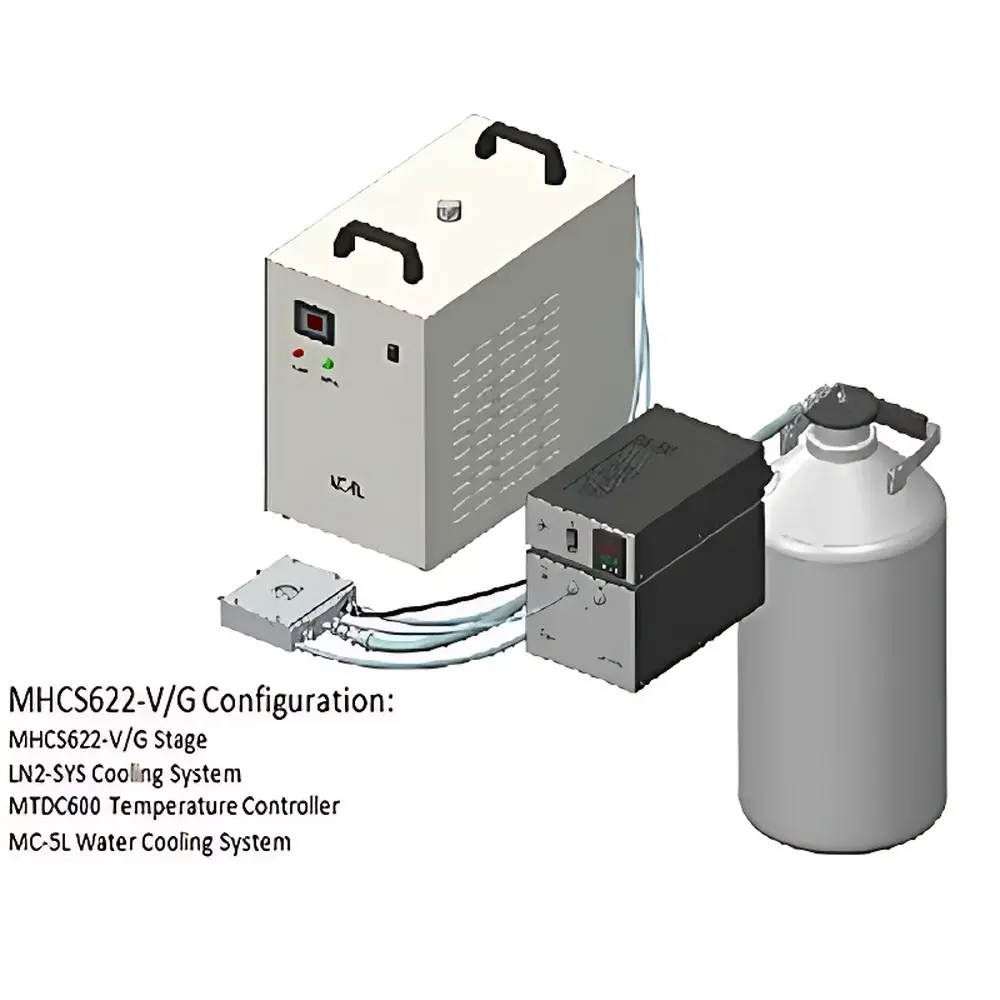
| Controller | MTDC600 Programmable Temperature Controller with USB 2.0 interface and embedded power supply |
| Cooling Option | LN2-SYS liquid nitrogen cryogenic system |
| Mounting | Horizontal or vertical integration compatible |
Overview
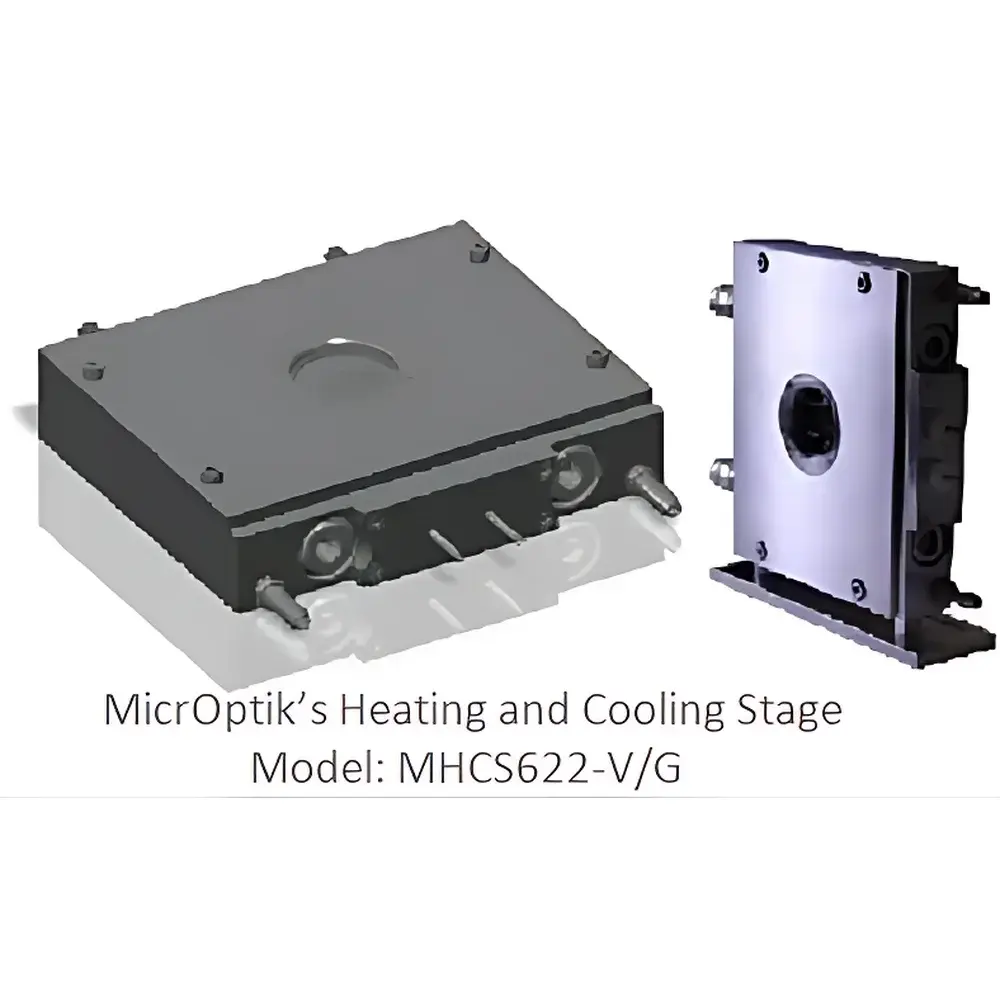
The MicrOptik MHCS622-V/G is a precision-engineered optical microscopy stage designed for in situ thermal analysis under controlled atmospheric conditions. It operates on the principle of active resistive heating combined with optional cryogenic cooling (via integrated LN2-SYS interface), enabling real-time observation of dynamic phase transitions, thermal expansion, crystallization, decomposition, and microstructural evolution across an exceptional temperature span—from cryogenic −190 °C to high-temperature +600 °C. Unlike passive hot stages, the MHCS622-V/G integrates closed-loop feedback control using platinum resistance temperature detectors (RTDs) and a dual-mode PID/PID-switching algorithm, ensuring thermal stability within ±0.1 °C and repeatability critical for quantitative materials characterization. Its vacuum-tight and gas-sealed architecture (rated to 10−6 mbar base pressure and compatible with inert or reactive gas purging) supports correlative optical microscopy, Raman spectroscopy, FTIR imaging, and photoluminescence studies where ambient contamination or oxidation must be excluded.
Key Features
- Vacuum- and gas-compatible chamber with O-ring sealed lid and standardized KF-16 or CF-35 flange options for seamless integration into vacuum lines or glovebox environments.
- Large 40 mm × 40 mm sample area with 32 mm unobstructed optical aperture—optimized for high-NA objectives and long-working-distance lenses (6 mm standard, down to 2 mm available).
- Modular chamber height (4–20 mm) accommodates thick samples, multi-layer stacks, or custom sample holders without compromising optical access.
- Four electrically isolated feedthrough channels (expandable to 6 or 8) support simultaneous integration of thermocouples, bias electrodes, or optical fibers for multimodal experiments.
- MTDC600 programmable controller featuring 0.1 °C resolution, auto-tuning PID parameters, ramp/soak profiles, safety interlocks, and real-time logging via USB 2.0.
- Water-cooled base plate design minimizes thermal drift in the microscope frame and maintains mechanical stability during rapid thermal cycling.
- Tool-free removable top cover enables rapid sample loading and cleaning—critical for high-throughput lab workflows and cleanroom-compatible protocols.
Sample Compatibility & Compliance
The MHCS622-V/G accommodates diverse sample geometries including polished wafers, thin films, mineral sections, fluid inclusion mounts, polymer blends, battery electrode cross-sections, and semiconductor heterostructures. Its inert stainless-steel and ceramic construction complies with ISO 14644-1 Class 5 cleanroom requirements when operated under nitrogen purge. The system supports ASTM E111 (tensile deformation at elevated temperature), ISO 11357 (thermal analysis of polymers), and USP (thermal microscopy for pharmaceutical solid-state analysis). All electrical components meet CE and RoHS directives; vacuum components conform to ISO 2862 and VDI/VDE 2048 standards for leak integrity testing.
Software & Data Management
The included MTDC600 Control Suite provides a validated Windows-based platform compliant with FDA 21 CFR Part 11 for audit trail generation, electronic signatures, and user-access level management. Experimental protocols—including multi-step temperature ramps, dwell times, and trigger-linked image capture—are fully scriptable. Temperature data is exported in CSV or HDF5 format synchronized with timestamped metadata (e.g., stage position, vacuum pressure, gas flow rate). Integration with third-party acquisition software (e.g., NIS-Elements, ZEN, or MATLAB via DLL API) enables automated correlation between thermal events and optical/spectral responses.
Applications
- Geosciences: In situ observation of fluid inclusion homogenization, melting/freezing point depression, and mineral phase transitions under simulated crustal P–T conditions.
- Materials Science: Quantitative measurement of coefficient of thermal expansion (CTE), grain boundary mobility, and solid-state reaction kinetics in ceramics and composites.
- Semiconductor & PV: Real-time monitoring of solder joint reflow, intermetallic growth, passivation layer delamination, and perovskite film degradation under thermal stress.
- Pharmaceuticals: Polymorph screening, hydrate/dehydrate transitions, and amorphous–crystalline conversion kinetics in API formulations.
- Soft Matter: Gelation temperature mapping, LC phase identification, and micelle aggregation behavior under controlled thermal gradients.
FAQ
What vacuum level is achievable with the MHCS622-V/G stage?
The stage achieves base pressures below 10−6 mbar when paired with a turbomolecular pump and properly baked; standard operation in high vacuum (10−5–10−3 mbar) is routine.
Can the stage be used with oil-immersion objectives?
Yes—its gas-tight design allows nitrogen or argon purging to eliminate condensation; optional immersion-compatible gaskets and low-outgassing optical windows are available.
Is the MTDC600 controller compatible with LabVIEW or Python?
Yes—the controller exposes SCPI-compliant USB commands; Python drivers and LabVIEW VIs are provided in the SDK package.
How is temperature uniformity across the sample area verified?
MicrOptik provides traceable calibration reports showing ±0.3 °C spatial uniformity over the central 25 mm² region at steady state, measured using a calibrated micro-thermocouple array.
Does the system support GLP/GMP documentation workflows?
Yes—audit trails, calibration logs, user permissions, and electronic signature capability are built into the MTDC600 Control Suite per 21 CFR Part 11 Annex 11 requirements.




