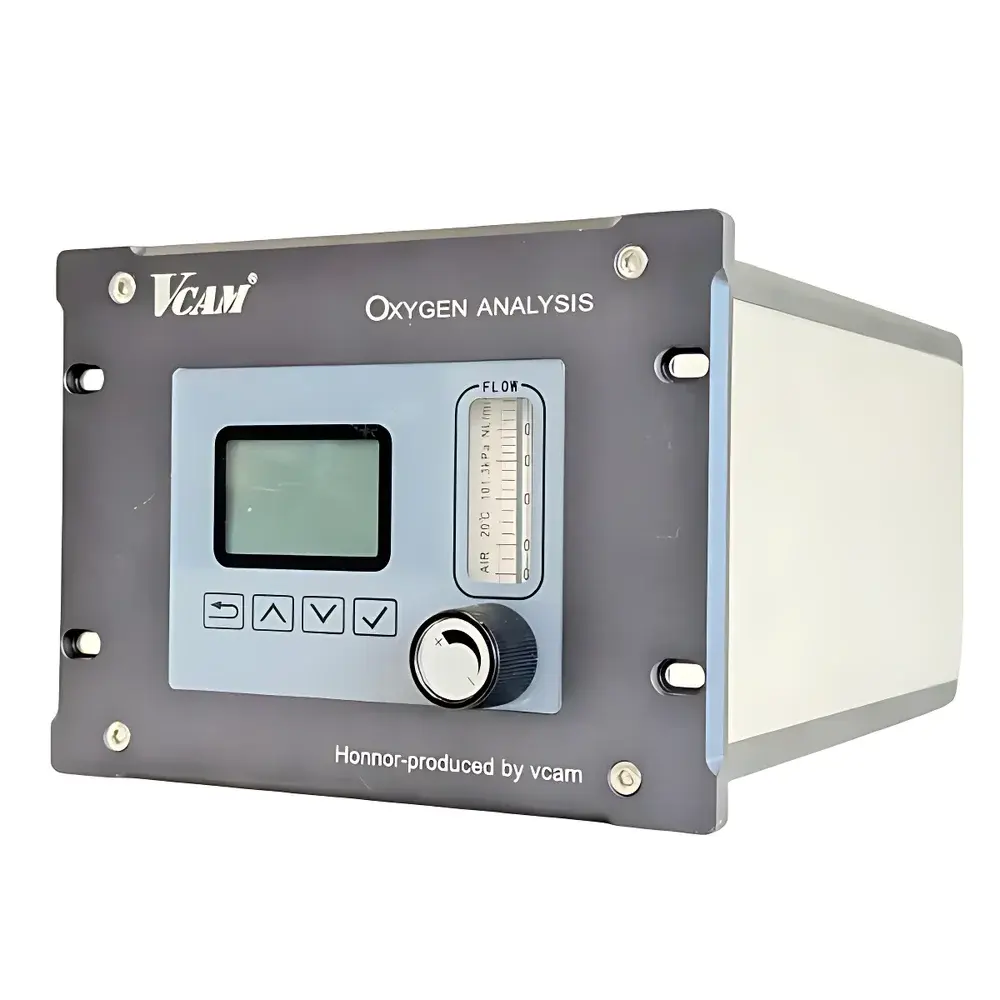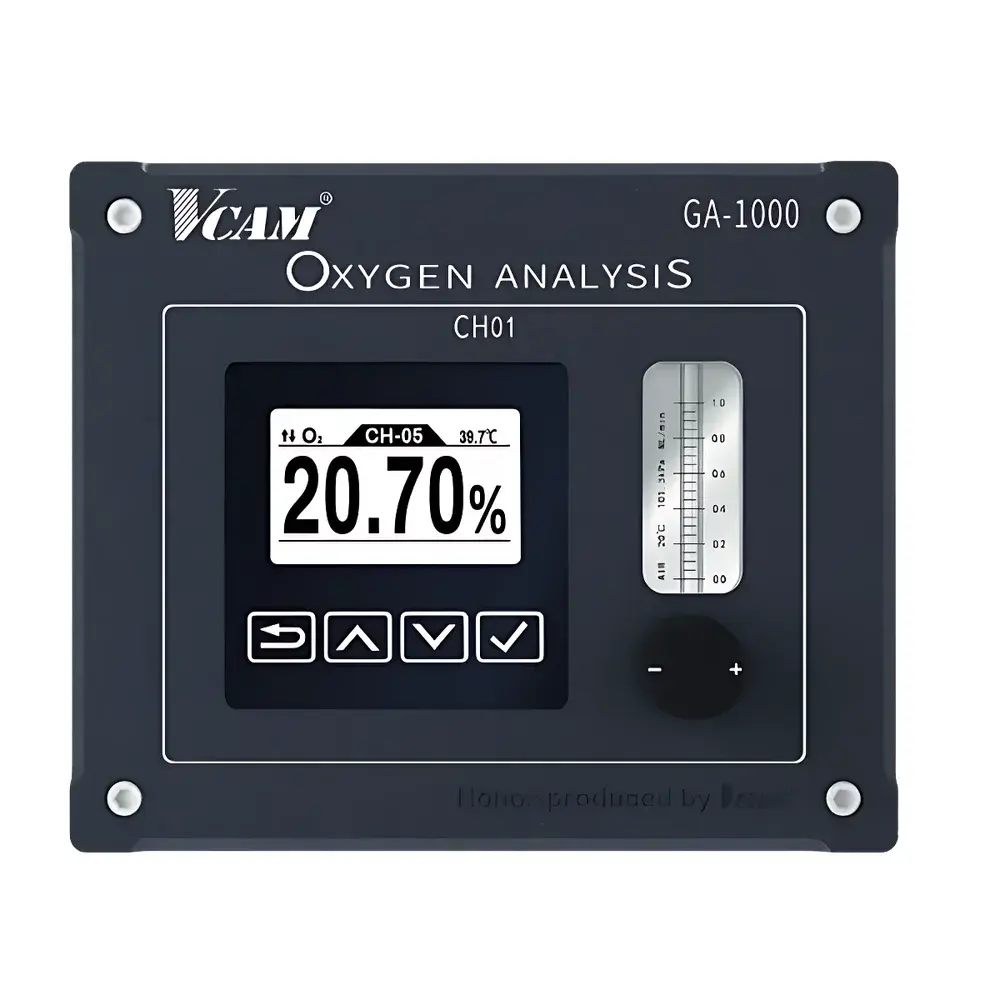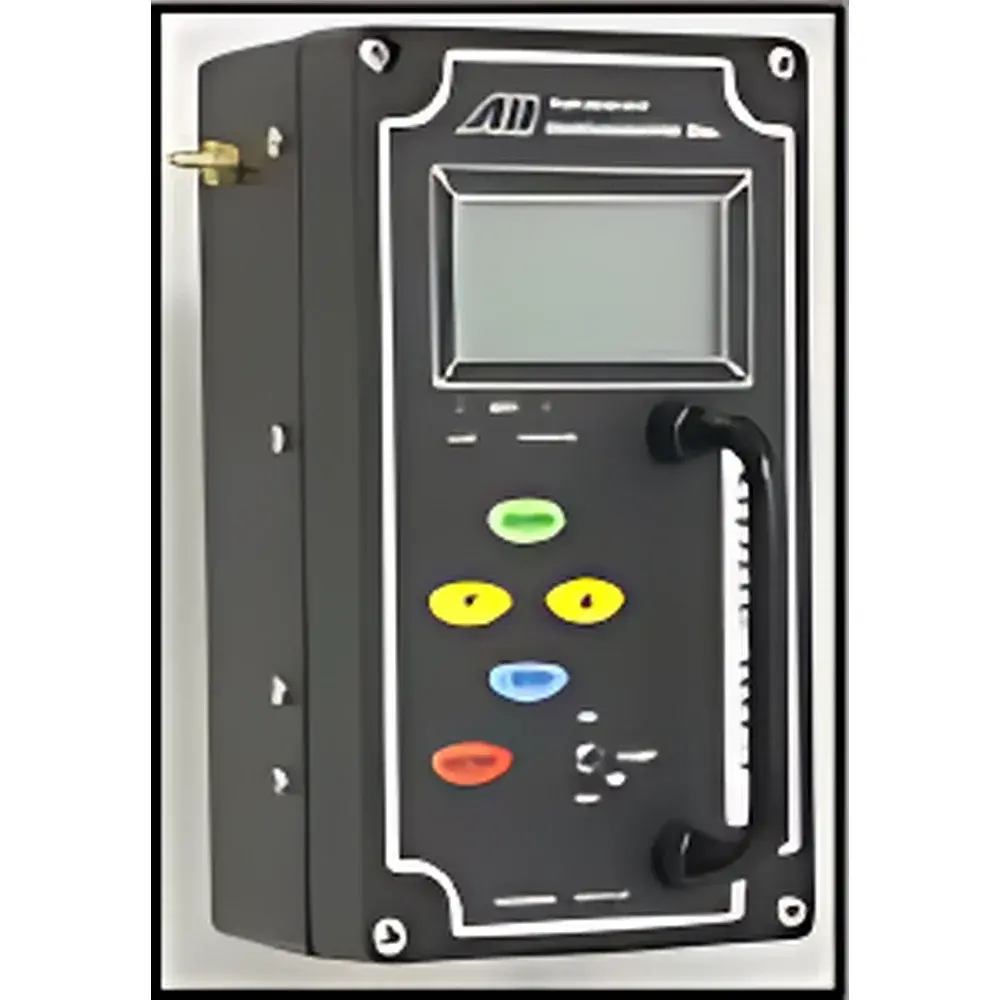
AII GPR-2000 Portable High-Range Oxygen Analyzer
| Brand | AII |
|---|---|
| Origin | USA |
| Model | GPR-2000 |
| Measurement Principle | Electrochemical Sensor |
| Range | 0–1%, 0–5%, 0–10%, 0–25% O₂ (Auto/Manual Switching) |
| Resolution | 0.01% O₂ |
| Accuracy | ±1% of full scale (at 25°C, 1 atm) |
| Linearity | R² > 0.995 |
| Response Time (T₉₀) | <10 s |
| Sensor Lifetime | 36 months (standard), 24 months (acid-resistant) |
| Enclosure | Anodized Aluminum, NEMA 4X Rated |
| Dimensions | 4" × 9" × 3" (10.2 × 22.9 × 7.6 cm) |
| Weight | 7 lbs (3.2 kg) |
| Display | Backlit LCD with Real-Time Temperature Readout |
| Output | 0–1 V Analog |
| Power | Rechargeable Battery (60-day operational life per charge) |
| Certifications | CE, ISO 9001 |
| Operating Temperature | 5–45°C with Built-in Temperature Compensation |
| Pressure Range | 5–30 psig (vacuum operation optional with integrated pump) |
| Flow Rate | 0.5–5 SCFH (recommended: 2 SCFH ≈ 1 L/min) |
| Gas Compatibility | H₂, He, hydrocarbons, inert gases, acid gases (CO₂, H₂S—requires acid-resistant sensor option) |
| Calibration | Recommended with 80% FS certified gas |
| Inlet/Outlet | 1/8" Swagelok® Compression Fittings |
| Standard Accessories | Rugged Carrying Case, Charger & Battery, 2 m Sample Tubing, English/Chinese User Manual |
| Optional Accessories | Integrated Flow Control Valve & Rotameter, Internal Vacuum Pump, Food Packaging Configuration, Intrinsically Safe Design (Class I, Div 1, Groups A/B/C/D), Acid-Resistant Sensor Kit |
Overview
The AII GPR-2000 Portable High-Range Oxygen Analyzer is an electrochemical-based field instrument engineered for reliable, real-time measurement of oxygen concentrations in industrial process streams and ambient environments. Unlike paramagnetic or zirconia-based analyzers, the GPR-2000 employs a galvanic electrochemical cell optimized for stability and repeatability across high-range oxygen applications (0–25% O₂). Its solid-state sensor design eliminates moving parts and external power requirements for sensing—enabling rapid deployment in mobile QA/QC audits, commissioning verification, and routine safety checks. The analyzer operates on a diffusion-limited current principle: O₂ molecules permeate a selective membrane and undergo reduction at the cathode, generating a current linearly proportional to partial pressure. This analog signal is digitized, temperature-compensated, and scaled to deliver traceable %O₂ output. Designed for use in non-corrosive and moderately acidic gas matrices—including hydrogen, helium, nitrogen, argon, natural gas, and food-grade modified atmospheres—the GPR-2000 meets functional safety expectations for periodic verification in regulated environments.
Key Features
- Four selectable full-scale ranges (0–1%, 0–5%, 0–10%, 0–25% O₂) with seamless auto-ranging or manual override for flexibility across diverse applications.
- High-resolution readout (0.01% O₂) and metrological accuracy (±1% FS at 25°C, 1 atm), validated against NIST-traceable calibration standards.
- NEMA 4X-rated anodized aluminum enclosure ensures dust-tight, water-resistant performance suitable for outdoor and plant-floor use.
- Integrated temperature compensation algorithm corrects for thermal drift across the full 5–45°C operating range, maintaining linearity (R² > 0.995) without manual recalibration.
- Rechargeable battery provides up to 60 days of continuous operation per charge—ideal for extended field surveys and remote site monitoring.
- Real-time LCD display shows measured O₂ concentration, ambient temperature, battery status, and active alarm conditions (low battery, over-range, sensor fault).
- 0–1 V analog output enables direct integration with PLCs, DCS systems, or data loggers for trending and archival in compliance with GLP/GMP documentation protocols.
Sample Compatibility & Compliance
The GPR-2000 is compatible with a broad spectrum of process gases, including reducing atmospheres (H₂, CO), inert carriers (N₂, Ar, He), hydrocarbon mixtures (natural gas, refinery off-gas), and food packaging blends (N₂/CO₂/O₂). For applications involving elevated CO₂ or H₂S content—common in biogas, sour gas, or fermentation exhaust—AII offers an acid-resistant sensor variant with extended lifetime under low-pH exposure. The instrument complies with CE marking requirements for electromagnetic compatibility (EMC Directive 2014/30/EU) and low-voltage safety (LVD Directive 2014/35/EU). While not intrinsically safe by default, the optional Class I, Division 1 (Groups A, B, C, D) explosion-proof configuration satisfies hazardous location requirements per NEC Article 500 and IEC 60079-0. All units are manufactured under ISO 9001-certified quality management systems, supporting audit readiness for FDA-regulated facilities performing environmental monitoring per 21 CFR Part 11 Annex 11 data integrity guidelines.
Software & Data Management
The GPR-2000 operates as a standalone, firmware-driven instrument with no embedded software stack or cloud connectivity. All configuration, calibration, and diagnostic functions are executed via front-panel navigation. However, its 0–1 V analog output is fully compatible with third-party SCADA platforms (e.g., Siemens Desigo, Honeywell Experion, Ignition SCADA) and validated data acquisition systems used in pharmaceutical cleanroom monitoring or food packaging line validation. When paired with a calibrated chart recorder or time-stamped DAQ system, the analog signal supports ALCOA+ (Attributable, Legible, Contemporaneous, Original, Accurate, Complete, Consistent, Enduring, Available) data governance frameworks. Firmware updates—though infrequent—are delivered via USB-to-serial interface using AII’s proprietary configuration utility, which maintains full audit trail logs for change control procedures required under GxP environments.
Applications
- Food packaging integrity testing: Verification of residual O₂ in modified atmosphere packaging (MAP) lines for meat, cheese, and snack products.
- Heat treatment furnace atmosphere control: Monitoring endothermic gas mixtures in steel annealing and sintering processes.
- Power plant boiler combustion optimization: Spot-checking flue gas O₂ to validate air/fuel ratio adjustments.
- Electronics manufacturing: Monitoring inert glovebox purge cycles (N₂/Ar) prior to semiconductor wafer handling.
- Research laboratories: Quantifying O₂ depletion kinetics in catalytic reaction studies or microbial respiration assays.
- Refinery flare gas analysis: Field verification of oxygen content in vent streams prior to incineration.
FAQ
What calibration gas is recommended for routine verification?
A certified 80% of full-scale (FS) O₂ standard gas in balance N₂ is recommended for daily or pre-use verification. For multi-range instruments, calibrate at the highest selected range first.
Can the GPR-2000 measure oxygen in hydrogen-rich streams?
Yes—the standard electrochemical sensor is compatible with H₂ matrices up to 100% H₂; however, cross-sensitivity to H₂ is negligible below 10 ppm and does not affect O₂ accuracy within specification limits.
Is temperature compensation automatic or user-adjustable?
Temperature compensation is fully automatic and embedded in firmware; no user input or manual offset is required.
How often should the sensor be replaced?
Standard sensors have a nominal service life of 36 months under typical ambient conditions; acid-resistant variants require replacement every 24 months when exposed to >1,000 ppm CO₂ or >10 ppm H₂S.
Does the unit support digital communication protocols such as Modbus or HART?
No—the GPR-2000 provides only analog 0–1 V output. Digital interfaces are not supported; users requiring Modbus RTU or HART must integrate an external signal converter compliant with ISA-50.00.01 standards.