
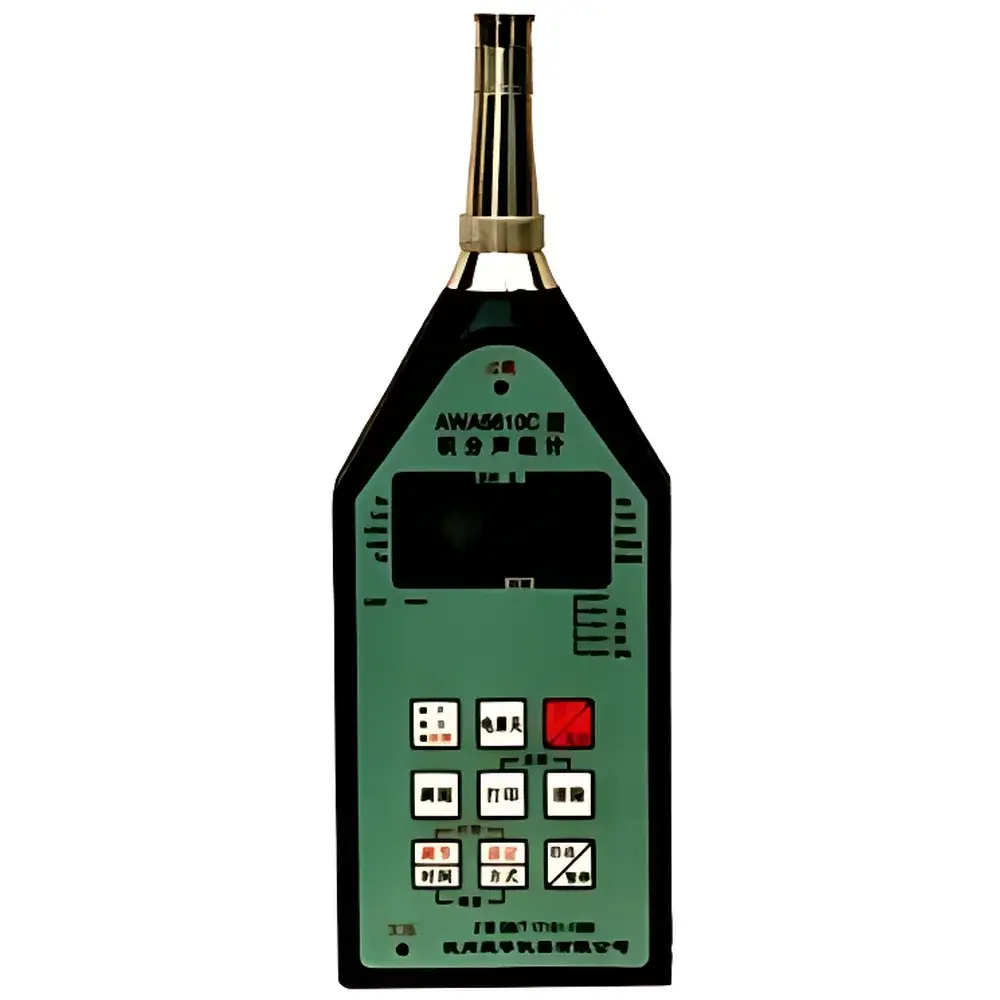
AWA5610C Integrated Sound Level Meter
| Origin | Zhejiang, China |
|---|---|
| Manufacturer Type | Distributor |
| Origin Category | Domestic (China) |
| Model | AWA5610C |
| Pricing | Upon Request |
| Microphone | 1/2″ Electret Condenser, Sensitivity ≈40 mV/Pa |
| Measurement Range | 35–130 dBA (ref. 2×10⁻⁵ Pa) |
| Frequency Range | 20 Hz–12.5 kHz |
| Frequency Weighting | A-weighting |
| Time Weighting | Fast (F), Slow (S) |
| Detector | True RMS, Crest Factor 3 |
| Accuracy Class | IEC 61672 Class 2 |
| Measurement Durations | Manual, 10 s, 1 min, 5 min, 10 min, 20 min, 1 h, 4 h, 8 h, 24 h |
| Display | 4-digit LCD showing Lp, Leq, Lmax, Lmin, Linst, Tm, and real-time calendar/clock |
| Data Storage | 60 measurement records with timestamp, duration, Lmax/Lmin/Leq |
| Output Interface | RS-232C |
| Calibration | 94.0 dB @ 1 kHz (using standard acoustic calibrator) |
| Power Supply | 4×AA alkaline batteries (5#) |
| Dimensions (L×W×H) | 210×72×32 mm |
| Mass | 300 g |
| Compliance | IEC 61672:2002, GB/T 17181–1997 Class 2 |
Overview
The AWA5610C Integrated Sound Level Meter is a compact, microprocessor-controlled instrument engineered for precision environmental and occupational noise assessment in accordance with international electroacoustic metrology standards. Based on true RMS detection and digital signal processing, it delivers stable, repeatable measurements across its full dynamic range (35–130 dBA) with A-frequency weighting and selectable time constants (Fast or Slow). Designed to meet the performance requirements of IEC 61672:2002 Class 2 and GB/T 17181–1997 Class 2, the AWA5610C provides traceable, field-deployable acoustic data suitable for regulatory reporting, workplace compliance verification, and long-term ambient monitoring programs.
Key Features
- True RMS detector with crest factor capability up to 3 — ensures accurate peak and continuous level estimation under non-sinusoidal or impulsive noise conditions.
- Integrated 1/2″ electret condenser microphone (sensitivity ≈40 mV/Pa) with flat frequency response from 20 Hz to 12.5 kHz — optimized for broadband environmental and industrial noise characterization.
- Multi-parameter real-time display: instantaneous sound pressure level (Lp), equivalent continuous sound level (Leq), maximum (Lmax) and minimum (Lmin) levels, and measurement duration (Tm), all synchronized with calendar and clock (year/month/day/hour/minute/second).
- Configurable measurement durations ranging from 10 seconds to 24 hours — supporting short-term spot checks, shift-based exposure evaluation (e.g., 8-hr TWA), and extended environmental baseline studies.
- Onboard storage for 60 complete measurement sessions — each record includes timestamp, duration, Lmax, Lmin, Leq, and user-defined settings — enabling offline audit and retrospective analysis without continuous PC connection.
- RS-232C serial interface compliant with EIA/TIA-232 standards — supports direct data export to PCs or compatible thermal printers (e.g., UP-40TS) for hard-copy reporting in field or lab environments.
- Low-power architecture: powered by four AA alkaline cells (typical operational life >20 h at 25°C) or optional external DC supply (5–6 V), with automatic power-source isolation to prevent backfeed or battery drain during external operation.
Sample Compatibility & Compliance
The AWA5610C is designed for free-field sound pressure measurements in air under standard atmospheric conditions (20 °C, 101.3 kPa, 50% RH). It is not intended for underwater, high-temperature, or explosive atmospheres. Its mechanical design (210 × 72 × 32 mm, 300 g) enables handheld operation, tripod mounting via standard 1/4″–20 UNC thread (adapter required), and integration into fixed monitoring stations using optional enclosures. The instrument complies fully with IEC 61672–1:2002 (Electroacoustics – Sound level meters – Part 1: Specifications) for Class 2 performance, including tolerance limits for frequency weighting, time weighting, linearity, and temperature dependence. It also satisfies GB/T 17181–1997, the Chinese national standard aligned with IEC 61672, ensuring acceptance in domestic regulatory submissions and cross-border technical equivalence assessments.
Software & Data Management
While the AWA5610C operates autonomously without host software, its RS-232C interface permits integration with third-party data acquisition platforms or custom scripts (e.g., Python with pySerial, LabVIEW VIs) for automated logging, time-series visualization, and batch report generation. Measurement records are transmitted in ASCII format with fixed-field delimiters, facilitating import into spreadsheet applications or SQL databases. No proprietary drivers or closed-format binaries are required. For calibration traceability, users must employ an accredited 1 kHz, 94.0 dB sound calibrator (e.g., AWA6221B or equivalent) prior to each measurement session — consistent with ISO 9001 and ISO/IEC 17025 quality system requirements for measurement equipment control.
Applications
- Environmental noise mapping and long-term monitoring near transportation corridors, construction sites, and urban residential zones.
- OHS compliance testing per OSHA 29 CFR 1910.95, EU Directive 2003/10/EC, and China’s GBZ 2.2–2007 occupational exposure limits.
- Product noise certification for appliances, HVAC systems, automotive components, and industrial machinery (preliminary screening prior to formal anechoic chamber testing).
- Educational acoustics laboratories — ideal for student experiments in sound propagation, spectral analysis fundamentals, and noise control principles.
- Community noise complaint investigations requiring portable, court-admissible instrumentation with documented calibration history.
FAQ
What calibration standard is required for traceable measurements?
A 1 kHz, 94.0 dB acoustic calibrator conforming to IEC 60942 Class 2 or better is mandatory before each use; calibration certificate must be current and issued by an ISO/IEC 17025-accredited laboratory.
Can the AWA5610C measure C-weighted or Z-weighted spectra?
No — the AWA5610C implements only A-frequency weighting per its Class 2 designation and firmware architecture. For broadband or low-frequency analysis, a Class 1 meter with multi-weighting capability (e.g., AWA6291) is recommended.
Is the RS-232 output compatible with modern USB-equipped computers?
Yes — via industry-standard USB-to-RS-232 adapters (FTDI or CP2102 chipset-based), provided driver installation and COM port configuration are performed prior to communication.
Does the device support statistical analysis (e.g., L10, L50, L90) or octave band filtering?
No — the AWA5610C computes only integral metrics (Lp, Leq, Lmax, Lmin). Statistical or spectral functions require higher-tier instruments such as the AWA6228+ series or third-party post-processing of raw time-history data.
How often should the microphone be recalibrated?
Annual recalibration by an accredited acoustics laboratory is recommended; more frequent verification (e.g., quarterly) is advised in high-use or harsh-environment deployments.
Related Products







