
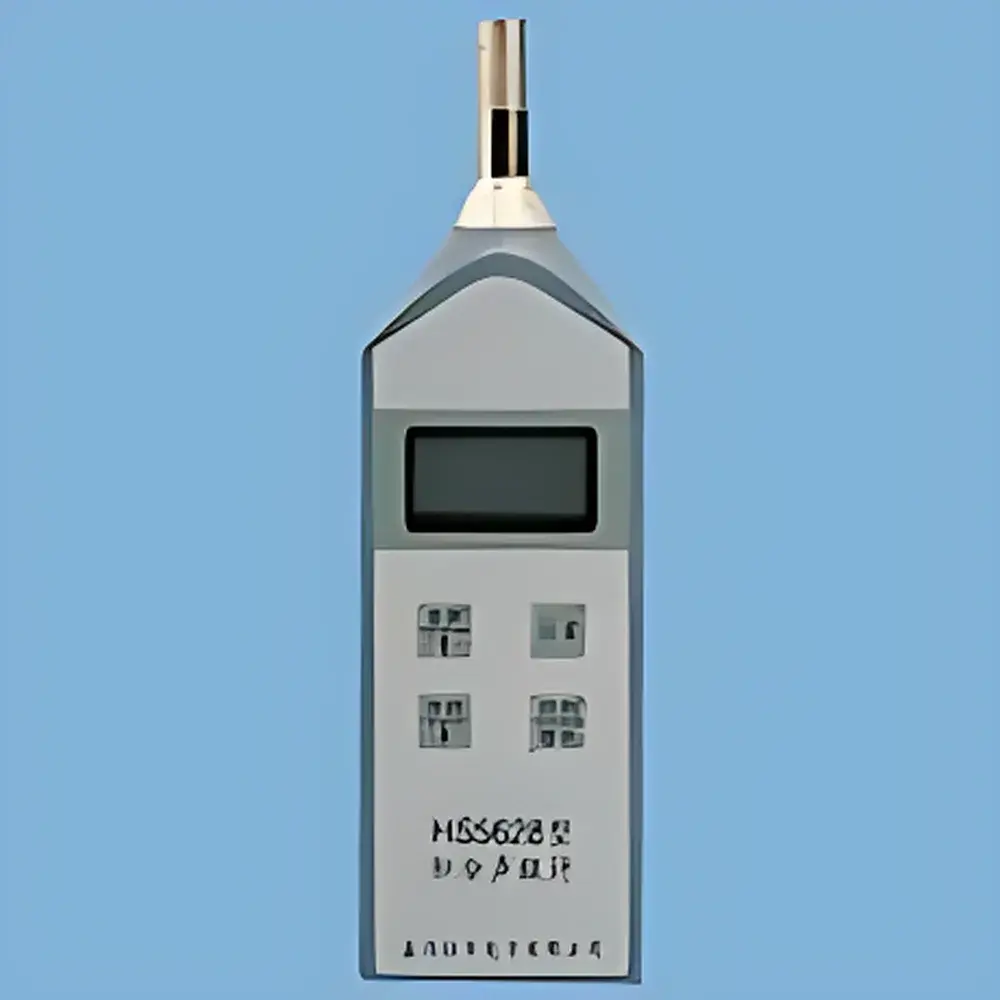
HS5628 Integrated Sound Level Meter
| Origin | Beijing, China |
|---|---|
| Manufacturer Type | Authorized Distributor |
| Origin Category | Domestic (PRC) |
| Model | HS5628 |
| Price Range | USD 280–700 |
| Frequency Range | 20 Hz–10 kHz |
| Sound Pressure Level Range | 30 dB(A) to 130 dB(A) |
| Frequency Weighting | A, C |
| Time Weighting | Fast (F), Slow (S) |
| Detector | Digital True RMS with Peak Factor ≥ 3 |
| Dynamic Range per Range | ≥ 60 dB (High/Mid/Low 3-range auto-switching) |
| Measurement Duration Options | 10 s, 1 min, 5 min, 10 min, 15 min, 20 min, 30 min, 1 h, 8 h, 24 h, Manual |
| Metrics Calculated | L<sub>p</sub>, L<sub>eq</sub>, L<sub>AE</sub>, SD, L<sub>max</sub>, L<sub>min</sub>, E (Sound Exposure) |
| Display | 8×2 dot-matrix LCD |
| AC Output | Yes |
| Power Supply | 2 × AA alkaline batteries |
| Dimensions (L×W×H) | 200 × 62 × 30 mm |
| Mass | 200 g (including batteries) |
| Operating Temperature | –10 °C to +50 °C |
| Relative Humidity Range | 20%–90% RH (non-condensing) |
Overview
The HS5628 Integrated Sound Level Meter is a compact, handheld instrument engineered for precision environmental and occupational noise assessment in accordance with international electroacoustic standards. It operates on the principle of digital true root-mean-square (RMS) detection of sound pressure signals captured by a 1/2″ externally polarized condenser microphone, delivering metrologically traceable measurements compliant with IEC 61672-1:2013 Class 2 requirements and GB/T 3785.2–2010 (Chinese national implementation of IEC 651). Designed for field-deployable reliability, the meter supports time-integrated metrics—including equivalent continuous sound pressure level (Leq), sound exposure level (LAE), and statistical percentiles—enabling quantitative evaluation of noise exposure over defined durations from 10 seconds to 24 hours. Its dual-frequency weighting (A and C), selectable time constants (Fast/Slow), and three-level automatic range switching ensure robust performance across diverse acoustic environments—from urban ambient monitoring to industrial machinery surveys.
Key Features
- Class 2-compliant electroacoustic performance per IEC 61672-1:2013 and GB/T 3785.2–2010
- Digital true RMS detector with peak factor ≥ 3, minimizing waveform distortion errors in impulsive or non-stationary noise
- Three independent measurement ranges (High/Mid/Low), each offering ≥60 dB linear dynamic range and seamless auto-ranging
- Configurable integration periods: 10 s, 1, 5, 10, 15, 20, and 30 minutes; 1, 8, and 24 hours; plus manual mode
- Real-time calculation and display of Lp, Leq, LAE, standard deviation (SD), Lmax, Lmin, and sound exposure (E)
- 8×2 dot-matrix LCD with backlight-independent contrast, optimized for outdoor readability under variable lighting
- AC analog output for connection to external data loggers or oscilloscopes (output impedance: 1 kΩ, nominal level: 1 V RMS full scale)
- Low-power design powered by two standard AA alkaline cells, supporting >15 hours of continuous operation at typical ambient conditions
- Compact form factor (200 × 62 × 30 mm) and lightweight construction (200 g with batteries) for extended handheld use
Sample Compatibility & Compliance
The HS5628 is validated for use with standard 1/2″ free-field response microphones (e.g., Φ12.7 mm electret condenser type) and requires no external preamplifier. It meets the physical and electrical interface specifications outlined in IEC 61094-4 for microphone couplers and is suitable for measurements in open-air, indoor, and semi-enclosed environments where reverberation time is < 2 s. The instrument satisfies regulatory prerequisites for workplace noise monitoring under OSHA 29 CFR 1910.95 and EU Directive 2003/10/EC, provided calibration is performed prior to each measurement campaign using an accredited acoustic calibrator (e.g., 1 kHz, 94 dB or 114 dB reference tone). All firmware and hardware configurations are documented per ISO/IEC 17025:2017 clause 7.7 (traceability of measurements) and support GLP-aligned recordkeeping when paired with external logging systems.
Software & Data Management
While the HS5628 does not include embedded Bluetooth or USB connectivity, its AC output enables analog signal capture by third-party DAQ systems compatible with ±1 V full-scale input. Measurement results are displayed locally and retained in volatile memory only during active operation—no internal storage or timestamped data export is implemented. Users intending to archive time-series data must integrate the meter with external recording hardware and apply post-processing algorithms consistent with ISO 1996-2:2017 (acoustics — description, measurement and assessment of environmental noise). For audit readiness, laboratories should maintain calibration certificates, daily verification logs (using Class 1 calibrator), and operator training records in alignment with ISO/IEC 17025 Clause 6.4 (equipment management).
Applications
- Environmental noise mapping near transportation corridors (roads, railways, airports)
- Occupational health assessments in manufacturing, construction, and warehousing facilities
- Compliance verification against municipal noise ordinances and national emission limits (e.g., China’s GB 12348–2008)
- Pre- and post-mitigation evaluation of noise control interventions (barriers, enclosures, damping treatments)
- Educational demonstrations of sound propagation, frequency weighting effects, and time-averaging principles
- Baseline surveys for environmental impact assessments (EIAs) under ISO 14001 frameworks
FAQ
Is the HS5628 suitable for legal compliance reporting?
Yes—when operated within its specified environmental limits and calibrated before each use with a traceable Class 1 acoustic calibrator, it fulfills technical requirements for Class 2 instrumentation in non-critical regulatory contexts including preliminary workplace assessments and community noise screening.
Does the device support data logging or PC connectivity?
No. The HS5628 provides real-time analog AC output but lacks internal memory, USB, Bluetooth, or serial interfaces. Persistent data capture requires external DAQ hardware.
What is the recommended calibration interval?
Per ISO 9001 and ISO/IEC 17025 best practices, field calibration using a certified acoustic calibrator is required before and after each measurement session; full metrological recalibration by an accredited laboratory is advised every 12 months.
Can the HS5628 measure impulse noise (e.g., gunshots, stamping presses)?
It supports Fast (F) time weighting and true RMS detection with peak factor ≥3, making it appropriate for moderately impulsive events—but not for peak sound pressure level (Lpeak) assessment, which requires Class 1 instrumentation per IEC 61672-1 Annex B.
Is temperature compensation applied automatically?
No. The instrument specifies operational limits (–10 °C to +50 °C), but does not feature active thermal drift correction. Measurements outside 23 ± 5 °C require uncertainty budgeting per GUM (JCGM 100:2008).







