
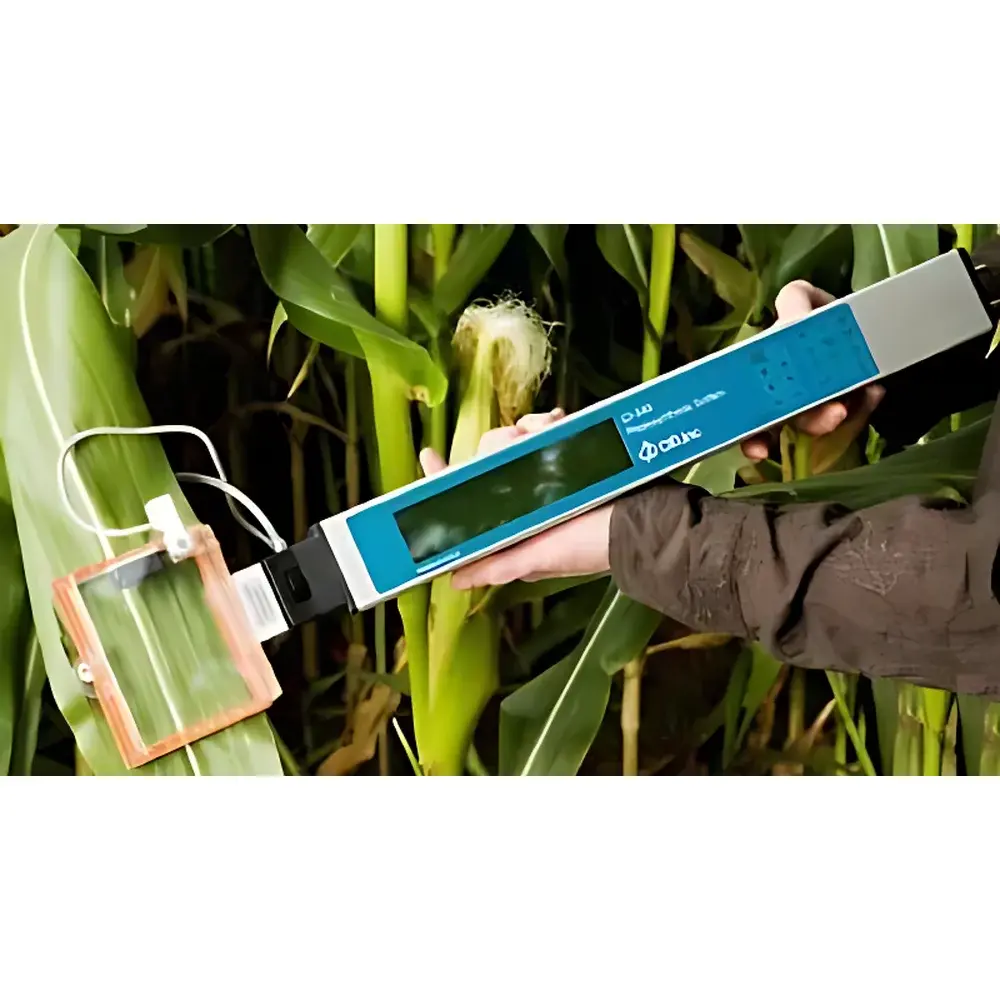
CID CI-340 Portable Photosynthesis Measurement System
| Origin | USA |
|---|---|
| Manufacturer Type | Authorized Distributor |
| Origin Category | Imported |
| Model | CI-340 |
| Pricing | Available Upon Request |
Overview
The CID CI-340 Portable Photosynthesis Measurement System is a field-deployable, handheld instrument engineered for high-fidelity, real-time quantification of plant gas exchange and chlorophyll fluorescence under natural or controlled conditions. Based on the principle of open- and closed-path infrared gas analysis (IRGA), the CI-340 simultaneously measures CO₂ assimilation (A), transpiration rate (E), stomatal conductance (gₛ), intercellular CO₂ concentration (Cᵢ), and water use efficiency (WUE) with minimal system lag—enabled by direct coupling between the leaf chamber and integrated non-dispersive infrared (NDIR) CO₂ and capacitive H₂O analyzers. Its modular architecture integrates all core components—including flow control, data acquisition, power management, and environmental sensing—within a single ergonomic housing (452 × 53 × 48 mm; 1.5 kg with battery), eliminating external tubing, separate controllers, or laptop dependency during operation. Designed for ecological fieldwork, agronomic trials, and physiological phenotyping, the CI-340 supports both steady-state and dynamic response protocols—including light-response (A–PAR), CO₂-response (A–Cᵢ), and temperature-response curves—without requiring post-acquisition calibration or signal synchronization.
Key Features
- Fully integrated handheld platform: All subsystems—NDIR CO₂/H₂O analyzers, mass flow controller (100–1000 cm³/min), PAR sensor (400–700 nm), leaf/air temperature thermocouples (±0.1°C), non-contact infrared leaf temperature sensor (±0.3°C), and 2 MB internal memory—are co-located in one ruggedized unit.
- Dual measurement modes: Supports both open-system (ambient air reference) and closed-system (recirculated air) configurations for flexible experimental design across diverse canopy structures and microclimates.
- Modular environmental control: Optional detachable accessories enable precise manipulation of leaf-level conditions—CI-301LA (red LED illumination, 660 nm ±10 nm, up to 2500 μmol·m⁻²·s⁻¹), CI-301AD (CO₂/H₂O injection via solid CO₂ tablets and humidity generator), CI-510CS (thermoelectric leaf temperature control, ±25°C from ambient), and CI-510CF (pulse-amplitude-modulated chlorophyll fluorescence with saturating flash, 10,000 μmol·m⁻²·s⁻¹).
- Multi-chamber compatibility: Nine standardized leaf chambers (square, rectangular, cylindrical) ranging from 6.25 cm² to 234 cm² window area; plus CI-301SR soil respiration chamber (100 mm diameter) for belowground flux assessment.
- Field-optimized power & interface: Rechargeable 7.2 Ah Li-ion battery enables ≥12 hours of continuous operation; dual connectivity via RS-232 or USB for real-time data streaming and firmware updates; backlit LCD display (320 × 60 pixels) with intuitive menu navigation.
Sample Compatibility & Compliance
The CI-340 accommodates broad taxonomic and morphological diversity—from narrow grass blades and conifer needles to broad dicot leaves and moss mats—via interchangeable chamber geometries and adjustable gasket seals. All sensors comply with ISO 7726 (ergonomics of thermal environments) for temperature measurement traceability and ASTM E2913 (standard practice for spectral responsivity of photosynthetic photon flux sensors). The system’s firmware supports GLP-compliant data logging, including operator ID, timestamp, GPS metadata (when paired with optional external module), and audit-trail-enabled parameter changes—meeting foundational requirements for FDA 21 CFR Part 11–aligned workflows in regulated crop science applications.
Software & Data Management
Data are stored internally in non-volatile memory with time-stamped records (up to 2 million points) and exported as CSV or ASCII files compatible with MATLAB, R, Python (Pandas), and industry-standard statistical packages. CID’s proprietary CI-Analyzer software provides post-processing tools for calculating derived parameters (e.g., quantum yield of PSII, electron transport rate, mesophyll conductance estimation via variable J method), curve fitting (non-rectangular hyperbola, Farquhar-von Caemmerer-Berry model), and batch export for multi-treatment comparisons. All raw sensor outputs—including differential CO₂/H₂O signals, flow rates, and chamber pressure—are retained to support method validation and uncertainty propagation analysis per ISO/IEC 17025 guidelines.
Applications
- Field-based ecophysiology: Diurnal carbon gain modeling, drought stress phenotyping, and climate change impact assessment across forest understories, alpine meadows, and agroecosystems.
- Crop improvement programs: High-throughput screening of photosynthetic efficiency traits (e.g., Vcₘₐₓ, Jₘₐₓ, gₘ) in breeding nurseries under realistic light and vapor pressure deficit gradients.
- Urban vegetation studies: Quantifying stomatal regulation responses to air pollutants (O₃, NO₂) and heat island effects using portable, battery-powered deployment.
- Soil-plant-atmosphere continuum research: Coupled measurements of leaf gas exchange and soil CO₂ efflux (via CI-301SR) to partition ecosystem respiration components.
- Education and training: Undergraduate and graduate laboratory instruction in plant physiology, emphasizing first-principles understanding of diffusion limitations, biochemical constraints, and environmental modulation of photosynthesis.
FAQ
What is the measurement principle behind the CI-340’s CO₂ and H₂O detection?
The system employs non-dispersive infrared (NDIR) absorption spectroscopy for CO₂ and capacitive humidity sensing for H₂O—both calibrated against NIST-traceable standards and validated per ISO 8573-4 for gas analyzer accuracy.
Can the CI-340 operate in extreme environmental conditions?
Yes—the instrument is rated for operation between –5°C and +50°C and 0–100% RH; its shock-resistant housing and vibration-insensitive NDIR optics ensure stable performance during mobile surveys on rough terrain or aboard research vessels.
Is fluorescence measurement synchronized with gas exchange data?
Yes—CI-510CF integrates fiber-optic coupling and hardware-triggered acquisition, ensuring sub-millisecond temporal alignment between chlorophyll fluorescence kinetics (Fo, Fm, Fv/Fm, ΦPSII) and concurrent A/E/gₛ values.
How does the system handle data integrity during extended field deployments?
Internal memory writes data redundantly; power-loss recovery preserves the last 500 records; and optional SD card backup (via USB adapter) supports >1 GB of continuous logging without PC tethering.
Are calibration procedures user-accessible and traceable?
Zero/span calibration routines are embedded in firmware; users may perform two-point CO₂ calibration using certified 0 ppm and 1000 ppm gases; H₂O calibration uses saturated salt solutions per ISO 4885; all calibrations are logged with date/time stamps and operator IDs.





