
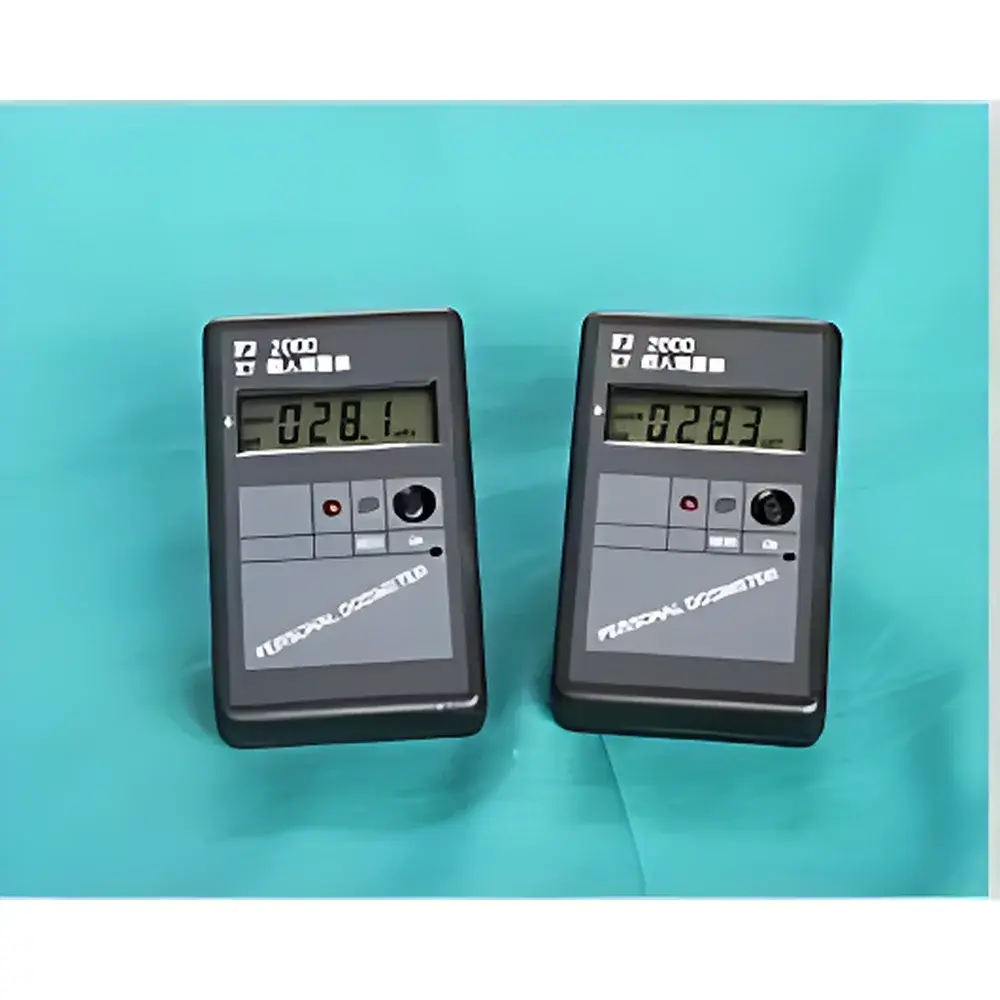
FJ2000 Personal Dosimeter
| Origin | Beijing |
|---|---|
| Manufacturer Type | Distributor |
| Origin Category | Domestic |
| Model | FJ2000 |
| Price Range | USD 1–299 |
| Instrument Class | Dose/Dose Rate Meter |
| Form Factor | Portable |
| Measured Medium | Air (Ambient Radiation Field) |
| Detector Type | Compensated GM Tube |
| Radiation Types | X-ray and Gamma (γ) |
| Dose Range | 0.0 µSv – 99.99 mSv (Hp(10)) |
| Dose Rate Range | 0.1 µSv/h – 99.99 mSv/h (Hp(10)) |
Overview
The FJ2000 Personal Dosimeter is a compact, microprocessor-controlled radiation monitoring instrument engineered for real-time measurement of personal dose equivalent Hp(10) from X-ray and gamma (γ) radiation fields in occupational environments. It operates on the principle of gas ionization detection using a compensated Geiger-Müller (GM) tube—optimized to deliver energy-independent response across a broad photon energy range (50 keV to 1.3 MeV). Designed to meet national standards GB/T 13161–2015 and international reference criteria including IEC 61526:2010 (Radiation protection instrumentation — Measurement of personal dose equivalents Hp(10) and Hp(0.07) for X, gamma, neutron and beta radiations), the device delivers traceable, field-deployable dosimetry without requiring external calibration infrastructure. Its ultra-low power architecture (<2 mW typical current draw) enables continuous operation for up to 720 hours on two AAA alkaline cells—making it suitable for extended shift monitoring in nuclear facilities, radiography labs, radiotherapy departments, and emergency response teams.
Key Features
- Compensated GM detector with energy response deviation ≤±30% over 50 keV–1.3 MeV (referenced to 137Cs)
- Dual-mode display: simultaneous or toggle view of accumulated dose (0.0 µSv–99.99 mSv) and dose rate (0.1 µSv/h–99.99 mSv/h), both reported as Hp(10)
- Programmable audio-visual alarm system with three independent thresholds: cumulative dose (≥50 µSv), dose rate (≥25 µSv/h), and detector saturation/blockage
- High electromagnetic immunity (EMI-resistant design per IEC 61000-4 series), validated for use near high-frequency industrial equipment and MRI suites
- Robust environmental tolerance: operational within −10 °C to +50 °C and 0–95% RH (at +35 °C), with thermal drift ≤±10% and humidity-induced error ≤±10%
- Compact form factor (55 × 92 × 18 mm) and lightweight construction (<75 g without batteries; <98 g fully equipped), optimized for belt-clip or pocket wear
Sample Compatibility & Compliance
The FJ2000 is intended for direct measurement of ambient photon radiation fields in air—requiring no sample preparation or media insertion. It responds to unshielded X- and γ-emitting isotopes including 137Cs, 60Co, and 192Ir, and is routinely deployed in accordance with ALARA (As Low As Reasonably Achievable) protocols. The instrument complies with Chinese national standard GBZ 128–2019 (Occupational Health Standard for Personal Monitoring of External Radiation) and aligns with ISO 4037-3:2019 for reference radiation field characterization. While not certified for FDA 21 CFR Part 11 or EU MDR, its audit-ready data logging behavior (including timestamped alarm events and battery status flags) supports GLP-aligned recordkeeping in regulated QA/QC workflows.
Software & Data Management
The FJ2000 operates as a standalone, embedded-system dosimeter with no onboard Bluetooth, USB, or wireless interface. All measurement data—including cumulative dose, dose rate snapshots, alarm timestamps, and low-battery indicators—are retained in non-volatile memory and displayed locally via a 4-digit LCD. No proprietary software or driver installation is required. For enterprise-level dose registry integration, users may manually transcribe readings into LIMS or radiation safety management platforms (e.g., RadPro, DOSIS, or custom Excel-based tracking templates). The device includes built-in audit trail elements: “LOBAT” indicator for voltage <2.7 V ±0.05 V, “ALARM” flag persistence during blockage events, and audible pulse feedback per 0.1 µSv increment—enabling verifiable operator awareness without digital dependency.
Applications
- Radiation protection monitoring for personnel in industrial radiography (NDT), especially during pipeline weld inspection and aerospace component testing
- Real-time dose oversight for maintenance technicians entering controlled areas of nuclear power plants or research reactors
- Supplemental dosimetry for staff in diagnostic imaging departments (X-ray rooms, CT control booths) and teletherapy units (e.g., cobalt-60 units)
- First-responder readiness kits for civil defense, HAZMAT teams, and border radiation screening operations
- Field validation of shielding integrity during decommissioning projects or radioactive waste handling procedures
FAQ
What radiation types does the FJ2000 detect?
It is calibrated and optimized for X-ray and gamma (γ) photons only. It does not measure alpha, beta, or neutron radiation.
Is the FJ2000 suitable for use in high-humidity environments?
Yes—its humidity-related measurement error remains ≤±10% at up to 95% relative humidity (measured at +35 °C), making it appropriate for tropical or indoor humidified facilities.
How is calibration traceability established?
The instrument is factory-calibrated against national primary standards maintained by CNIM (China National Institute of Metrology) or accredited third-party laboratories per JJG 393–2021. End-user recalibration is recommended annually or after physical impact.
Does the device support data export?
No—data output is visual only. Users must manually record values or integrate readings into external reporting systems.
What is the battery life under typical use conditions?
With two AAA alkaline cells and average background exposure (<0.2 µSv/h), continuous operation exceeds 720 hours (~30 days); battery voltage monitoring is provided via the “LOBAT” display flag.







