
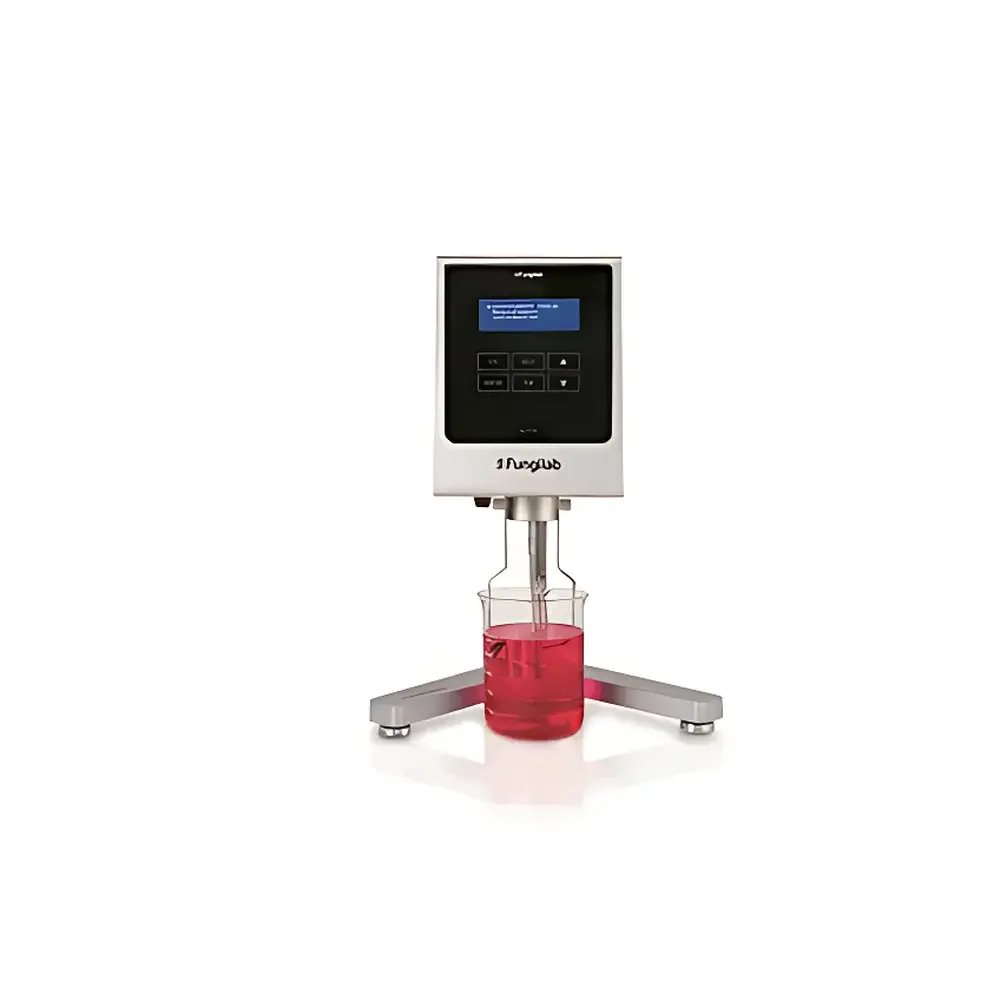
Fungilab Viscolead Adv Series Rotational Viscometer
| Origin | Spain |
|---|---|
| Manufacturer Type | Authorized Distributor |
| Origin Category | Imported |
| Model | Viscolead Adv Series |
| Instrument Type | Rotational Viscometer |
| Viscosity Range | 20–106,000,000 cP |
| Repeatability | ±0.2% |
| Accuracy | ±1% of full scale |
| Viscosity Resolution | 0.01 cP (with LCP adapter, <1000 cP) |
| Temperature Range | 0–100 °C |
| Temperature Resolution | 0.1 °C |
| Temperature Accuracy | ±0.1 °C |
| Temperature Sensor | PT100 |
| Power Supply | 100–240 VAC, 50/60 Hz |
| Speed Range | 0.3–100 rpm (18 speeds) |
| Data Logging | USB export to Excel via Datalogger software |
| Calibration | User-definable viscosity & temperature calibration |
| Language Support | 10 languages including English, German, French, Spanish, Chinese, etc. |
| Compliance | Designed for GLP/GMP environments |
Overview
The Fungilab Viscolead Adv Series Rotational Viscometer is an engineered solution for precise, repeatable measurement of dynamic viscosity in laboratory and quality control environments. Based on the Couette principle—where torque generated by a rotating spindle immersed in a fluid is directly proportional to its shear stress—the instrument delivers reliable rheological data across a broad operational range. Its modular design accommodates three interchangeable spindle configurations (L-, R-, and H-series), enabling seamless transition from low-viscosity liquids (e.g., solvents, coatings, pharmaceutical suspensions) to highly viscous materials (e.g., adhesives, mastics, polymer melts). The Viscolead Adv operates under controlled shear conditions, supporting both steady-state and time-dependent viscosity assessments essential for formulation development, process validation, and regulatory compliance.
Key Features
- Triple-spindle compatibility (L/R/H series) with automatic range calculation—users select spindle and speed; the system computes maximum measurable viscosity in real time.
- Integrated PT100 temperature probe with ±0.1 °C accuracy ensures thermal stability critical for temperature-sensitive fluids (e.g., hydrogels, edible oils, resins).
- Onboard data logging with customizable intervals; raw measurements—including rpm, torque %, viscosity (cP/mPa·s), shear stress (N/m²), shear rate (s⁻¹), and temperature—are exportable via USB to Excel-compatible .csv files.
- Ten programmable measurement protocols support TTT (Torque Termination Threshold) and TTS (Time Termination Setting) modes—ideal for QC batch testing or comparative rheological screening.
- Self-diagnostic routine with audible and visual alerts verifies sensor integrity, motor function, and thermal calibration prior to operation.
- Multi-language interface (10 options, including English, Spanish, German, and Chinese) and intuitive icon-driven navigation reduce operator training time and minimize input errors.
- Stainless steel (AISI 316) spindles and protective legs ensure corrosion resistance and mechanical durability in aggressive chemical environments.
Sample Compatibility & Compliance
The Viscolead Adv supports diverse sample geometries and volumes through optional accessories: the APM micro-volume adapter (as low as 2 mL), LCP low-viscosity adapter (for sub-10 cP fluids), and Heldal high-viscosity unit (for non-Newtonian pastes >10⁶ cP). All standard spindles conform to ISO 2555 and ASTM D2196 specifications for geometry and dimensional tolerances. When paired with traceable calibration standards and operated under documented procedures, the system meets GLP requirements and supports 21 CFR Part 11 compliance—particularly when using the Datalogger software with enabled electronic signatures, audit trails, and user access controls. Temperature-controlled water baths (sold separately) extend applicability to ISO 7305 and USP viscosity testing protocols.
Software & Data Management
The included Datalogger software provides secure, timestamped acquisition of viscosity-time-temperature profiles over user-defined durations. It enables post-acquisition curve fitting (e.g., Newtonian slope analysis), statistical reporting (mean, SD, CV%), and direct export to Excel or PDF for inclusion in technical reports or regulatory submissions. Raw data files retain metadata—including operator ID, calibration date, spindle ID, ambient conditions, and firmware version—ensuring full traceability. Optional integration with LIMS platforms is supported via CSV schema mapping. Software updates are distributed through Fungilab’s authorized channel and include version-controlled release notes aligned with IEC 62304 medical device software lifecycle standards.
Applications
- Pharmaceutical: Viscosity profiling of ophthalmic solutions, syrups, and topical gels per USP ; excipient compatibility studies.
- Food & Beverage: Consistency evaluation of sauces, dairy products, and plant-based alternatives under varying shear rates.
- Paints & Coatings: Flow behavior assessment during application simulation (e.g., brushing, spraying) and shelf-life stability monitoring.
- Chemicals & Polymers: Quality assurance of resins, adhesives, and elastomer precursors; correlation with molecular weight distribution.
- Academic Research: Teaching fundamental rheology concepts and validating constitutive models (e.g., Power Law, Bingham Plastic) in undergraduate and graduate labs.
FAQ
What spindle configuration should I select for my sample?
Select L-series for low-viscosity Newtonian fluids (1,000,000 cP). Always verify spindle immersion depth and container geometry per ISO 2555.
Can I measure kinematic viscosity (cSt) directly?
Yes—kinematic viscosity is calculated internally when user-input density (g/cm³) is entered prior to measurement. Dynamic viscosity (cP) is measured first; cSt = cP / density.
Is temperature control mandatory for accurate results?
Temperature significantly affects viscosity—especially for polymers and biological fluids. While ambient measurements are possible, reproducible results require active temperature stabilization via PT100 feedback and external bath integration.
How often does the system require recalibration?
Annual verification against NIST-traceable silicone oil standards is recommended. Field calibration of viscosity and temperature is user-accessible via the front-panel menu using certified reference materials.
Does the Viscolead Adv support GMP documentation requirements?
Yes—when used with validated Datalogger software, electronic records include operator authentication, change history, and immutable timestamps, fulfilling core elements of FDA 21 CFR Part 11 and EU Annex 11 for regulated environments.



