
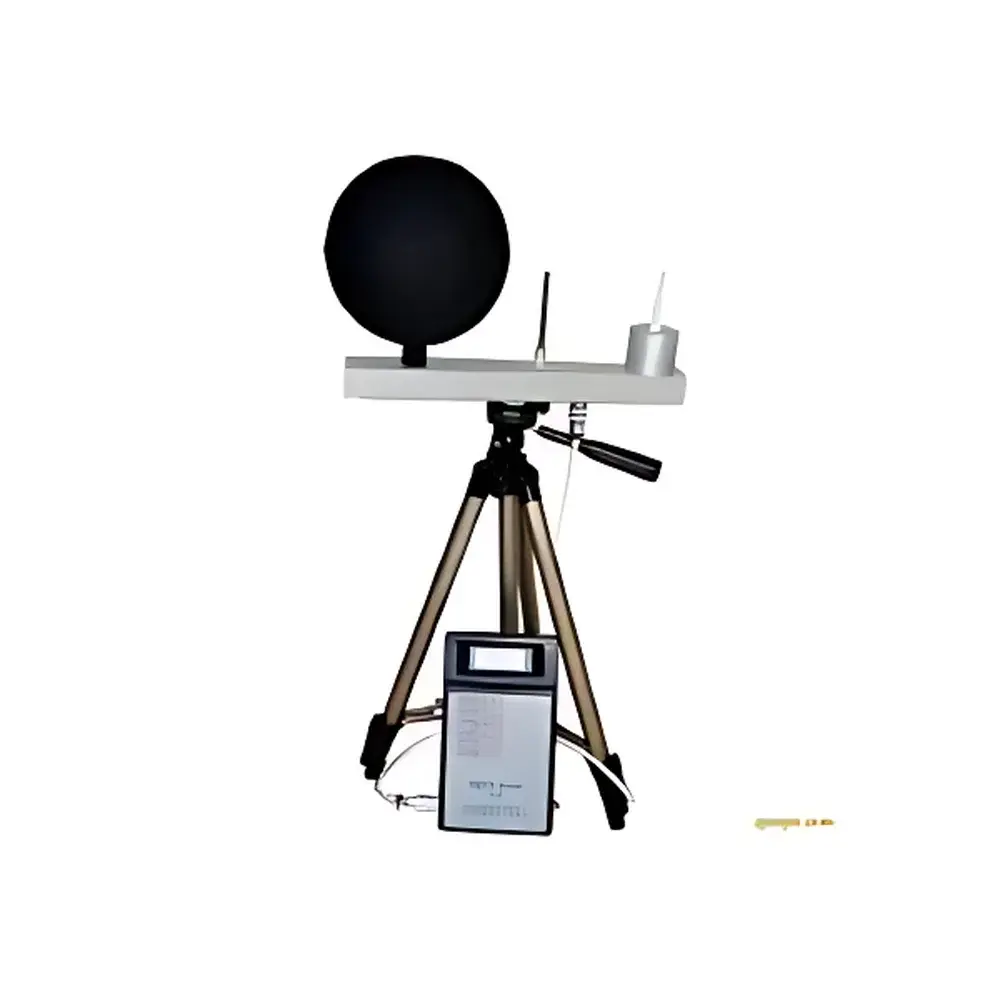
WBGT-2006 Wet-Bulb Globe Temperature (WBGT) Heat Stress Index Meter
| Origin | Beijing, China |
|---|---|
| Manufacturer Type | Authorized Distributor |
| Origin Category | Domestic (PRC) |
| Model | WBGT-2006 |
| Pricing | Upon Request |
| Dry-Bulb Range | 10–60 °C (±0.5 °C) |
| Natural Wet-Bulb Range | 5–40 °C (±0.5 °C) |
| Black Globe Range | 20–120 °C (±0.5 °C @ 20–50 °C |
| Globe Diameter | 150 mm |
| Globe Emissivity | ≥0.95 (matte black surface) |
| Wet-Bulb Sensor | Cylindrical, Ø6 ±1 mm × L30 ±5 mm |
| Data Logging Duration | Up to 100 hours |
| Interface | USB 2.0 |
| Display | Full Chinese GUI |
| Compliance | GB/T 4200–1997, ISO 7243:1989 |
Overview
The WBGT-2006 Wet-Bulb Globe Temperature (WBGT) Heat Stress Index Meter is an industrial-grade environmental monitoring instrument engineered for quantitative assessment of thermal stress in occupational settings. It implements the internationally standardized WBGT index—a composite metric derived from three physically distinct temperature measurements: natural wet-bulb temperature (Tnwb), black globe temperature (Tg), and dry-bulb (ambient air) temperature (Ta). The instrument computes the WBGT index in real time using the ISO 7243:1989 formula: WBGT = 0.7×Tnwb + 0.2×Tg + 0.1×Ta (for outdoor environments with solar load) or WBGT = 0.7×Tnwb + 0.3×Tg (for indoor or shaded conditions). Designed for continuous deployment in manufacturing plants, foundries, power generation facilities, and logistics hubs, the WBGT-2006 supports long-term heat exposure evaluation across full work shifts—aligning with physiological heat strain thresholds defined in occupational hygiene frameworks.
Key Features
- Triple-sensor architecture with independently calibrated dry-bulb, natural wet-bulb, and 150-mm matte-black globe thermometers—each optimized per ISO 7243 geometric and emissivity requirements (ε ≥ 0.95)
- Digital temperature sensing with direct digital signal output, eliminating analog drift and enabling stable ±0.5 °C accuracy across critical ranges (10–60 °C for dry-bulb; 5–40 °C for wet-bulb; 20–50 °C for globe)
- Integrated data logger with non-volatile memory supporting up to 100 hours of timestamped, multi-parameter recording at user-selectable intervals (1–60 min)
- USB 2.0 interface compliant with Windows-based analysis software for post-acquisition processing—including max/min/mean calculation over arbitrary time windows, trend visualization, and export to CSV/Excel
- Full Chinese graphical user interface with real-time simultaneous display of all four primary parameters: Ta, Tnwb, Tg, and computed WBGT value
- Ruggedized enclosure rated for industrial ambient operation (temperature: −10 °C to +50 °C; relative humidity: 10–95% RH non-condensing)
Sample Compatibility & Compliance
The WBGT-2006 is validated for use in static and low-air-velocity environments typical of indoor industrial workplaces (e.g., metal casting, glass manufacturing, boiler rooms) and outdoor operations under moderate solar irradiance. Its natural wet-bulb sensor conforms to ISO 7243 specifications: cylindrical geometry (Ø6 ±1 mm, L30 ±5 mm), cotton wick hydration protocol, and passive ventilation. The 150-mm black globe meets thermal mass and surface emissivity criteria required for accurate mean radiant temperature (MRT) estimation. The instrument is type-approved per GB/T 4200–1997 “Grading of Hot Work” and fully implements the calculation methodology and reporting structure mandated by ISO 7243:1989. It supports compliance documentation for occupational health audits under China’s GBZ 2.1–2019 (Occupational Exposure Limits for Hazardous Agents) and aligns with ACGIH TLV® and NIOSH REL frameworks for heat stress surveillance.
Software & Data Management
The included PC application software provides secure, traceable data handling for regulatory reporting. Raw logged data are stored with embedded timestamps, sensor IDs, and unit metadata. Software functions include batch statistical analysis (min/max/mean/std dev), customizable time-window slicing, overlay plotting of all four parameters, and automated WBGT threshold alerting (e.g., >28 °C for moderate work intensity). Audit trails record all user actions—including data export, parameter modification, and calibration log entries—supporting GLP-aligned workflows. While not FDA 21 CFR Part 11 certified out-of-the-box, the software architecture permits integration with enterprise validation protocols via configurable electronic signature modules and encrypted database logging.
Applications
- Real-time heat stress monitoring during shift rotations in steel mills, cement kilns, and asphalt paving operations
- Validation of engineering controls (e.g., local exhaust ventilation, radiant barrier installation) per OSHA Technical Manual Chapter 3
- Baseline thermal hazard assessment for Job Safety Analysis (JSA) and Permit-to-Work systems
- Supporting medical surveillance programs by correlating WBGT exposure duration with physiological endpoints (e.g., core temperature rise, heart rate variability)
- Field verification of HVAC performance in warehouse distribution centers during summer peak loads
- Academic research on thermal comfort indices in semi-industrial microclimates (e.g., urban logistics nodes, agricultural processing sheds)
FAQ
What standards does the WBGT-2006 comply with?
It is designed and verified to meet GB/T 4200–1997 and ISO 7243:1989 requirements for WBGT measurement methodology, sensor geometry, and index computation.
Can the instrument be used outdoors under direct sunlight?
Yes—its black globe sensor is calibrated for solar-loaded conditions; the standard outdoor WBGT formula (0.7Tnwb + 0.2Tg + 0.1Ta) is applied automatically when ambient UV indicators exceed predefined thresholds.
Is calibration traceable to national standards?
The device ships with a factory calibration certificate referencing CNAS-accredited reference standards; field recalibration services are available through authorized service centers with NIM-traceable equipment.
Does the software support multi-user access control?
The current version operates in single-user mode; however, exported datasets are compatible with LIMS platforms supporting role-based permissions and hierarchical audit trails.
How often should the wet-bulb wick be replaced?
Per ISO 7243, the cotton wick must be replaced before each measurement session or after 4 hours of continuous use—whichever occurs first—to ensure evaporative integrity and measurement repeatability.







