
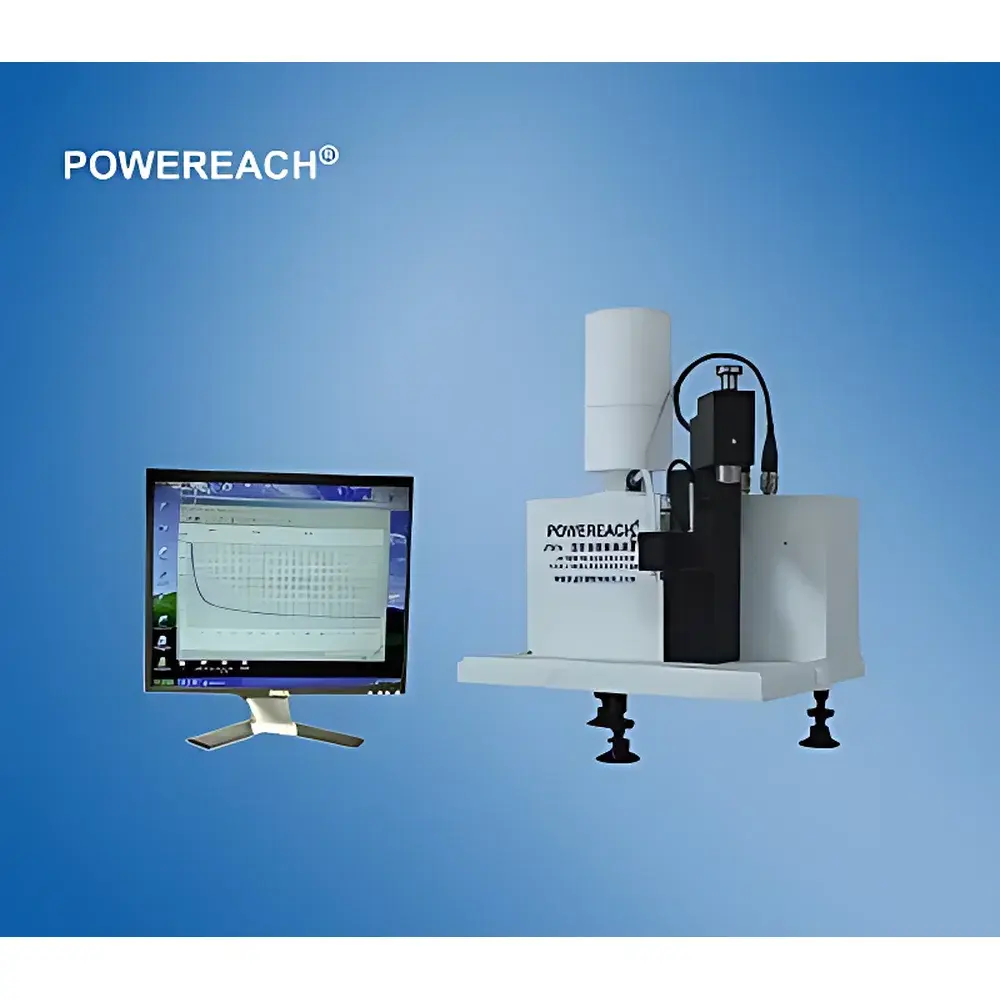
JF99A Powder Contact Angle Analyzer
| Origin | Beijing, China |
|---|---|
| Manufacturer Type | Authorized Distributor |
| Origin Category | Domestic (PRC) |
| Model | JF99A |
| Pricing | Upon Request |
| Measurement Principle | Washburn Capillary Rise Method |
| Pressure Range | 0–330 mbar |
| Pressure Resolution | 0.16 mbar |
| Operating Temperature | Ambient |
| Quartz Tube Dimensions | OD 10 mm |
| Instrument Dimensions | 295 × 240 × 260 mm |
| Power Supply | 220 V AC, 20 W |
| Optional Accessory | JYF08 Automated Powder Packing Station (programmable tapping cycles, real-time counter, uniform mechanical compaction) |
Overview
The JF99A Powder Contact Angle Analyzer is a dedicated instrumentation system engineered for the quantitative determination of apparent contact angles on powdered and granular solid materials—where conventional sessile-drop or captive-bubble methods are inapplicable due to surface heterogeneity, porosity, and lack of macroscopic planarity. Unlike solid-surface contact angle measurement, powder systems require indirect thermodynamic inference based on capillary-driven liquid penetration kinetics. The JF99A implements the Washburn equation—a fundamental relationship derived from Poiseuille flow theory and Young–Laplace capillary pressure balance—to calculate the equilibrium contact angle θ from time-resolved pressure differentials during spontaneous liquid ingress into a consolidated powder bed. This method is widely accepted in colloid science, pharmaceutical formulation development, catalyst characterization, and mineral processing for assessing wettability, surface energy heterogeneity, and interfacial affinity under controlled packing density.
Key Features
- Washburn-based capillary rise quantification with high-resolution differential pressure transduction (0.16 mbar resolution over 0–330 mbar range)
- Dual-diameter quartz capillary tubes (ID 6 mm and 8 mm) enabling comparative analysis across pore-size distributions and minimizing wall-effect bias
- Integrated real-time density validation protocol: automatic generation of linearized ln(t) vs. h² plot upon “Measure” command; deviation from linearity indicates insufficient or excessive powder bed compaction
- Compact benchtop architecture (295 × 240 × 260 mm) with low power consumption (20 W, 220 V AC), suitable for regulated laboratory environments including QC labs operating under GLP conditions
- Modular compatibility with the optional JYF08 Automated Powder Packing Station, which replicates standardized manual tapping protocols via programmable mechanical impact cycles and live step counting—ensuring inter-operator reproducibility in bed density preparation
Sample Compatibility & Compliance
The JF99A accommodates free-flowing, cohesive, and slightly agglomerated powders—including APIs, excipients, metal oxides, ceramic precursors, activated carbons, and soil simulants—with particle size distributions typically ranging from 1 µm to 500 µm. Sample mass requirements are minimal (typically 0.5–2 g per test), reducing material consumption during screening. While the instrument itself does not carry formal ISO/IEC 17025 certification, its Washburn methodology aligns with ASTM D7484–19 (Standard Test Method for Determination of Wettability of Powders by Capillary Rise) and supports traceable data acquisition workflows compliant with FDA 21 CFR Part 11 when paired with validated electronic lab notebook (ELN) integration. All quartz components meet USP and ISO 8536-1 specifications for optical clarity and chemical inertness.
Software & Data Management
Data acquisition is managed via embedded firmware with USB interface support for external PC logging. Real-time pressure vs. time curves are plotted in native coordinate space; the system automatically computes the slope of the linear region in the Washburn-transformed plot (h² vs. t), from which contact angle is derived using the calibrated capillary constant and known liquid surface tension (γLV) and viscosity (η). Raw datasets export in CSV format for post-processing in MATLAB, Python (SciPy/Pandas), or statistical platforms such as JMP or Minitab. Audit trails—including operator ID, timestamp, tube ID, ambient temperature annotation, and packing validation status—are retained in non-erasable memory, supporting GMP-aligned documentation practices.
Applications
- Pharmaceutical R&D: Quantifying wetting behavior of active pharmaceutical ingredients (APIs) and excipients during wet granulation process design
- Materials Science: Evaluating surface modification efficacy (e.g., silanization, plasma treatment) on nanoparticle dispersions prior to composite fabrication
- Geotechnical Engineering: Assessing clay mineral hydrophobicity relevant to soil water retention modeling and contaminant transport prediction
- Battery Electrode Development: Characterizing carbon black or LiCoO₂ powder wettability with carbonate-based electrolytes to optimize slurry rheology and electrode homogeneity
- Food Science: Investigating starch or protein powder hydration kinetics for functional ingredient selection in dry-mix formulations
FAQ
What liquids are compatible with the Washburn method on the JF99A?
Commonly used probe liquids include n-hexadecane, diiodomethane, ethylene glycol, and water—each selected based on known surface tension and polarity to enable surface energy component analysis via Owens–Wendt or van Oss approaches.
Why is powder bed density critical to measurement validity?
Capillary radius distribution—and thus the effective hydraulic permeability—is highly sensitive to interparticle void fraction; deviations from optimal density introduce systematic error in the Washburn slope interpretation and invalidate θ calculation.
Can the JF99A be used for hydrophobic powder quantification?
Yes—contact angles >90° are reliably resolved through negative capillary pressure signatures and appropriate reference liquid selection (e.g., high-surface-tension polar liquids against low-energy surfaces).
Is calibration traceable to national standards?
Pressure transducer calibration is performed using NIST-traceable deadweight testers; users receive a calibration certificate valid for 12 months, with field verification possible using certified reference manometers.
Does the system support multi-liquid sequential testing?
Yes—quartz tubes are easily cleaned and dried between runs; full method revalidation (including packing density check) is recommended before each new liquid to ensure consistent bed morphology.



