
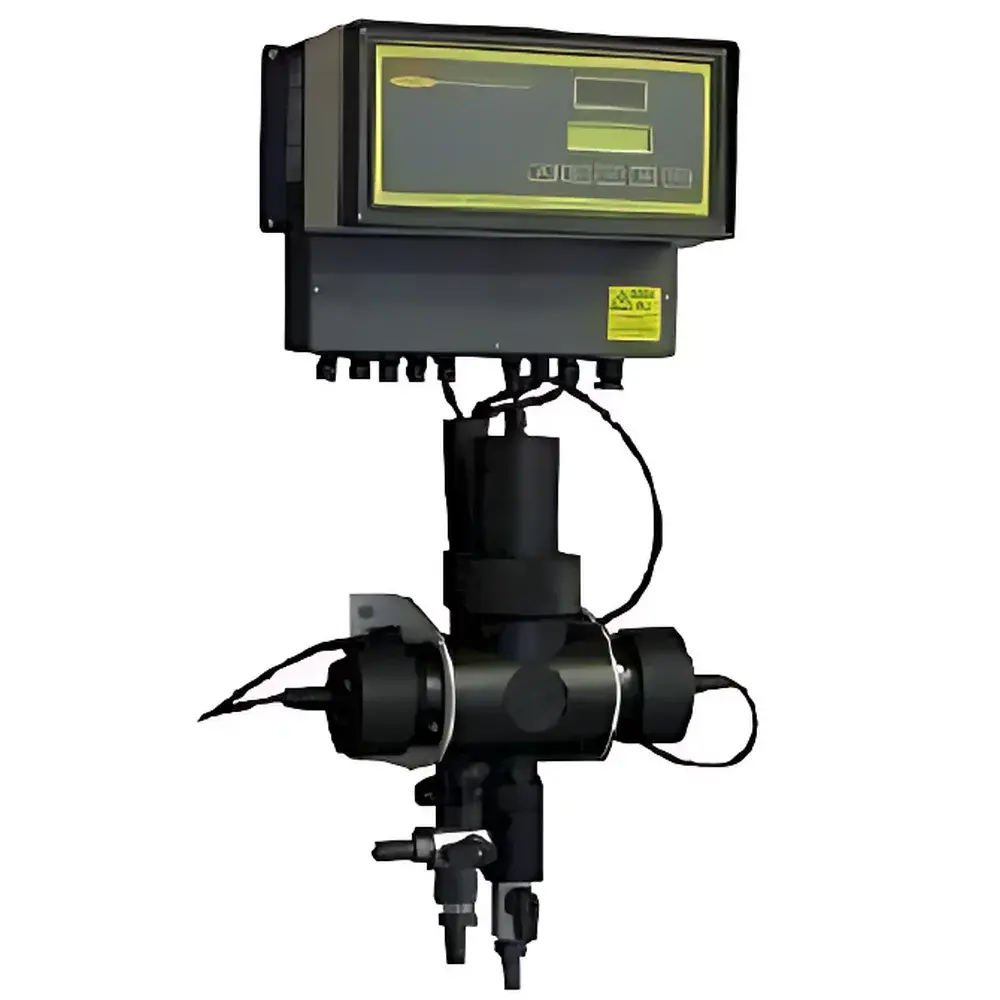
WaterWatch2970 Online Colorimeter
| Origin | UK |
|---|---|
| Manufacturer Type | Distributor |
| Origin Category | Imported |
| Model | WaterWatch2970 |
| Price | Upon Request |
| LED Wavelength | 460 nm |
| Optical Stability | High long-term stability under varying environmental conditions |
| Instrument Weight | 2.0 kg |
| Instrument Dimensions | 222 mm × 310 mm × 180 mm |
| Instrument IP Rating | IP65 |
| Instrument Housing Material | ABS |
| Cable Entries | 5 × M13 + 1 × M20 |
| Probe Weight | 4.5 kg |
| Probe Dimensions | 440 mm × 325 mm × 225 mm |
| Probe IP Rating | IP68 |
| Probe Housing Material | ABS |
| Operating Temperature | −0 °C to +60 °C |
| Storage Temperature | −20 °C to +60 °C |
| Installation Environment | Indoor or outdoor |
| Power Supply | 115/230 VAC ±10/−15% |
| Power Consumption | 11 W |
| Analog Output | Isolated 4–20 mA, max. load resistance 750 Ω |
| Relay Outputs | 3 relays (2 process alarms: high/low |
| Alarm Range Adjustment | 0–100% of sensor full scale |
| Communication Interface | RS232 |
Overview
The WaterWatch2970 Online Colorimeter is an industrial-grade, continuous-monitoring instrument engineered for precise, real-time measurement of color (expressed as Platinum-Cobalt or Hazen units) in water and wastewater streams. It operates on the principle of single-wavelength absorbance photometry at 460 nm—a wavelength selected for optimal sensitivity to yellow-hue coloration commonly associated with organic contaminants, humic substances, and industrial effluents. Unlike benchtop colorimeters requiring manual sampling and calibration, the WaterWatch2970 integrates a flow-through optical cell directly into process lines, enabling uninterrupted in-situ analysis without sample diversion or dilution. Its robust optical architecture—featuring a temperature-stabilized LED light source and matched photodetector—ensures metrological consistency across fluctuating ambient temperatures, pressure, and vibration typical in municipal and industrial settings. Designed for unattended operation over extended intervals, the instrument complies with fundamental performance expectations outlined in ISO 7887 (Water quality — Determination of colour) and supports traceable data acquisition aligned with laboratory-grade reference methods.
Key Features
- Stable 460 nm LED light source with drift-compensated intensity control, delivering <1.5% signal variation over 12 months under continuous operation
- Integrated automatic cleaning module compatible with standard air-pulse or mechanical wiper systems, minimizing fouling-induced measurement drift in turbid or biofouling-prone applications
- Dual-enclosure design: IP65-rated main analyzer unit for wall or panel mounting; IP68-rated submersible probe for direct insertion into open channels, wet wells, or pressurized pipes
- Low-power consumption (11 W) and dual-voltage compatibility (115/230 VAC) support deployment in remote or energy-constrained infrastructure sites
- Isolated 4–20 mA analog output with user-configurable scaling and full-scale range adjustment (0–100%), compliant with IEC 61000-6-2/6-4 EMC standards
- Three programmable relay outputs—two dedicated to process high/low limit alarms, one reserved for system fault notification—each rated for 5 A switching capacity at common industrial voltages
Sample Compatibility & Compliance
The WaterWatch2970 is validated for use with clarified and moderately turbid aqueous matrices, including drinking water, surface water, treated effluent, and cooling tower make-up. It is not intended for highly suspended solids (>100 mg/L SS), viscous fluids, or chemically aggressive media without appropriate pre-filtration or conditioning. The optical path length and spectral bandwidth are optimized to minimize interference from common interferents such as nitrate (at 460 nm), chloride, and low-concentration iron. While not certified to EN 14181 (QAL3) or US EPA Method 180.1 per se, its measurement principle and repeatability (±2 PCU at 20 PCU, based on factory verification against NIST-traceable standards) meet the technical thresholds required for compliance monitoring under EU Urban Wastewater Treatment Directive Annex I and USEPA NPDES permit reporting frameworks. Data integrity is supported through timestamped RS232 serial logging, enabling integration with SCADA or LIMS platforms that enforce audit trails per 21 CFR Part 11 requirements.
Software & Data Management
Data acquisition and configuration are managed via ASCII-based command protocol over RS232 serial interface—designed for seamless integration with programmable logic controllers (PLCs), distributed control systems (DCS), or custom HMI software. No proprietary driver or closed-source firmware is required; all parameters—including zero/span calibration points, alarm thresholds, relay hysteresis, and output scaling—are adjustable using standardized AT-style commands. Raw absorbance values, calculated color units, and diagnostic status flags (e.g., lamp health, cleaning cycle counter, temperature deviation) are transmitted at user-defined intervals (default: 10 s). For facilities requiring electronic record retention, the device supports time-synchronized data export to CSV-compatible formats when interfaced with external data loggers compliant with GLP/GMP metadata tagging conventions.
Applications
- Real-time color monitoring at drinking water treatment plant final effluent points to verify compliance with WHO and national aesthetic guidelines (e.g., ≤15 PCU)
- Early detection of upstream contamination events (e.g., tannin leaching, industrial dye discharge) in raw water intakes
- Performance validation of activated carbon or ozone-based color removal units in advanced treatment trains
- Process optimization of coagulation-flocculation stages by correlating color reduction with dosing rates and jar test results
- Regulatory reporting for municipal wastewater dischargers subject to color-based discharge limits under local environmental codes
FAQ
What calibration standards are recommended for field verification?
NIST-traceable liquid color standards (e.g., StablCal® PCU solutions) spanning 5–100 PCU are recommended for periodic verification. Factory calibration is performed using primary reference materials traceable to UK National Physical Laboratory (NPL) standards.
Can the probe be installed in pressurized pipelines?
Yes—the IP68-rated probe is rated for continuous submersion up to 10 m water column equivalent pressure and may be mounted in-line via flanged or threaded adapters (DN50–DN150); pressure-rated gaskets and isolation valves are required for maintenance access.
Is routine maintenance required beyond the automatic cleaning cycle?
Annual inspection of optical windows for micro-scratches or persistent residue, verification of LED output intensity, and validation of analog output linearity constitute the manufacturer-recommended preventive maintenance schedule.
Does the instrument support Modbus RTU or other industrial protocols?
No native Modbus implementation is included; however, third-party protocol converters (RS232-to-Modbus RTU) are widely deployed in operational environments to enable DCS integration without firmware modification.




