
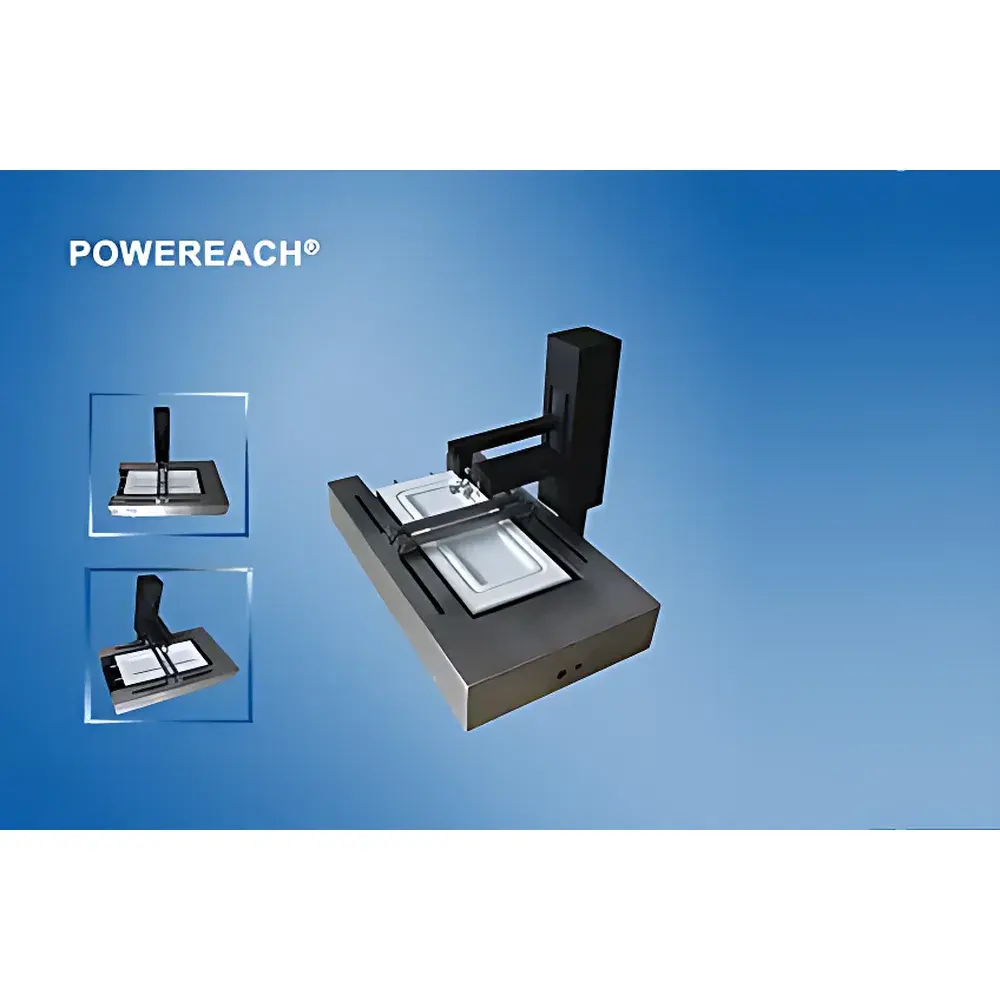
SCI300C2 Langmuir-Blodgett Trough System with Wilhelmy Plate Surface Tensiometry
| Origin | Beijing, China |
|---|---|
| Manufacturer Type | Authorized Distributor |
| Origin Category | Domestic (PRC) |
| Model | SCI300C2 |
| Price Range | USD 14,000 – 28,500 |
| Surface Tension Range | 0–150 mN/m |
| Resolution | 0.05 mN/m |
| Measurement Method | Wilhelmy Plate (ISO 6295, ASTM D971) |
| Trough Material | PTFE (fully fluorinated) |
| Trough Dimensions | 300 mm × 100 mm |
| Compression Ratio | Up to 90% |
| Barrier Speed | 0.48–97 mm/min |
| Deposition Speed | 0.22–45 mm/min |
| Deposition Modes | Upstroke & Downstroke |
| Power Supply | AC 220 V ±10%, 50 Hz |
| Max. Power Consumption | 150 W |
| Operating Temp. | Ambient (compatible with external thermostatic bath) |
| RH Range | 30–85% |
| Optional Configurations | Dual-trough, multi-trough, or custom-area troughs |
Overview
The SCI300C2 Langmuir-Blodgett (LB) Trough System is a precision-engineered platform for quantitative characterization of monolayer films at the air–liquid interface. Based on the classical Langmuir compression methodology and Wilhelmy plate tensiometry, it enables real-time measurement of surface pressure (π), surface tension (γ), molecular area (A), and compressibility modulus (Cs⁻¹) during dynamic lateral compression and vertical transfer. The system operates on the fundamental principle that amphiphilic molecules—such as phospholipids, surfactants, peptides, polymers, and biomimetic lipids—spontaneously form ordered monolayers at the aqueous subphase surface. By monitoring π–A isotherms under controlled barrier motion and environmental conditions, researchers extract thermodynamic parameters critical to understanding membrane phase behavior, domain formation, collapse mechanisms, and interfacial rheology. Its design adheres to established physical chemistry frameworks described in IUPAC recommendations for monolayer analysis and aligns with experimental protocols referenced in key literature on pulmonary surfactant biophysics (e.g., *Biochimica et Biophysica Acta*, *Langmuir*).
Key Features
- Fully automated operation via embedded microcontroller and host PC, minimizing operator-induced variability in barrier positioning, deposition speed, and data sampling intervals.
- High-stability Wilhelmy plate sensor with 0.05 mN/m resolution, calibrated per ISO 6295 and ASTM D971 standards; integrated temperature-compensated electronics ensure long-term baseline stability.
- PTFE-coated Langmuir trough (300 × 100 mm active area) offering ultra-low leakage (<0.1 mm²/h), chemical inertness toward organic solvents and biological subphases, and negligible background adsorption.
- Motorized, leak-proof barrier system with programmable speed control (0.48–97 mm/min) and position feedback, enabling precise compression cycles and hysteresis studies.
- Vertical deposition module supporting both upstroke and downstroke transfer at adjustable speeds (0.22–45 mm/min), compatible with hydrophilic/hydrophobic substrates including silicon wafers, mica, quartz, and ITO glass.
- Real-time π–A and γ–A isotherm generation with automatic detection of onset of monolayer collapse, phase transition points, and limiting molecular area.
- Configurable deposition modes: constant surface pressure (π-controlled), constant area (A-controlled), or stepwise compression with user-defined dwell times.
- Modular architecture supports optional dual-trough configurations, thermostatic subphase coupling (via external recirculating chiller), and integration with Brewster angle microscopy (BAM) or fluorescence microscopy stages.
Sample Compatibility & Compliance
The SCI300C2 accommodates a broad spectrum of interfacial materials, including natural and synthetic phospholipids (e.g., DPPC, POPG), lung surfactant extracts (e.g., Survanta®, Curosurf®), peptide–lipid hybrids, block copolymers, dendrimers, and conjugated amphiphiles used in organic electronics. Subphase compatibility extends to aqueous buffers (PBS, Tris-HCl), salt solutions (CaCl₂, MgCl₂), and low-conductivity solvents for solvent-spreading protocols. All hardware components comply with CE electromagnetic compatibility (EMC) directives and meet IP20 enclosure rating for laboratory use. Software supports audit trail logging and user-access controls aligned with GLP principles; raw data files are stored in timestamped, non-proprietary ASCII format for third-party analysis and regulatory submission (e.g., FDA 21 CFR Part 11–compliant environments when deployed with validated IT infrastructure).
Software & Data Management
The Windows-based control software provides intuitive graphical interface for experiment setup, real-time visualization, and post-acquisition processing. Key capabilities include: synchronized acquisition of surface pressure, barrier position, temperature, and time stamps at up to 10 Hz; overlay of multiple isotherms with normalization to molecular weight or headgroup area; calculation of compressibility modulus (Cs⁻¹ = −A·dπ/dA); export of processed curves to CSV, PNG, or SVG formats; and batch-mode analysis for high-throughput screening. All datasets retain full metadata (operator ID, date/time, calibration status, environmental conditions), ensuring traceability across longitudinal studies. No cloud dependency—data remains locally stored and fully owned by the user.
Applications
- Biophysical investigation of pulmonary surfactant monolayers in NRDS and ARDS pathophysiology models.
- Structure–function correlation of lipid–protein interactions in model membranes and exosome mimics.
- Optimization of LB-film fabrication for gas sensors, photonic crystals, and molecular electronics.
- Adsorption kinetics and interfacial rheology of polymeric surfactants in wastewater treatment formulations.
- Quality control of synthetic surfactants and emulsifiers per USP <72> and Ph. Eur. 2.9.36 guidelines.
- Fundamental studies of 2D phase transitions, domain morphology, and electrostatic screening effects in mixed monolayers.
FAQ
What subphase temperature control options are available?
The SCI300C2 operates at ambient temperature but includes standardized ports for connection to external thermostatic baths (e.g., Julabo F25) capable of maintaining subphase temperatures from 5 °C to 45 °C with ±0.1 °C stability.
Can the trough be customized for larger or asymmetric geometries?
Yes—custom trough dimensions (including 300 × 200 mm and dual-chamber variants), alternative barrier types (e.g., hydrophilic ceramic), and integrated electrode arrays for electrochemical LB deposition are available upon request.
Is the Wilhelmy plate sensor replaceable and recalibratable in-house?
The platinum-iridium Wilhelmy plate is field-replaceable; calibration is performed using distilled water and standard sodium dodecyl sulfate (SDS) solutions following ASTM D1331 procedures—no proprietary tools required.
Does the system support GMP/GLP-compliant documentation workflows?
While the base software does not include electronic signature or role-based access out-of-the-box, its ASCII data export, full metadata logging, and deterministic control logic enable validation per Annex 11 and ALCOA+ principles when implemented within a qualified laboratory IT environment.
What maintenance is required for long-term operational reliability?
Routine cleaning of the PTFE trough and barrier surfaces with ethanol or isopropanol; annual verification of motor encoder linearity and tensiometer zero-drift; no consumables beyond standard Wilhelmy plates and subphase chemicals.



