
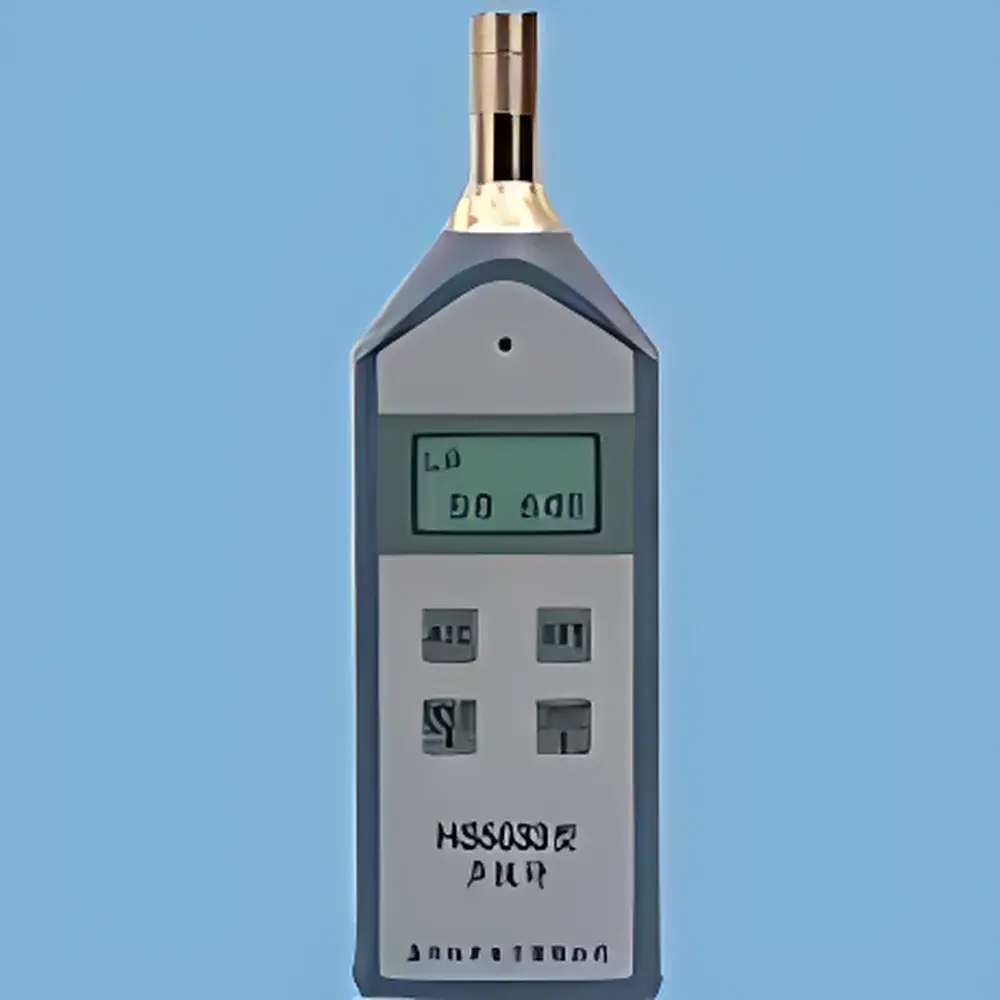
HS5633 Sound Level Meter
| Origin | Beijing, China |
|---|---|
| Manufacturer Type | Authorized Distributor |
| Origin Category | Domestic (PRC) |
| Model | HS5633 |
| Price Range | USD 140–280 |
| Frequency Range | 31.5 Hz – 8 kHz |
| Measurement Range | 35 dB(A) – 130 dB(A) |
| Frequency Weighting | A-weighting, C-weighting |
| Time Weighting | Fast (F) |
| Display | 2-line alphanumeric LCD with backlight |
| Output | AC & DC analog outputs |
| Power Supply | 1 × 9 V alkaline battery |
| Dimensions | 230 × 72 × 30 mm |
| Mass | 200 g |
| Compliance | GB/T 3785–2010 Class 2, IEC 61672-1:2013 Class 2 |
Overview
The HS5633 Sound Level Meter is a portable, general-purpose acoustic measurement instrument engineered for field and laboratory use in environmental noise assessment, occupational health monitoring, and basic acoustical engineering applications. It operates on the principle of electret condenser microphone transduction, converting sound pressure fluctuations into proportional electrical signals that are digitally processed to yield weighted sound pressure levels (SPL). Designed and verified to meet the performance requirements of GB/T 3785–2010 (equivalent to IEC 61672-1:2013) Class 2 specifications, the HS5633 delivers reliable, repeatable measurements across its specified dynamic and frequency range. Its compact form factor and low power consumption make it suitable for extended-duration surveys, including roadside traffic noise mapping, industrial perimeter monitoring, and indoor ambient noise evaluation under ISO 1996-2 or ISO 9612 compliance frameworks.
Key Features
- Class 2-compliant electroacoustic performance per IEC 61672-1:2013 and GB/T 3785–2010 — validated for routine environmental and occupational noise assessments.
- Two-channel alphanumeric LCD display with adjustable backlight, enabling legible operation in low-light conditions such as nighttime community noise studies or indoor facility audits.
- Integrated peak-hold function for capturing transient sound events (e.g., construction impact noise, vehicle pass-by peaks), with manual reset capability.
- Dual analog outputs: AC-coupled output (0.707 V RMS per 94 dB SPL reference) for connection to external analyzers or data loggers; DC-coupled output (10 mV/dB) for direct integration with chart recorders or SCADA systems.
- Configurable time weighting: Fast (F) response mode only, optimized for real-time monitoring where temporal resolution aligns with human perception thresholds.
- Frequency weighting options: A-weighting (for environmental and hearing conservation applications per ISO 1999) and C-weighting (for assessing low-frequency energy content, e.g., HVAC or machinery noise).
- Lightweight housing (200 g) with ergonomic grip and ruggedized casing — designed for handheld operation over multi-hour survey periods without fatigue.
Sample Compatibility & Compliance
The HS5633 is intended for airborne sound pressure level measurements in open-air, semi-enclosed, and indoor environments. It accommodates standard 1/2-inch electret condenser microphones (not included) with nominal sensitivity of −30 dB re 1 V/Pa. The instrument complies with national and international regulatory frameworks governing environmental noise monitoring, including China’s HJ 640–2012 Technical Specification for Environmental Noise Monitoring and the EU’s Environmental Noise Directive (2002/49/EC) measurement prerequisites for strategic noise mapping. While not certified for legal metrology (Class 1), its Class 2 accuracy supports pre-compliance screening, baseline characterization, and trend analysis aligned with ISO 14001 environmental management system requirements.
Software & Data Management
The HS5633 operates as a standalone meter without embedded memory or USB connectivity. However, its analog outputs enable seamless integration with third-party data acquisition platforms (e.g., National Instruments DAQ systems, Campbell Scientific CR1000X) supporting time-synchronized logging at user-defined intervals. When paired with compliant software (e.g., MATLAB Signal Processing Toolbox, Brüel & Kjær PULSE™ Lite), users may perform post-acquisition spectral averaging, Leq calculation, and octave-band analysis. All measurement sessions adhere to traceable calibration protocols; users are required to perform periodic verification using an accredited acoustic calibrator (e.g., 94 dB / 114 dB @ 1 kHz per IEC 60942) and maintain calibration logs per GLP principles.
Applications
- Environmental noise surveys around transportation corridors (roads, railways, airports) per ISO 1996-1 and local municipal ordinances.
- Workplace noise exposure assessment in accordance with OSHA 29 CFR 1910.95 and GBZ/T 188–2014 occupational health standards.
- Preliminary acoustic diagnostics for building envelope integrity, HVAC system commissioning, and equipment noise labeling.
- Educational use in physics and environmental science laboratories for teaching fundamental acoustics concepts, including decibel scale interpretation and frequency weighting effects.
- Community complaint investigations where rapid, field-deployable instrumentation is prioritized over high-resolution spectral analysis.
FAQ
Is the HS5633 suitable for regulatory compliance reporting?
It meets Class 2 accuracy requirements per IEC 61672-1 and is appropriate for screening-level assessments and internal reporting, but not for legally binding enforcement actions requiring Class 1 instrumentation.
Does the device support slow (S) or impulse (I) time weighting?
No — the HS5633 implements Fast (F) time weighting only, consistent with its design focus on general-purpose monitoring rather than specialized impulse noise evaluation.
Can it measure equivalent continuous sound level (Leq)?
Not natively — Leq calculation requires external integration with time-series data acquisition hardware and post-processing software.
What is the recommended calibration interval?
Annual calibration against a traceable acoustic calibrator is advised; field verification before and after each measurement session is strongly recommended per ISO/IEC 17025 guidelines.
Is the microphone included with the unit?
No — the HS5633 is supplied as a meter body only; a compatible 1/2″ electret condenser microphone must be sourced separately and mounted via standard BNC or LEMO interface.
Related Products







