
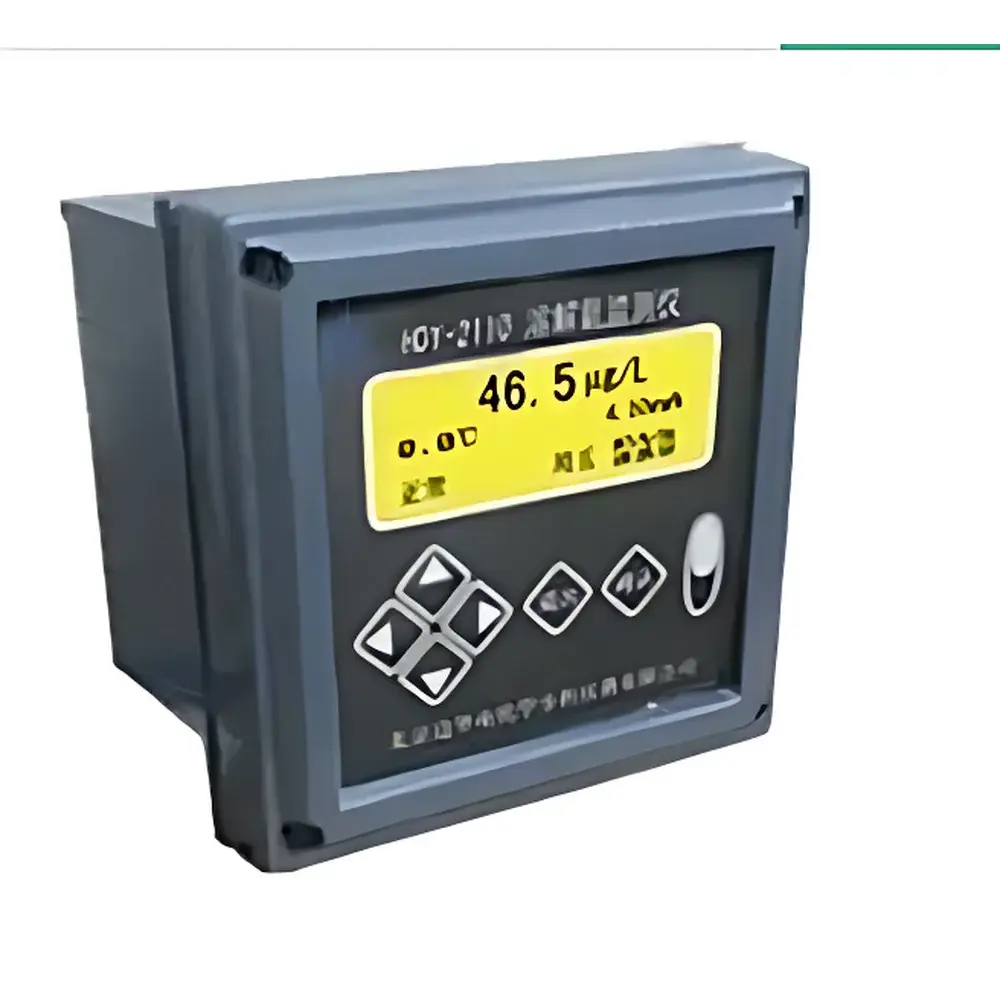
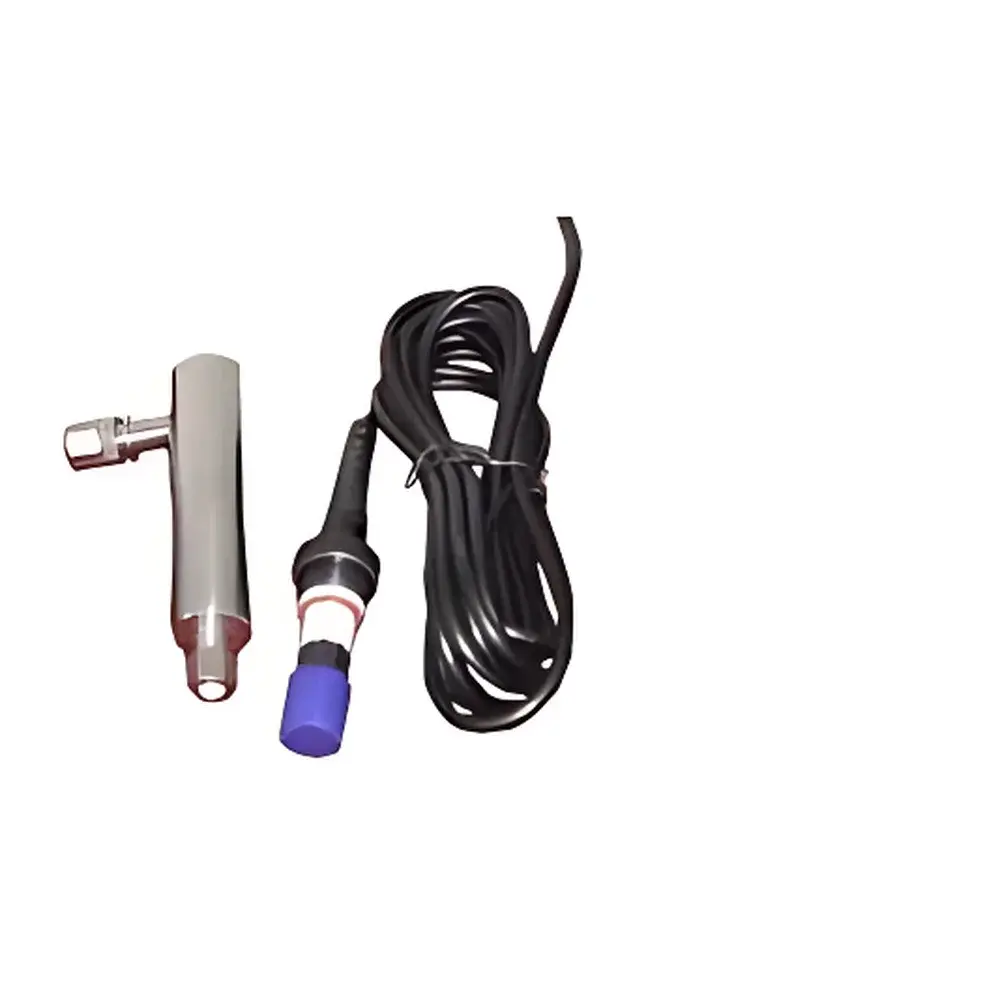
HDY-2110Z Dissolved Oxygen Online Monitor
| Origin | Beijing, China |
|---|---|
| Manufacturer Type | Authorized Distributor |
| Origin Category | Domestic (PRC) |
| Model | HDY-2110Z |
| Price Range | USD 2,800–4,200 |
| Instrument Type | Online Continuous Monitor |
| Measurement Principle | Polarographic Electrochemical Sensor |
| Measurement Range | (0.0–20.0, 0.0–200) µg/L |
| Accuracy | ±5.0% F.S. for (0.0–20.0) µg/L range |
| Repeatability | ±1.5% F.S. |
| Detection Limit | 0.10 µg/L |
| Resolution | 0.10 µg/L (ppb mode), 0.01 mg/L (ppm mode) |
| Response Time (t₉₀) | <60 s at 25 °C |
| Temperature Compensation | Automatic (5–50 °C), Manual Settable (0–55 °C) |
| Output | 4–20 mA (load 250–500 Ω), RS485 or CAN bus interface |
| Power Supply | AC 85–265 V, 45–65 Hz, ≤20 VA |
| Enclosure Rating | IP65 |
| Dimensions | 146 × 146 × 108 mm (H×W×D) |
| Panel Cutout | 138 × 138 mm |
| Weight | 1.5 kg (ppb configuration), 1.7 kg (ppm configuration) |
Overview
The HDY-2110Z Dissolved Oxygen Online Monitor is an industrial-grade, continuous-process analytical instrument engineered for high-stability measurement of dissolved oxygen (DO) in ultrapure water and general aqueous process streams. It employs a polarographic electrochemical sensing principle—based on Clark-type amperometric detection with a gold cathode and silver/silver chloride reference electrode—optimized for low-concentration applications down to sub-ppb levels. The system is specifically designed for environments where trace-level DO control is critical to process integrity, including boiler feedwater systems, semiconductor rinse loops, pharmaceutical water-for-injection (WFI) distribution networks, and high-purity steam generation. Its dual-range architecture enables seamless auto-ranging between 0.0–200 µg/L (ppb) and 0.0–20.0 mg/L (ppm), eliminating manual range switching while maintaining metrological traceability across both regimes.
Key Features
- 32-bit ARM-based embedded controller with real-time operating system (RTOS), supporting deterministic data acquisition and multi-threaded communication handling.
- Dual-mode polarographic sensor architecture: optimized for high-sensitivity ppb-level measurement (≤10 µg/L response within 60 s at 25 °C) and robust ppm-level operation with ±1.0% F.S. accuracy.
- CAN bus as standard fieldbus interface—compliant with ISO 11898-1—enabling deterministic, noise-immune integration into distributed control systems (DCS) and SCADA architectures; optional RS485 Modbus RTU support available.
- Expandable wireless telemetry: integrated 3G cellular module (compatible with China Mobile/Unicom/Telecom NB-IoT fallback) for remote parameter viewing, alarm notification, and historical trend access via secure web portal—no local IT infrastructure required.
- Industrial-grade front panel: 192 × 64 dot-matrix monochrome LCD with adjustable backlight, full Chinese character menu navigation, and eight tactile membrane keys for glove-compatible operation.
- Single-board SMT design with conformal coating, eliminating interconnect harnesses and contact-based failures; rated for continuous operation under ambient temperatures from 5 °C to 45 °C and relative humidity ≤85% RH (non-condensing).
Sample Compatibility & Compliance
The HDY-2110Z is validated for use with low-conductivity, low-particulate aqueous streams meeting the following sampling criteria: temperature 5–45 °C, flow rate 300 ±50 mL/min, pressure 0.01–0.02 MPa, suspended solids ≤5 µm (no colloids, oils, or surfactants). It complies with IEC 61000-6-2 (immunity) and IEC 61000-6-4 (emissions), and meets IP65 ingress protection per IEC 60529. While not certified to ISO/IEC 17025 or ASTM D888, its measurement methodology aligns with the principles outlined in ASTM D888-22 (Standard Test Methods for Dissolved Oxygen in Water) and USP (Total Organic Carbon and Dissolved Oxygen in Purified Water and Water for Injection). The instrument supports audit-trail-capable data logging when paired with compliant SCADA or LIMS platforms, facilitating GLP/GMP-aligned documentation practices.
Software & Data Management
Data output is provided via isolated 4–20 mA analog signal (250–500 Ω load) and digital interfaces (CAN bus primary, RS485 secondary). The onboard firmware stores up to 30 days of 1-minute interval DO, temperature, and status logs in non-volatile memory. Remote access via the integrated 3G module permits secure HTTPS-based visualization of real-time values, alarm states (HI/LO/FAULT), and calibration history through a browser-accessible dashboard. All configuration changes—including sensor zero/span settings, temperature compensation coefficients, and alarm thresholds—are timestamped and user-logged. When deployed in regulated environments, the system can be configured to export CSV-formatted logs compatible with FDA 21 CFR Part 11-compliant review workflows, though electronic signature functionality requires external validation of the host platform.
Applications
- Power generation: real-time monitoring of boiler feedwater and condensate return lines to prevent oxidative corrosion in high-pressure steam cycles.
- Pharmaceutical manufacturing: continuous verification of dissolved oxygen in purified water (PW) and water-for-injection (WFI) distribution loops per EU GMP Annex 1 and USP .
- Semiconductor fabrication: ultra-low DO control (<5 µg/L) in deionized rinse water recirculation systems to minimize wafer surface oxidation.
- Chemical and petrochemical processing: DO surveillance in catalyst regeneration streams, amine solvent loops, and closed cooling water systems.
- Municipal and industrial wastewater treatment: integration into aeration basin control strategies for energy-efficient biological oxygen demand (BOD) management.
- Pulp & paper production: optimization of bleaching chemistry and prevention of fiber degradation via precise DO profiling in whitewater circuits.
FAQ
What is the recommended calibration frequency for the HDY-2110Z in continuous operation?
Calibration should be performed at least once every 7 days for ppb-level applications and once every 30 days for ppm-level service, using zero-oxygen solution (sodium sulfite) and air-saturated water standards. More frequent calibration may be required in high-fouling or high-temperature installations.
Can the instrument operate without a flow cell?
No—the specified 300 mL/min flow rate is mandatory for stable polarographic current development and thermal equilibrium at the sensor membrane; static immersion will yield drift and extended response times.
Is the 3G module compatible with international cellular networks?
The standard module supports China’s 3G UMTS bands (B1/B8); for global deployment, a hardware variant with quad-band LTE-M/NB-IoT (B1/B3/B5/B8/B20) must be ordered separately.
Does the HDY-2110Z support automatic temperature compensation across its full operating range?
Yes—automatic compensation is active from 5 °C to 50 °C using a built-in Pt1000 RTD; manual override is available for fixed-point calibration verification or non-standard media.
What maintenance is required for the polarographic sensor?
Electrolyte replenishment every 6 months and membrane replacement every 12 months are recommended under typical operating conditions; more frequent servicing is advised for applications with particulates or oxidizing agents.
Related Products







