
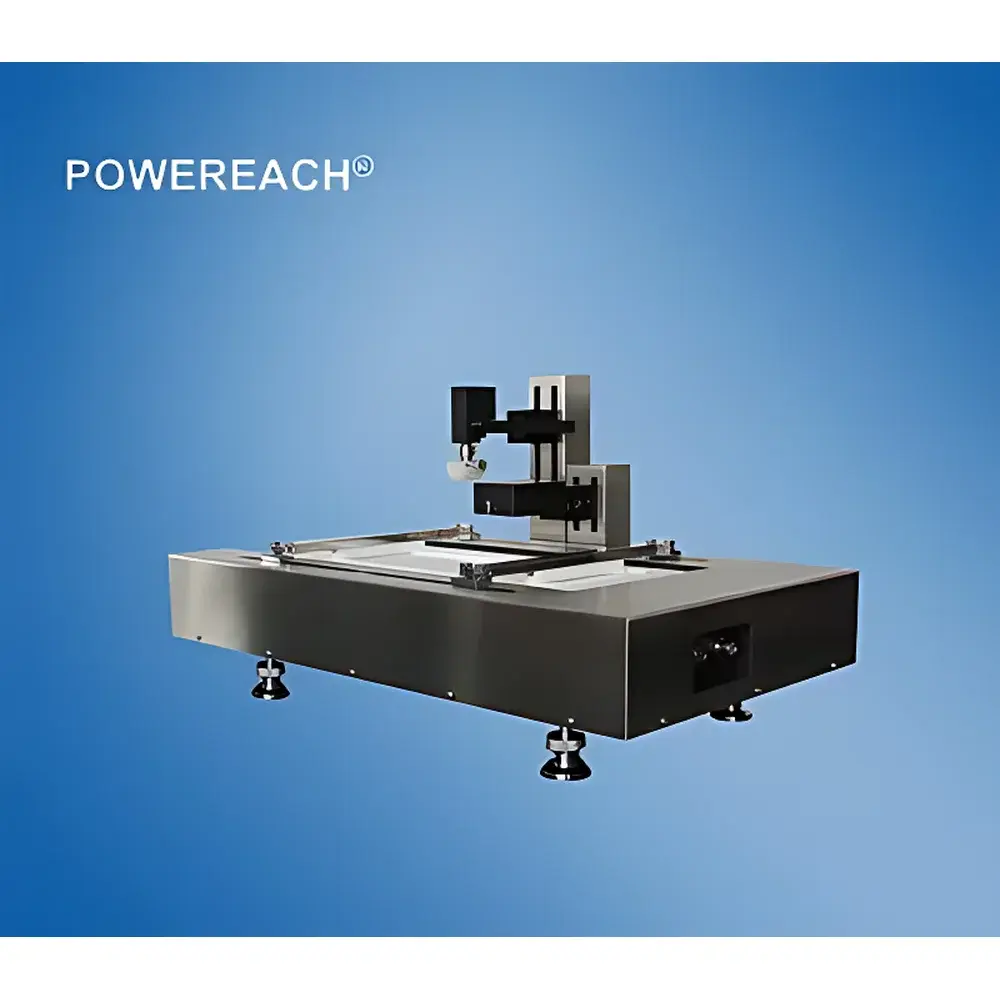
JML04C2 Langmuir-Blodgett Trough System with Wilhelmy Plate Surface Tensiometry
| Origin | Beijing, China |
|---|---|
| Manufacturer Type | Authorized Distributor |
| Origin Category | Domestic (PRC) |
| Model | JML04C2 |
| Pricing | Available Upon Request |
| Surface Tension Range | 0–150 mN/m |
| Resolution | 0.05 mN/m |
| Measurement Method | Wilhelmy Plate (Wilhelmy Type) |
| Trough Configuration | Langmuir |
| Trough Material | Fully PTFE (Teflon®) |
| Trough Dimensions | 300 mm × 100 mm |
| Compression Ratio | Up to 90% |
| Barrier Type | Leakproof Barrier |
| Barrier Speed | 0.48–97 mm/min |
| Deposition Speed | 0.22–45 mm/min |
| Deposition Modes | Upward & Downward |
| Power Supply | AC 220 V ±10%, 50 Hz |
| Max Power Consumption | 150 W |
| Operating Temperature | Ambient (with optional external thermostatic bath support) |
| Operating Humidity | 30–85% RH |
| Software Interface | Windows-based GUI with data export, curve fitting, and post-processing capability |
| Compliance | Designed for GLP-compliant lab environments |
Overview
The JML04C2 Langmuir-Blodgett Trough System is a precision-engineered platform for quantitative characterization of monolayer films at the air–liquid interface. Based on the classical Langmuir trough architecture and integrated Wilhelmy plate tensiometry, it enables real-time measurement of surface pressure (π), surface tension (γ), molecular area (A), and compressibility modulus (Cs⁻¹) during dynamic compression/expansion cycles. The system operates on the principle of force balance: the vertical force exerted on a platinum or filter paper Wilhelmy plate immersed at the interface is directly proportional to the surface tension of the subphase. Coupled with a motorized, leakproof barrier and high-resolution linear actuators, the JML04C2 supports reproducible formation, compression, and vertical transfer (Langmuir–Blodgett deposition) of amphiphilic monolayers—including phospholipids, surfactants, peptides, polymers, and hybrid nanoparticles. Its design reflects decades of refinement in interfacial science instrumentation, supporting foundational research in pulmonary surfactant biophysics, biomimetic membrane assembly, and functional thin-film fabrication for optoelectronic and sensing applications.
Key Features
- Fully automated operation via embedded microcontroller and PC-hosted Windows-based software—minimizing manual intervention and operator-induced variability.
- High-precision Wilhelmy plate sensor with 0.05 mN/m resolution and full 0–150 mN/m dynamic range, calibrated traceably to NIST-traceable standards.
- PTFE-lined Langmuir trough (300 mm × 100 mm active area) offering exceptional chemical inertness, low background contamination, and minimal evaporation or leakage.
- Leakproof barrier mechanism enabling stable, high-fidelity compression up to 90% surface area reduction with programmable speed control (0.48–97 mm/min).
- Dual-mode deposition capability: upward and downward vertical dipping with adjustable speed (0.22–45 mm/min) and real-time tension feedback for constant-pressure or constant-area protocols.
- Integrated surface tension auto-measurement function prior to monolayer formation—ensuring accurate baseline subphase characterization.
- Modular hardware architecture supporting customization: dual-trough configurations, thermostatic jacket integration, and optional environmental enclosures for humidity/temperature control.
Sample Compatibility & Compliance
The JML04C2 accommodates a broad spectrum of amphiphilic systems, including synthetic surfactants (e.g., SDS, CTAB), natural lipids (DPPC, POPG), protein–lipid complexes, block copolymers, graphene oxide dispersions, and peptide monolayers. Its PTFE construction ensures compatibility with aggressive solvents (chloroform, chloroform/methanol mixtures) and aqueous subphases containing salts, buffers, or divalent cations (Ca²⁺, Mg²⁺). The system meets essential requirements for GLP-compliant laboratories: raw data files include timestamps, instrument metadata, and user identifiers; software supports electronic signatures and audit trails when deployed under validated 21 CFR Part 11 configurations. While not certified to ISO/IEC 17025 out-of-the-box, its metrological performance aligns with ASTM D971 (surface tension of petroleum products) and ISO 6889 (interfacial tension by Wilhelmy plate method) test principles.
Software & Data Management
The native Windows application provides intuitive graphical control of barrier position, deposition parameters, and real-time plotting of π–A, γ–A, and Cs⁻¹–A isotherms. All curves are exportable in CSV, TXT, and PNG formats; built-in tools enable polynomial fitting, phase transition identification (via inflection analysis), and compressibility calculation. Data files embed acquisition parameters (date/time, temperature, barrier speed, plate calibration factor), ensuring full traceability. For regulated environments, optional software validation packages—including IQ/OQ documentation, change control logs, and electronic signature modules—are available upon request. Raw sensor voltage outputs and processed tension values are stored separately to support independent reprocessing and uncertainty propagation analysis.
Applications
- Biophysical studies of pulmonary surfactant monolayers: modeling alveolar film stability, collapse mechanisms, and therapeutic surfactant formulation efficacy in NRDS and ARDS research.
- Development of lipid-based drug delivery systems: characterizing liposome monolayer analogs, membrane fluidity transitions, and peptide insertion thermodynamics.
- Functional nanomaterial assembly: controlled deposition of quantum dot–lipid hybrids, 2D MOF monolayers, and conductive polymer films for organic electronics.
- Environmental interface science: quantifying adsorption kinetics and packing behavior of dissolved organic matter (DOM) and microplastic surfactants at water–air interfaces.
- Teaching and methodology training: standardized protocols for undergraduate and graduate labs in colloid & interface science, soft matter physics, and biophysical chemistry.
FAQ
What subphase temperature control options are available?
The JML04C2 operates at ambient temperature but features standard ports for connection to external recirculating chillers or thermostatic baths (e.g., Julabo F25) to maintain subphase temperatures between 5 °C and 45 °C with ±0.1 °C stability.
Can the trough be configured for dual-chamber operation?
Yes—custom dual-trough systems with independent barriers and synchronized control are available; contact technical sales for mechanical and software integration specifications.
Is the Wilhelmy plate sensor replaceable and recalibratable in-house?
The platinum plate is field-replaceable; calibration uses standard reference liquids (pure water, ethanol) and follows ISO 6889 procedures—no proprietary tools required.
Does the software support automated multi-cycle hysteresis measurements?
Yes—users can define sequential compression–expansion loops with variable speed ramps, dwell times, and endpoint criteria; all cycles are logged with unique identifiers.
What level of service and firmware update support is provided?
As the instrument is backed by full intellectual property rights held by the manufacturer, users receive direct technical support, firmware patches, and hardware upgrade paths—including future compatibility with LB transfer robots and in situ spectroscopic add-ons.



