
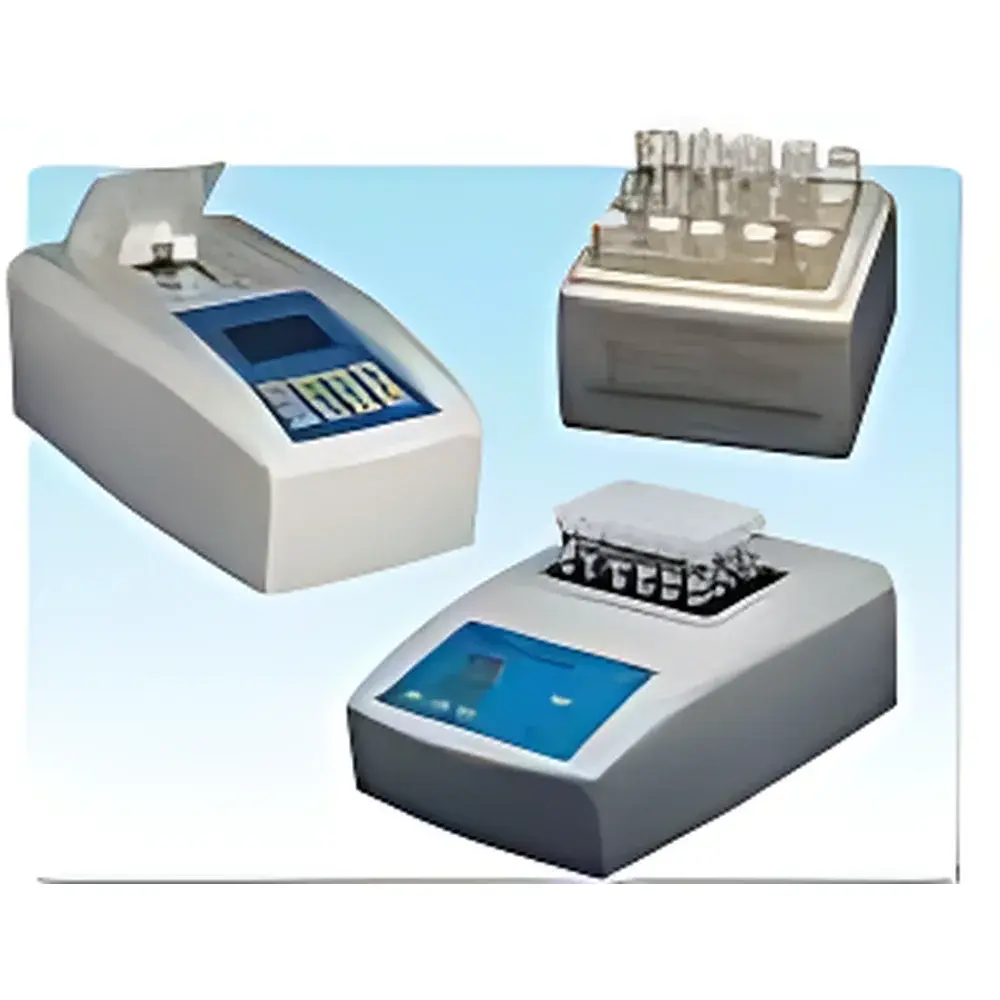
ET3150B/ET1150M Chemical Oxygen Demand (COD) Analyzer
| Origin | Beijing, China |
|---|---|
| Manufacturer Type | Authorized Distributor |
| Origin Category | Domestic (China-made) |
| Model | ET3150B/ET1150M |
| Instrument Type | Benchtop Laboratory Analyzer |
| Power Supply | 220 V AC, 50 Hz |
| Operating Temperature | 5–50 °C |
| Relative Humidity | 20–85 % RH |
| Wavelength Accuracy | ±2 nm |
| Wavelength Selection | 420 nm and 610 nm (LED-based optical system) |
| Photometric Accuracy | ±8 % of full scale |
| Repeatability | RSD ≤ 3 % |
| Photometric Stability | ΔA < 0.005 A within 20 min |
| Measurement Modes | Absorbance, Transmittance, Concentration |
| Built-in Test Programs | COD, TN, TP, NH₃-N, F⁻ |
| Preloaded Calibration Curves | 6 |
| User-defined Curve Storage | Supported |
| ET3150B Digestion Block Capacity | 24 × Φ16 × 100 mm tubes |
| Digestion Temperature Accuracy | ±1 °C |
| COD Digestion Temp | 165 °C ±1 °C |
| TN/TP Digestion Temp | 105 °C |
| Timer Range | 1–1860 min (31 h) |
| Display | LCD with full Chinese interface |
| Heating Rate | 20 → 165 °C in ≤10 min |
| Safety Features | Auto-shutdown, over-temperature alarm, timer alert |
Overview
The ET3150B/ET1150M Chemical Oxygen Demand (COD) Analyzer is a microprocessor-controlled, dual-wavelength photometric system designed for precise, trace-level quantification of key water quality parameters—including COD, total nitrogen (TN), total phosphorus (TP), ammonia nitrogen (NH₃-N), and fluoride—in laboratory and field-deployable environments. It operates on the principle of colorimetric analysis using stable LED light sources and narrow-band interference filters, eliminating the need for traditional tungsten-halogen lamps and enabling long-term photometric stability. The system integrates two core modules: the ET1150M photometer (with selectable 420 nm and 610 nm detection channels) and the ET3150B programmable digestion block—engineered to meet standard regulatory digestion protocols defined in ISO 6060 (COD), ISO 11905-1 (TN), and ISO 11905-2 (TP). Its architecture supports both pre-validated method curves and user-customized calibration functions, ensuring flexibility across diverse sample matrices while maintaining compliance with routine environmental testing workflows.
Key Features
- Dual-wavelength LED photometry at 420 nm (for TN and nitrate-derived chromophores) and 610 nm (for phosphomolybdenum blue complex), minimizing spectral interference and improving selectivity
- Integrated digestion module (ET3150B) capable of simultaneous thermal treatment of 24 samples in standardized 16 × 100 mm borosilicate glass tubes
- Precise temperature control: ±1 °C accuracy at 165 °C (COD digestion) and 105 °C (TN/TP digestion), verified per ASTM D1253 and EPA Method 410.4 requirements
- Automated digestion sequencing with programmable time (1–1860 min), real-time digital display of temperature/time, and audible/visual end-of-cycle alerts
- Photometric performance validated to ISO 7027:2016 — repeatability RSD ≤ 3 %, stability ΔA < 0.005 A over 20 minutes, and linearity maintained across typical environmental concentration ranges
- Intuitive LCD interface with full Chinese language support; direct access to five built-in test protocols and six factory-loaded calibration curves
- User curve storage capability enables method adaptation for non-standard matrices or site-specific validation requirements
Sample Compatibility & Compliance
The ET3150B/ET1150M is validated for use with surface water, wastewater effluent, industrial process water, and drinking water sources following standard pretreatment guidelines (e.g., filtration, dilution, pH adjustment). Sample volumes are compatible with standard 16 × 100 mm digestion tubes and 10–50 mL volumetric preparation protocols. All measurement procedures align with internationally recognized methodologies: COD determination conforms to ISO 6060 and APHA Standard Methods 5220D; TN analysis follows the persulfate oxidation–colorimetric principle per ISO 11905-1; TP quantification adheres to ascorbic acid–reduced molybdenum blue methodology per ISO 11905-2. The instrument’s design supports GLP-compliant operation when paired with documented SOPs, audit-trail-enabled data logging (via optional USB export), and operator-accessible calibration verification routines.
Software & Data Management
While the base unit features embedded firmware without external PC dependency, the ET1150M photometer supports manual data recording via its LCD interface and optional USB data export (with compatible software provided separately). All measurements include timestamped absorbance, transmittance, and concentration outputs. Built-in memory retains up to 100 test results per parameter group. For regulated environments, users may implement supplementary electronic lab notebook (ELN) integration or LIMS interfacing through standardized CSV export. Though not natively 21 CFR Part 11 compliant, the system permits implementation of procedural controls—including operator logbooks, calibration logs, and digestion run records—to satisfy GMP/GLP documentation expectations during internal or third-party audits.
Applications
- Routine monitoring of municipal and industrial wastewater treatment plant influent/effluent streams
- Environmental impact assessments requiring multi-parameter compliance reporting (COD, TN, TP)
- Research laboratories studying nutrient cycling, eutrophication potential, or oxidation kinetics
- Regulatory compliance testing under national discharge permits (e.g., China’s GB 8978-1996, EU Urban Wastewater Treatment Directive)
- Educational settings for teaching fundamental principles of spectrophotometric analysis and redox chemistry
- Field-deployable screening where portability, low power demand, and rapid turnaround (<30 min/sample) are critical
FAQ
What digestion methods does the ET3150B support?
It supports closed-tube digestion per ISO 6060 (165 °C, 2 h) for COD, and lower-temperature oxidation (105 °C) for TN and TP using alkaline or acidic persulfate, respectively.
Can the ET1150M measure parameters beyond the five pre-programmed ones?
Yes—users may define custom calibration curves for additional analytes (e.g., silicate, nitrite) provided appropriate chemistry and wavelength selection are validated.
Is the instrument suitable for drinking water analysis?
Yes, with appropriate dilution and matrix-matched calibration; detection limits meet WHO and GB 5749-2022 requirements for TN and TP in potable supplies.
Does the system require annual recalibration by the manufacturer?
No—routine verification using NIST-traceable standards (e.g., potassium hydrogen phthalate for COD, potassium nitrate for TN) is sufficient; no proprietary service tools are required.
How is photometric drift compensated during extended use?
The LED source exhibits negligible aging over 50,000 hours; zero-point auto-adjustment occurs at each power-on, and baseline correction is performed before every measurement cycle.
Related Products







