
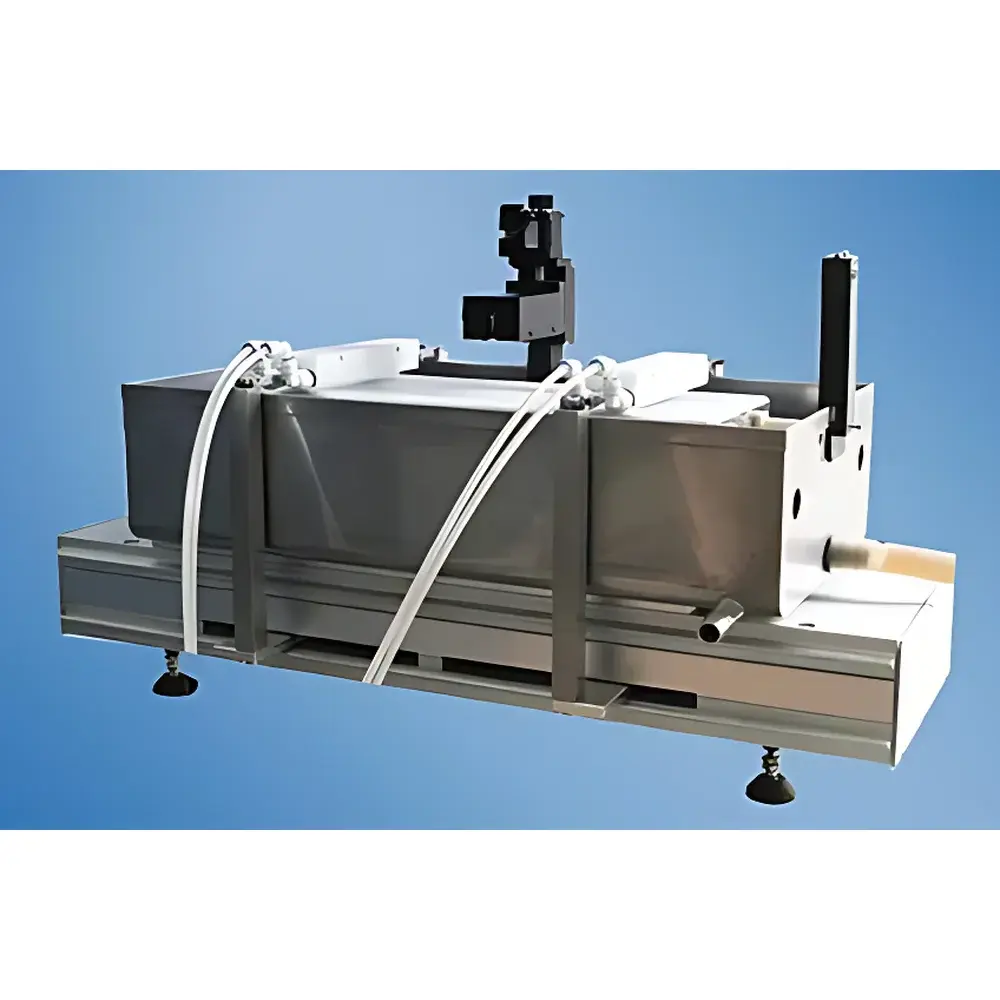
JML15A Langmuir-Blodgett Trough with Wilhelmy Plate Surface Tension & Monolayer Analysis System
| Origin | Beijing, China |
|---|---|
| Manufacturer Type | Authorized Distributor |
| Origin Category | Domestic (PRC) |
| Model | JML15A |
| Price Range | USD 28,000 – 70,000 |
| Surface Tension Range | 0–150 mN/m |
| Resolution | < 0.05 mN/m |
| Measurement Method | Wilhelmy Plate (Du Noüy–Washburn Principle) |
| Trough Dimensions | 700 mm × 140 mm |
| Compression/Expansion Speed | 10–100 mm/min (infinitely variable) |
| Temperature Control | Dual independent thermostatic water jackets (30 L pure water reservoir + 10 L trough jacket), both stabilized at 35 ± 0.5 °C |
| Cleaning | Automated spray-based trough and plate cleaning with waste drainage |
| Data Acquisition | PC-hosted Windows software with real-time π–A and γ–A isotherm plotting, programmable barrier control, constant surface pressure mode, and audit-trail-capable data logging |
Overview
The JML15A Langmuir-Blodgett (LB) Trough is a precision-engineered surface science instrument designed for quantitative characterization of amphiphilic monolayers at the air–water interface. It operates on the fundamental principle of the Wilhelmy plate method—measuring the vertical force exerted on a vertically immersed, hydrophilic platinum or glass plate as it contacts and withdraws from the aqueous subphase. This force, directly proportional to the liquid’s surface tension (γ, in mN/m), enables high-fidelity determination of interfacial thermodynamic parameters including surface pressure (π = γsubphase − γfilm) and molecular area (A). The system supports full isotherm acquisition (π–A curves) under controlled compression/expansion, enabling rigorous analysis of phase transitions, collapse pressure, compressibility modulus, and monolayer stability—critical metrics in colloid & interface science, thin-film device fabrication, and biomimetic membrane studies.
Key Features
- Fully automated barrier control via dual-axis stepper motor system with encoder-based position feedback, ensuring reproducible compression speeds from 10 to 100 mm/min (infinitely adjustable)
- High-sensitivity Wilhelmy plate sensor (NMB, full-scale 98 mN/m) with < 0.05 mN/m resolution and thermal drift compensation
- Large-area Langmuir trough (700 mm × 140 mm) fabricated from white PTFE-lined stainless steel, minimizing edge effects and enhancing signal-to-noise ratio
- Dual independent thermostatic systems: a 30 L pure-water reservoir (maintained at 35 ± 0.5 °C) feeds the subphase, while a separate 10 L jacket circulates temperature-controlled water around the trough body for thermal uniformity
- Integrated automated cleaning sequence: programmable solenoid valves activate PTFE nozzles to rinse both trough surface and Wilhelmy plate; waste fluid drains via dedicated φ90 mm sump with anti-surge baffle
- Real-time isotherm generation (π–A and γ–A plots), with user-definable surface pressure setpoints for dynamic barrier modulation during film formation
- Constant surface pressure (CSP) mode: barrier automatically adjusts position to maintain preset π values during vertical lifting (Langmuir–Blodgett transfer)
- Compliant with ISO 6889 (surface tension of surfactant solutions) and ASTM D971 (interfacial tension of oil-in-water systems) measurement protocols
Sample Compatibility & Compliance
The JML15A accommodates a broad range of amphiphilic materials—including fatty acids, phospholipids, block copolymers, nanoparticles, and conjugated polymers—in aqueous subphases buffered at defined pH and ionic strength. Its PTFE-lined trough and chemically inert glass or platinum Wilhelmy plates resist adsorption and contamination, supporting GLP-compliant workflows. All firmware and software operations log timestamps, operator IDs, and parameter configurations—enabling full traceability per FDA 21 CFR Part 11 requirements when paired with validated Windows OS environments. The system meets IEC 61000-6-3 (EMC emissions) and IEC 61010-1 (electrical safety for laboratory equipment) standards.
Software & Data Management
The Windows-based control suite provides a bilingual (English/Chinese) GUI with intuitive workflow navigation. It supports real-time visualization of π–A isotherms, automatic detection of phase transition points (LE–LC, LC–CS), and export of raw force/time data in CSV or ASCII format for third-party analysis (e.g., OriginLab, MATLAB). Data files include embedded metadata: date/time stamp, temperature setpoint, barrier speed, subphase composition, and calibration coefficients. Audit trail functionality records all user-initiated actions—including parameter changes, cleaning cycles, and manual overrides—with immutable timestamps—essential for regulatory submissions in pharmaceutical or cosmetic R&D settings governed by ICH Q5C or ISO 22716.
Applications
- Quantitative assessment of surfactant efficacy in personal care formulations (e.g., critical micelle concentration, packing density, and monolayer elasticity)
- Structure–function correlation of lung surfactant analogs for respiratory drug delivery research
- Optimization of LB-deposited organic semiconductor films for OFETs and OLED charge transport layers
- Interfacial rheology studies of protein–polymer co-adsorption in food emulsion stabilization
- Environmental monitoring of petroleum hydrocarbon monolayers on aquatic surfaces (e.g., spill response modeling)
- Teaching laboratories: hands-on instruction in Gibbs adsorption isotherm derivation, two-dimensional phase behavior, and Langmuir equation validation
FAQ
What surface pressure range can the JML15A accurately resolve?
The system measures surface pressures from 0 to 75 mN/m with linearity better than ±0.2 mN/m across the full scale, validated against NIST-traceable surfactant standards (e.g., octanol, stearic acid).
Is the Wilhelmy plate interchangeable between glass and platinum variants?
Yes—the instrument accepts standardized Wilhelmy plates (10 mm × 20 mm) in fused silica, platinum, or nickel; each requires individual calibration but shares identical mounting geometry and sensor interface.
Can the software generate reports compliant with ISO/IEC 17025 documentation requirements?
Yes—customizable report templates include instrument ID, calibration certificate numbers, environmental conditions (T, RH), operator signature fields, and digital signatures when integrated with enterprise PKI infrastructure.
Does the system support external synchronization with optical microscopes or Brewster angle microscopy (BAM)?
Yes—TTL-compatible trigger outputs are provided for frame-locked image capture during isotherm acquisition; BNC ports allow analog voltage output of real-time surface pressure for oscilloscope or DAQ integration.
What maintenance intervals are recommended for long-term accuracy?
Annual recalibration of the force transducer and verification of temperature uniformity across the trough surface are recommended; PTFE trough surfaces require no polishing but should be inspected quarterly for micro-scratches using 10× magnification.



