
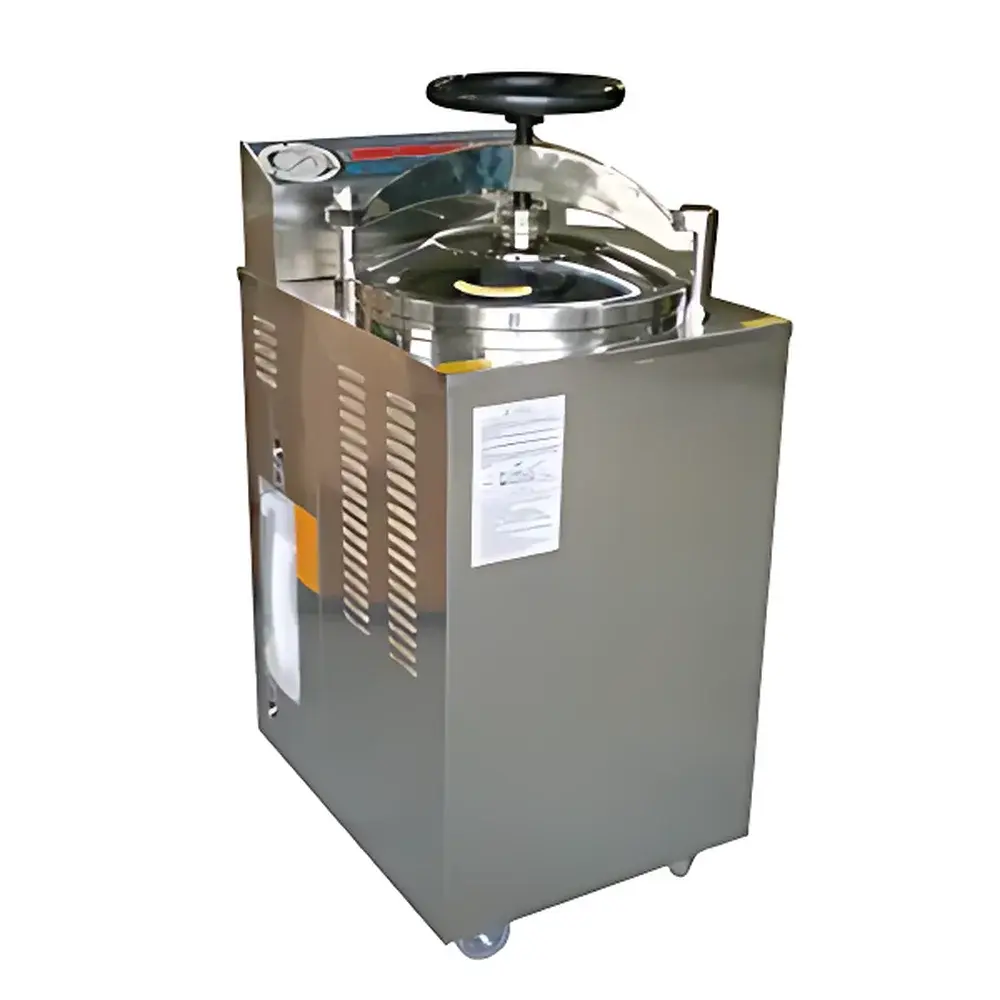
BOXUN YXQ-LS-75G Vertical Steam Sterilizer
| Brand | BOXUN |
|---|---|
| Origin | Shanghai, China |
| Manufacturer Type | Direct Manufacturer |
| Product Category | Domestic |
| Model | YXQ-LS-75G |
| Instrument Type | Vertical |
| Max Temperature | 135 °C |
| Max Pressure | 0.22 MPa |
| Chamber Dimensions | Ø400 × 720 mm |
| External Dimensions | 485 × 605 × 1190 mm |
| Chamber Volume | 75 L |
| Sterilization Power | 3.5 kW |
| Drying Power | 0.8 kW |
| Voltage/Frequency | 220 V ±10%, 50 Hz ±2% |
| Design Temp/Pressure | 138 °C / 0.25 MPa |
| Sterilization Timer Range | 4–120 min |
| Drying Timer Range | 30–240 min |
| Basket Dimensions | Ø360 × 280 mm (2 pcs) |
Overview
The BOXUN YXQ-LS-75G Vertical Steam Sterilizer is a Class B gravity-displacement and pre-vacuum compatible steam sterilization system engineered for laboratory, clinical, and research environments requiring reliable, repeatable terminal sterilization of heat- and moisture-stable materials. It operates on the principle of saturated steam under controlled pressure and temperature to achieve microbial inactivation—including bacterial spores—via protein denaturation and nucleic acid disruption. Designed to meet fundamental requirements of ISO 17665-1:2017 (Sterilization of health care products — Moist heat — Part 1: Requirements for the development, validation and routine control of a sterilization process for medical devices), the unit delivers precise thermal exposure profiles across its 75 L stainless-steel chamber. Its vertical orientation optimizes floor space utilization while maintaining full compliance with national safety standards for pressurized equipment (GB 8599–2008, China’s standard for steam sterilizers).
Key Features
- Stainless-steel construction throughout: Chamber, inner jacket, door, and baskets fabricated from SUS304 austenitic stainless steel—resistant to corrosion from repeated steam exposure, alkaline cleaning agents, and condensate accumulation.
- Interlocked handwheel door mechanism with automatic safety lock: Prevents door opening when internal pressure exceeds 0.02 MPa; mechanical and electronic dual redundancy ensures operator protection per EN 285:2015 Annex C requirements.
- Intelligent microprocessor-based control system: Programmable cycles include sterilization-only, sterilization + exhaust + drain + drying, and optional melt-hold functions (melting range: 60–98 °C; holding range: 40–60 °C), each with independent time settings (0–999 min).
- Integrated cold-air purge and dynamic air removal: Automatic cold-air discharge at cycle initiation improves steam penetration uniformity—critical for wrapped instruments and porous loads.
- Dual-stage overpressure relief: Mechanical spring-loaded safety valve (set at 0.25 MPa design limit) plus electronic overpressure cutoff (0.22 MPa operational max) provide layered fail-safe protection.
- Comprehensive safety monitoring: Low-water-level detection, dry-run prevention, overtemperature cutoff (138 °C hardware limit), and real-time chamber temperature/pressure logging via embedded sensors.
- Acoustic end-of-cycle alert and auto-shutdown: Confirms process completion without manual intervention; reduces risk of post-cycle thermal degradation.
Sample Compatibility & Compliance
The YXQ-LS-75G accommodates a broad range of sterilizable items, including but not limited to surgical instruments, gauze and textile packs, glassware (e.g., pipettes, flasks), liquid media (in vented containers), and rubber tubing. Its chamber geometry (Ø400 × 720 mm) and dual-tier basket configuration support efficient load arrangement while preserving steam circulation pathways. The unit complies with GB/T 30690–2014 (General technical requirements for small steam sterilizers) and incorporates features aligned with WHO Technical Report Series No. 992 Annex 5 (Good Manufacturing Practices for Sterile Pharmaceutical Products). Optional printer integration enables hard-copy record generation suitable for GLP/GMP documentation workflows.
Software & Data Management
While the base controller does not include network connectivity or PC-based software, it provides timestamped cycle logs stored internally (≥1000 cycles), accessible via front-panel navigation. Each log records start time, set parameters (T, P, duration), actual chamber temperature/pressure curves (sampled every 5 seconds), and fault codes. Optional RS232 or USB data export modules allow transfer to external databases for audit trail reconstruction. When paired with validated third-party LIMS interfaces or configured with optional thermal printer, the system supports 21 CFR Part 11–compliant record retention where local regulatory interpretation permits.
Applications
This sterilizer serves core functions across multiple sectors: microbiology labs sterilizing culture media and Petri dishes; hospital central sterile supply departments (CSSD) reprocessing reusable surgical kits; agricultural research facilities decontaminating soil samples and growth substrates; and pharmaceutical QC labs validating autoclave performance for media fill simulations. Its drying function enables rapid post-sterilization handling of metal instruments and glassware—reducing reliance on separate drying cabinets and minimizing contamination risk during transfer.
FAQ
What is the maximum allowable load volume for optimal sterilization efficacy?
For consistent lethality (F0 ≥ 12), total load mass should not exceed 65 L equivalent volume; overloading impedes steam penetration and extends come-up time.
Can this unit be validated per HTM 2030 or EN 285?
Yes—the YXQ-LS-75G meets essential design criteria for validation (e.g., temperature uniformity ±1 °C, pressure stability ±0.01 MPa, leak rate <0.1 kPa/min); users must perform IQ/OQ/PQ using calibrated thermocouples and biological indicators per their institutional SOPs.
Is the drying cycle suitable for heat-sensitive plastics?
No—drying occurs at 105–115 °C; only materials rated for sustained exposure above 100 °C (e.g., stainless steel, borosilicate glass, silicone) should undergo the full drying phase.
Does the unit support programmable cooling phases?
No—cooling is passive post-exhaust; active cooling or controlled depressurization is not implemented.
What maintenance intervals are recommended for long-term reliability?
Daily: Chamber wipe-down and door gasket inspection; Quarterly: Safety valve functional test and water level sensor calibration; Annually: Full pressure vessel inspection by certified technician per GB/T 150.1–2011.



