
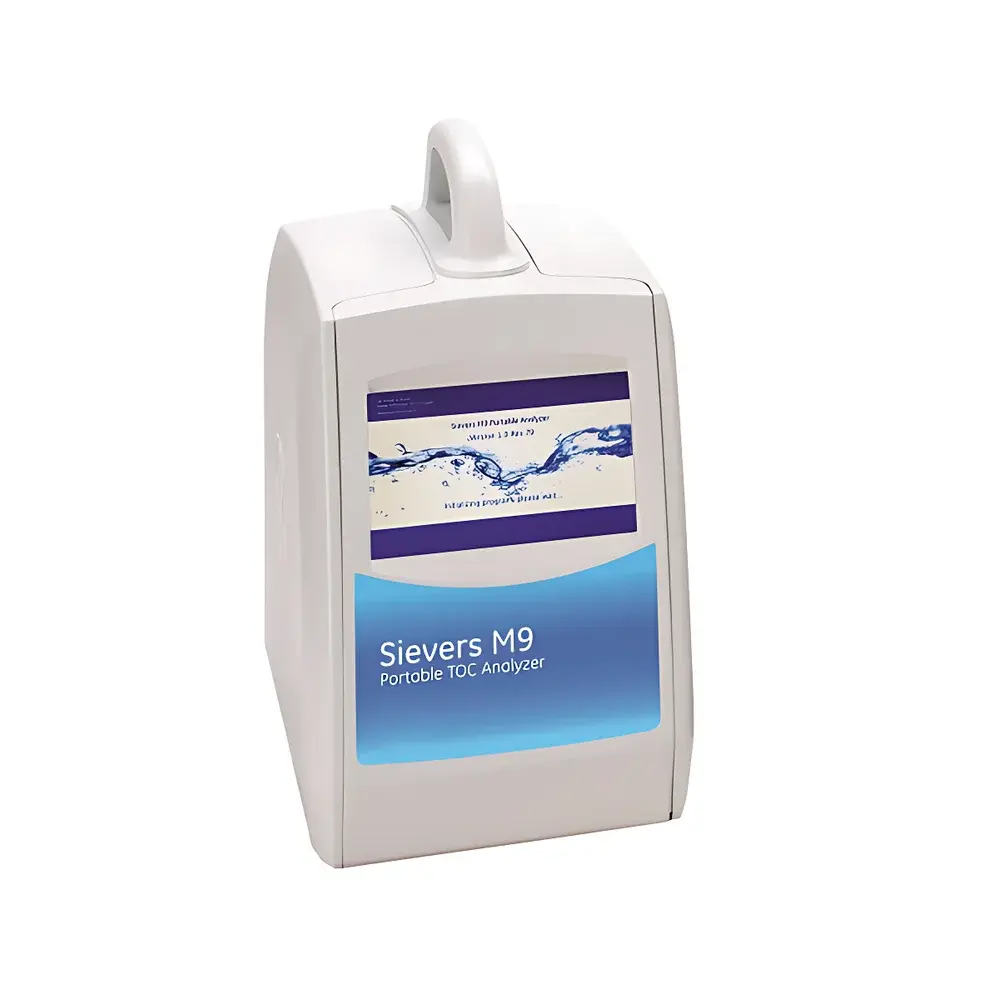
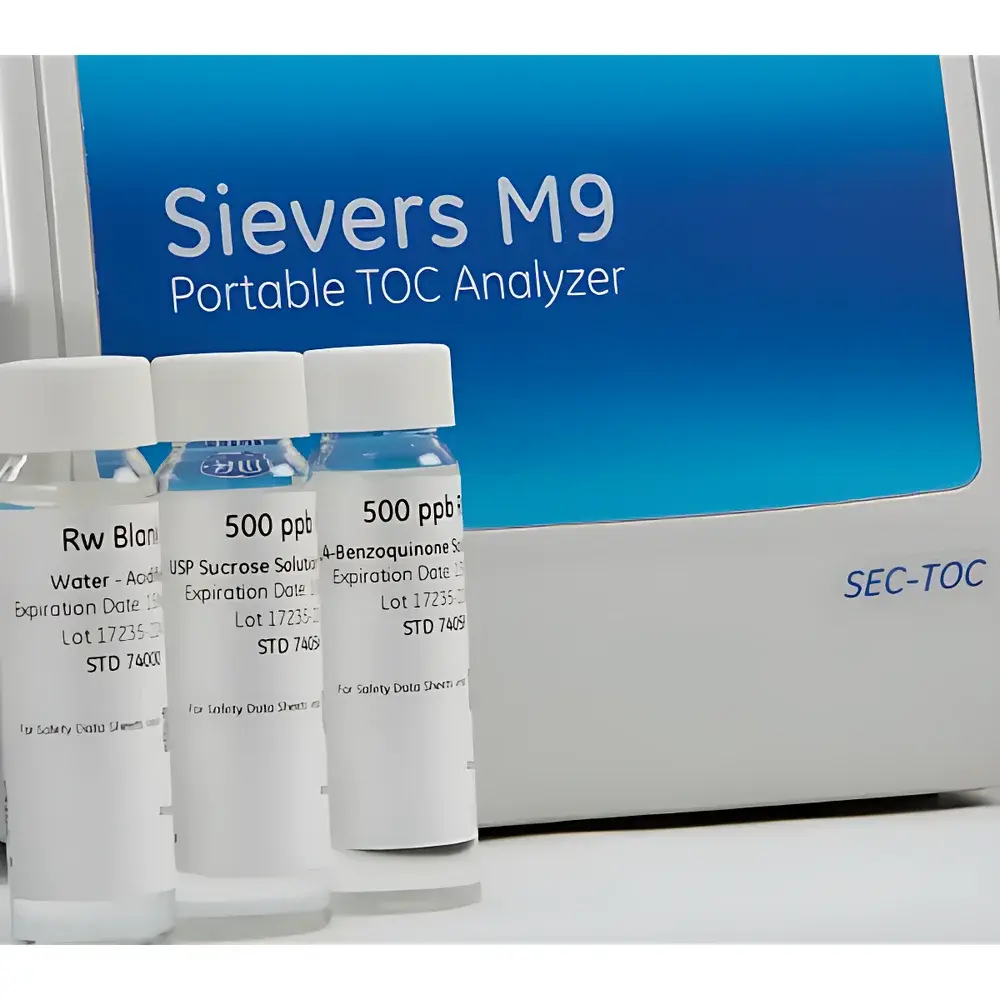
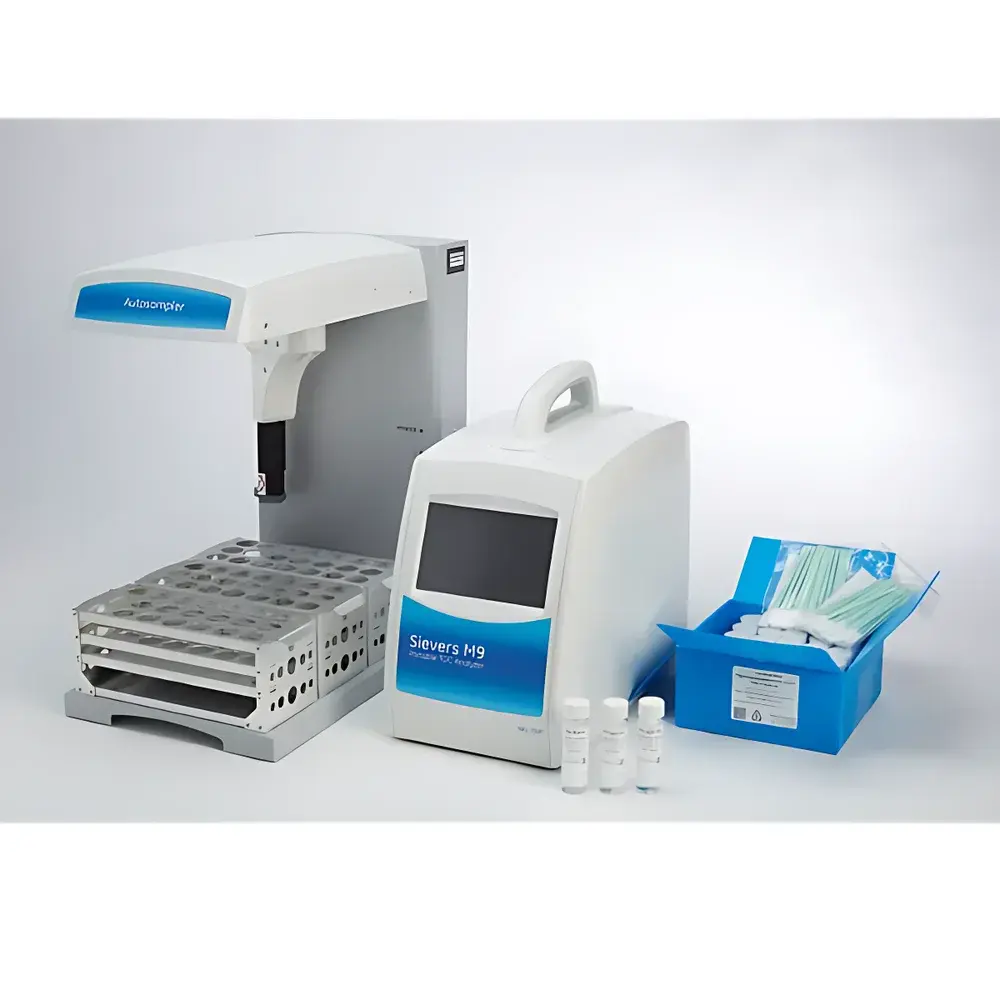
Sievers M9 Portable Total Organic Carbon (TOC) Analyzer
| Brand | Sievers (Veolia) |
|---|---|
| Origin | USA |
| Manufacturer Type | Original Equipment Manufacturer (OEM) |
| Product Category | Imported Instrument |
| Model | M9 Portable |
| Instrument Type | Portable TOC Analyzer |
| Detection Principle | Membrane Conductivity Detection |
| Oxidation Method | UV/Persulfate Oxidation |
| Measurement Range | 0.03 ppb – 50 ppm |
| Accuracy | ±2% or ±0.5 ppb (whichever is greater) |
| Resolution | 0.01 ppb |
| Detection Limit | 0.03 ppb |
| Repeatability | <1% RSD |
Overview
The Sievers M9 Portable Total Organic Carbon (TOC) Analyzer is a field-deployable, regulatory-compliant instrument engineered for high-precision quantification of organic carbon in ultrapure water systems, pharmaceutical process streams, and environmental water matrices. It employs a robust dual-oxidation strategy—combining 185/254 nm ultraviolet (UV) irradiation with catalyzed persulfate oxidation—to achieve near-complete conversion of non-volatile and volatile organic compounds into CO₂. The resulting CO₂ is selectively dissolved across a hydrophobic gas-permeable membrane and measured via high-stability membrane conductivity detection—a technique eliminating interferences from inorganic ions, particulates, or carrier gases. This principle ensures metrological traceability to NIST-traceable standards and delivers performance consistent with pharmacopeial requirements under dynamic flow conditions.
Key Features
- True portability: Weighing only 9.4 kg (20.8 lb) with integrated battery option, the M9 operates independently of external gas supplies, liquid reagent lines, or compressed air—enabling rapid deployment at any sampling point within a facility.
- Regulatory-ready architecture: Firmware and software are preconfigured to execute system suitability tests (SST), calibration verification, and reporting workflows compliant with USP , EP 2.2.44, JP , and JP —including compound-specific SST protocols (e.g., sucrose, 1,4-benzoquinone) and conductivity correlation algorithms required by Japanese Pharmacopoeia.
- Intelligent automation: Fully automated sequence execution includes auto-calibration, multi-point verification, blank subtraction, and real-time drift correction—reducing operator dependency and minimizing manual intervention.
- High-throughput analysis: Standard analysis time is 2 minutes; Turbo Mode reduces cycle time to 4 seconds for rapid screening without compromising accuracy or precision.
- Durability and serviceability: IP21-rated enclosure; annual preventive maintenance requires ≤4 hours; 12-month calibration stability verified per ASTM D5904 and ISO 8245; no consumables beyond UV lamp (rated for 12,000 hours) and oxidation reagent cartridges.
- Human-centered interface: 7-inch WVGA (800 × 480) full-color capacitive touchscreen with context-aware soft keys, graphical alarm navigation, and embedded help overlays—designed for operation by QC technicians with minimal training.
Sample Compatibility & Compliance
The M9 accepts discrete samples (via syringe or vial), continuous online flow (≥50 mL/min at ≤100 psig), or automated batch analysis (with optional 60-position autosampler). It supports sample temperatures from 5–95 °C (41–203 °F); PVDF-compatible iOS modules enable safe analysis of hot water up to 95 °C. Conductivity measurement (optional) covers 0.01–2000 µS/cm with ±0.005 µS/cm or ±1% accuracy—enabling concurrent PW/WFI conductivity verification per JP and USP . All data handling complies with FDA 21 CFR Part 11 requirements—including electronic signatures, audit trails, role-based access control, and immutable record storage. Instrument design conforms to IEC 61010-1 (safety) and IEC 61326-1 (EMC), certified to ETL and CE standards.
Software & Data Management
The onboard firmware implements a relational database architecture optimized for long-term data integrity, supporting SQL-based queries, customizable report templates (PDF/CSV), and secure export via USB host/device ports. Modbus TCP/IP and three isolated 4–20 mA analog outputs enable seamless integration into DCS/SCADA systems. Alarm logic includes configurable thresholds, latching/non-latching modes, and binary output triggering for automated shutdown or diversion events. All calibration records, SST logs, and raw chromatograms (conductivity vs. time) are timestamped, digitally signed, and retained with full revision history—facilitating GLP/GMP audits and regulatory inspections.
Applications
- Pharmaceutical water system validation and routine monitoring (PW, WFI, Pure Steam condensate)
- Troubleshooting TOC excursions in distribution loops, storage tanks, and point-of-use locations
- Verification of cleaning-in-place (CIP) efficacy and rinse water quality
- Environmental compliance testing of surface water, groundwater, and wastewater effluents
- Supporting ISO 14644-1 cleanroom water quality assessments
- Method transfer between lab-based and online TOC platforms using identical oxidation and detection physics
FAQ
Does the M9 require external carrier gas or compressed air?
No. The membrane conductivity detection method eliminates dependence on nitrogen, zero-air, or other purge gases.
Can the M9 perform simultaneous TOC and conductivity measurements?
Yes—when equipped with the optional integrated conductivity module, it satisfies JP and USP dual-parameter requirements for PW/WFI release testing.
What is the expected lifetime of the UV lamp?
The low-pressure mercury UV lamp is rated for 12,000 operating hours and contains mercury; disposal must follow local, state, and federal hazardous waste regulations.
Is remote diagnostics supported?
Yes—via Ethernet connection, authorized service personnel can initiate secure remote sessions for firmware updates, configuration review, and troubleshooting without onsite visit.
How does the M9 handle high-conductivity samples?
The hydrophobic membrane inherently rejects ionic interference; measured conductivity values remain stable even in samples up to 2000 µS/cm, ensuring TOC accuracy across diverse feedwater qualities.
Related Products







