
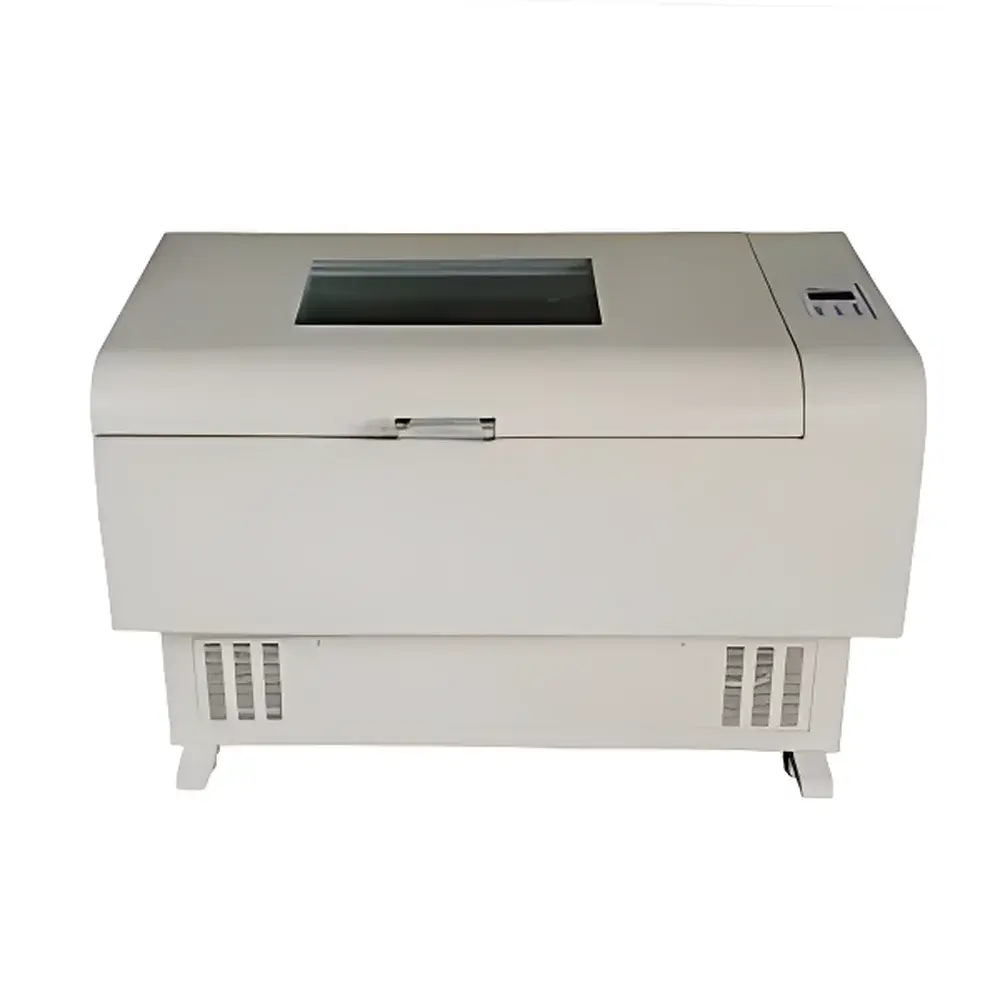
Boxun BSD-WX(F)1280 Large-Capacity Horizontal Incubator Shaker
| Brand | Boxun |
|---|---|
| Origin | Shanghai, China |
| Manufacturer Type | Direct Manufacturer |
| Product Category | Domestic |
| Model | BSD-WX(F)1280 |
| Instrument Type | Temperature-Controlled Orbital/Reciprocating Shaker |
| Timer Range | 0–999 h |
| Orbital Speed | 30–300 rpm |
| Reciprocating Speed | 30–250 rpm |
| Orbital Amplitude | Φ26 mm |
| Reciprocating Amplitude | 0–50 mm |
| Temperature Range | 4–60 °C |
| Shelf Quantity | 1 |
| Temperature Uniformity | ±1 °C (at 25 °C, empty chamber) |
| Temperature Stability | ±0.2 °C (at 37 °C) |
| Temperature Resolution | ±0.1 °C |
| Humidity Control Range | 40–95 %RH (±5 % fluctuation) |
| Power Supply | AC 220 V, 50/60 Hz |
| External Dimensions (W×D×H) | 1350 × 700 × 1000 mm |
| Chamber Dimensions (W×D×H) | 1010 × 590 × 470 mm |
| Shelf Dimensions | 950 × 530 mm (BSD-WX) / 920 × 560 mm (BSD-WF) |
| Max Load Capacity | 5000 mL × 7 (orbital) or 5000 mL × 7 (reciprocating) |
| Net Weight | 210 kg (BSD-WX) / 220 kg (BSD-WF) |
Overview
The Boxun BSD-WX(F)1280 is a large-capacity, horizontally configured incubator shaker engineered for high-reproducibility cultivation and biochemical reaction workflows requiring precise, simultaneous control of temperature and mechanical agitation. Designed around dual-mode oscillation—orbital (circular) and reciprocating (linear)—the instrument employs PID-based microprocessor regulation to maintain stable thermal environments across its full 4–60 °C operating range while delivering consistent, low-vibration motion profiles. Its structural architecture integrates forced-air convection, an insulated stainless-steel chamber with rounded corners and mirror-finish interior, and a reinforced bearing-driven drive system to ensure uniform heat distribution, minimal thermal overshoot during defrost cycles, and long-term operational reliability under continuous load. This platform meets the foundational engineering requirements for GLP-compliant cell culture expansion, microbial fermentation, enzyme kinetics studies, and hybridization protocols where environmental consistency directly impacts assay validity.
Key Features
- Two selectable oscillation modes: orbital (Φ26 mm amplitude, 30–300 rpm) and reciprocating (0–50 mm amplitude, 30–250 rpm), each calibrated to ±1 rpm accuracy
- PID-controlled temperature regulation with ±0.1 °C resolution, ±0.2 °C stability at 37 °C, and ±1 °C uniformity across the chamber at 25 °C (empty)
- Programmable multi-segment timing: up to 10 user-defined stages with independent setpoints for speed, temperature, and duration; total timer capacity up to 999 hours
- DC brushless motor drive system ensuring constant torque across the entire speed range, eliminating carbon wear and enabling smooth acceleration/deceleration profiles critical for shear-sensitive cultures
- Dual safety architecture: independent overtemperature cutoff switch, door interlock sensor, and motor overheat protection—each triggering automatic power disconnection
- Defrost management system minimizing temperature deviation during cycle transitions; integrated humidity control (40–95 %RH, ±5 % fluctuation) for extended suspension culture applications
- Ergonomic design elements: recessed control panel, tempered glass observation window, electrostatically coated exterior housing, and tool-free shelf access with quick-release clamping mechanism
Sample Compatibility & Compliance
The BSD-WX(F)1280 accommodates standard laboratory vessels ranging from 50 mL test tubes to 5000 mL baffled flasks, supporting configurations such as 2000 mL × 6 (orbital mode) or 500 mL × 75 (reciprocating mode). Its chamber geometry (1010 × 590 × 470 mm) and reinforced single-shelf structure (950 × 530 mm or 920 × 560 mm) are optimized for volumetric scalability without compromising mixing homogeneity. The unit conforms to IEC 61010-1 safety standards for laboratory equipment and supports audit-ready operation through password-protected parameter locking, real-time logging of setpoints and deviations, and optional GPRS alarm notification for out-of-specification events. While not certified for ISO 13485 or FDA 21 CFR Part 11 out-of-the-box, its data integrity framework—including timestamped event logs and non-editable runtime records—facilitates integration into validated QC/QA systems adhering to USP , ASTM E2500, and ISO/IEC 17025 requirements.
Software & Data Management
The embedded LCD interface provides real-time visualization of actual vs. target temperature, speed, remaining time, and system status codes. All operational parameters—including ramp rates, dwell times, and alarm thresholds—are configurable via intuitive menu navigation and secured by multi-level access control. Optional add-ons extend functionality: a thermal printer enables hardcopy generation of trend curves and endpoint reports; GPRS connectivity delivers SMS alerts upon temperature excursion, power interruption, or program completion; and RS-485/USB interfaces support bidirectional communication with LIMS or SCADA platforms for centralized monitoring. Audit trails record operator ID, timestamp, and parameter changes—supporting traceability in regulated environments where documentation of environmental conditions is mandated per CLIA, CAP, or EU Annex 11 guidelines.
Applications
This shaker serves core workflows in academic research laboratories, biopharmaceutical process development, and industrial quality control settings. Typical use cases include aerobic bacterial growth (e.g., E. coli expression cultures), yeast fermentation optimization, mammalian cell suspension expansion, antigen–antibody binding assays, DNA hybridization under controlled thermal cycling, and enzymatic digestion kinetics. Its wide temperature span and dual-motion capability make it suitable for comparative studies between orbital and linear agitation effects on oxygen transfer efficiency (kLa), biomass yield, and metabolite profile consistency. In food safety labs, it supports enrichment protocols compliant with ISO 6579 and AOAC 999.09; in environmental testing, it facilitates BOD incubation per EPA Method 405.1.
FAQ
What is the difference between BSD-WX and BSD-WF models?
The BSD-WX variant uses orbital shaking (Φ26 mm amplitude), while the BSD-WF employs reciprocating motion (0–50 mm amplitude); both share identical temperature control, chamber dimensions, and software architecture.
Does the unit support external data export?
Yes—via USB or RS-485 ports, enabling CSV-formatted log files compatible with Excel, MATLAB, or LabArchives for post-run analysis.
Can the shaker operate unattended for extended periods?
Yes—its 999-hour timer, auto-restart function after power recovery, and redundant thermal safeguards allow fully autonomous overnight or weekend runs.
Is humidity control active during shaking?
Yes—humidity regulation remains synchronized with temperature and agitation profiles, maintaining set RH levels throughout the entire operational cycle.
What maintenance is required for long-term reliability?
No scheduled motor servicing is needed due to the brushless design; routine tasks include chamber cleaning with ethanol, inspection of door gasket integrity, and annual calibration verification using NIST-traceable probes.




