
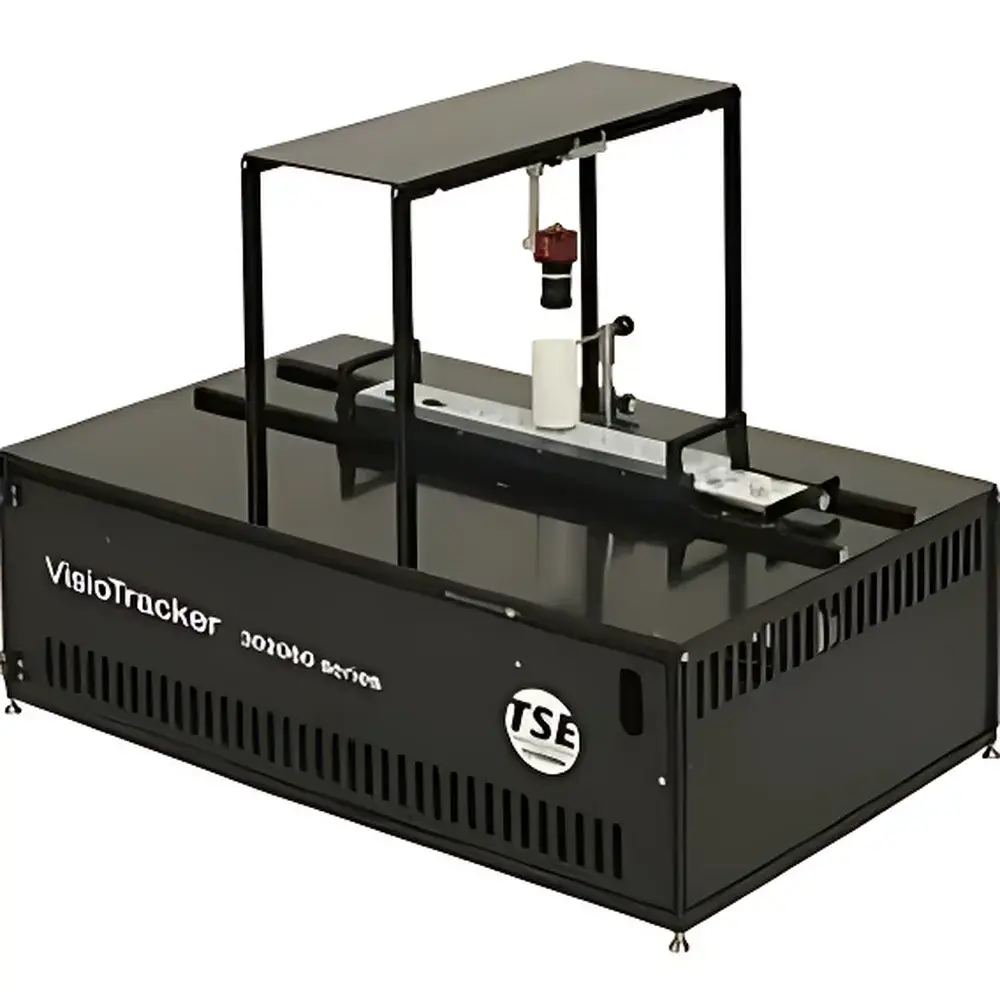
NewBehavior VisioTracker Automated Optomotor Response (OMR) Analysis System
| Brand | TSE Systems |
|---|---|
| Origin | Germany |
| Manufacturer Type | Authorized Distributor |
| Product Origin | Imported |
| Model | VisioTracker by NewBehavior |
| Pricing | Available Upon Request |
Overview
The NewBehavior VisioTracker Automated Optomotor Response (OMR) Analysis System is a purpose-built, high-precision platform engineered for quantitative, non-invasive assessment of visually guided motor behavior in small aquatic vertebrates—primarily zebrafish (Danio rerio) and medaka (Oryzias latipes) larvae and adults. At its core, the system leverages the optomotor response: a conserved, reflexive behavior wherein animals instinctively track moving visual stimuli (e.g., rotating gratings or drifting patterns) to stabilize their position in space. This innate sensorimotor coupling provides a robust, quantifiable readout of visual acuity, contrast sensitivity, motion detection fidelity, and downstream neural circuit integrity. Unlike manual observation or video-based scoring with post-hoc analysis, VisioTracker integrates real-time stimulus generation, synchronized high-speed imaging, and on-the-fly behavioral quantification—enabling objective, observer-independent measurement of response latency, tracking velocity, bout frequency, and directional persistence under fully controlled photic conditions.
Key Features
- Real-time, closed-loop stimulus control: Dynamic adjustment of spatial frequency, temporal frequency, contrast, pattern orientation, and motion direction—even during ongoing trials—ensures precise experimental parametrization and adaptive protocol execution.
- No pre-training or operant conditioning required: Relies exclusively on the innate OMR, eliminating learning confounds and enabling rapid throughput across developmental stages or genetically diverse cohorts.
- Digitally programmable stimulus library: Supports custom grating, sine-wave, random-dot kinematogram (RDK), and biologically relevant motion sequences via intuitive graphical interface; all stimuli are gamma-corrected and luminance-calibrated using integrated photometric validation.
- High-throughput experimental design: Accommodates up to 96 individual fish simultaneously in multi-well plates or custom arenas; automated arena recognition and ROI assignment minimize setup time and operator variability.
- Compact, benchtop footprint: Engineered for integration into standard laboratory environments—including light-controlled rooms and multi-system behavioral suites—without requiring dedicated infrastructure or vibration isolation.
- Automated raw data processing pipeline: Applies motion artifact correction, background subtraction, sub-pixel centroid tracking, and noise-filtered trajectory smoothing; outputs standardized CSV and HDF5 files compatible with MATLAB, Python (SciPy/Pandas), and R workflows.
Sample Compatibility & Compliance
The VisioTracker system is validated for use with larval (3–14 dpf) and adult zebrafish, medaka, and other small teleosts exhibiting robust OMR. It supports both free-swimming assays in Petri dishes or custom microfluidic chambers and restrained paradigms using agarose embedding or low-melt gel matrices. All optical components comply with IEC 62471 (Photobiological Safety) standards; LED-based stimulus displays meet EN 61000-3-2 harmonic emission limits. The system architecture adheres to GLP-compliant data integrity principles: audit-trail-enabled software logs all user actions, parameter changes, and calibration events; raw image sequences and processed metrics are timestamped, cryptographically hashed, and stored with immutable metadata—facilitating traceability for regulatory submissions (e.g., OECD TG 236, EPA OPPTS 850.1035) and internal QA/QC review.
Software & Data Management
VisioTracker Control & Analysis Suite (v5.x) is a Windows-based application built on a modular, deterministic real-time kernel. It provides dual-mode operation: interactive live monitoring with adjustable visualization overlays (velocity vectors, heatmaps, path density), and batch-mode scheduled experiments with conditional branching (e.g., stimulus escalation upon response failure). Data export conforms to MIAME/MINSEQE-aligned metadata schemas. Integrated support for FDA 21 CFR Part 11 compliance includes electronic signatures, role-based access control (RBAC), and encrypted database storage with automatic backup to network-attached storage (NAS) or cloud repositories (AWS S3, Azure Blob). Raw video archives are retained in lossless MJPEG-AVIs; processed metrics include angular velocity (°/s), gain (response amplitude / stimulus amplitude), phase lag (ms), and coherence (0–1 scale), all referenced to NIST-traceable timing signals.
Applications
- Genetic screening: Phenotypic characterization of visual pathway mutants (e.g., noi, lak, tbx2b) and CRISPR/Cas9 knockouts affecting retinal development or optic tectum connectivity.
- Neuropharmacology: Dose–response profiling of GABAergic, dopaminergic, and cholinergic modulators on sensorimotor gating and visual attention dynamics.
- Developmental neurotoxicology: Quantitative assessment of sub-lethal neurobehavioral deficits induced by environmental contaminants (e.g., PCBs, neonicotinoids, PFAS) during critical windows of visual circuit maturation.
- Sensory systems neuroscience: Mapping functional topography in the optic tectum via targeted optogenetic perturbation coupled with OMR readout.
- Drug discovery: Secondary phenotypic validation in high-content zebrafish screens targeting ophthalmic therapeutics, antipsychotics, or anti-epileptics.
FAQ
What species and life stages are supported?
Zebrafish and medaka from 3 days post-fertilization (dpf) through adulthood; validation data available for larval stages (3–7 dpf) and juvenile/adult swimming assays.
Does the system require external synchronization with electrophysiology or calcium imaging rigs?
Yes—TTL-compatible trigger I/O ports enable hardware-synchronized acquisition with patch-clamp amplifiers, two-photon microscopes, or miniature head-mounted fluorescence recorders.
Can VisioTracker be used for habituation or learning paradigms?
Not natively; it is optimized for reflexive OMR. For associative learning, the complementary VisioTrainer platform (also by NewBehavior) provides operant conditioning modules with reward delivery and memory retention tracking.
Is calibration documentation provided for regulatory audits?
Yes—NIST-traceable photometric calibration reports, timing accuracy validation certificates (±10 µs jitter), and software verification test protocols are included with each installation and updated annually.
How is data security handled for multi-user institutional deployments?
Role-based permissions, LDAP/Active Directory integration, encrypted local database storage, and optional FIPS 140-2 compliant encryption for exported datasets ensure alignment with HIPAA, GDPR, and institutional IRB requirements.





