
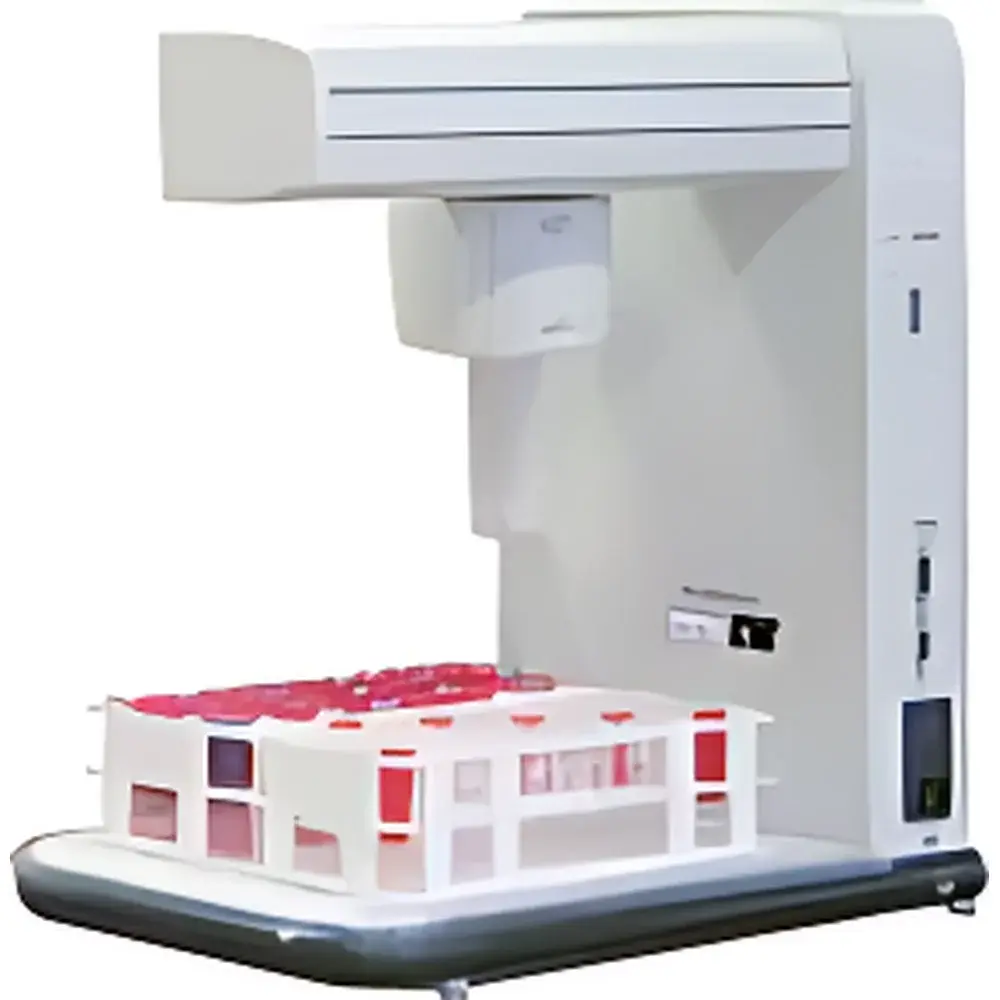
SEAL XY2-XY3 High-Capacity Random-Access Autosampler
| Brand | SEAL |
|---|---|
| Origin | Germany |
| Model | XY2-XY3 |
| Sample Capacity | 180 (XY2) / 270 (XY3) positions |
| Compatible Vial Sizes | 0.5 mL, 2 mL, 4 mL, 5 mL |
| Sampling Probe Material | Stainless Steel Sleeve + PEEK Needle |
| Dual-Needle Option | Available |
| Wash Station | Fixed (no movement required) |
| Motion Principle | Rotating Carousel Architecture |
| Control | Programmable Sampling Speed & Sequence |
Overview
The SEAL XY2-XY3 High-Capacity Random-Access Autosampler is an engineered solution for laboratories requiring robust, high-throughput sample introduction into discrete analyzers—particularly continuous flow analyzers (CFA), segmented flow analyzers (SFA), and automated wet-chemistry platforms. Based on a rotating carousel architecture, the system eliminates linear rail movement and mechanical arm translation, thereby reducing wear, positional drift, and carryover risk. Its core design adheres to the principles of deterministic random-access sampling: each vial position is individually addressable in real time, enabling non-sequential, priority-driven, or re-analysis–triggered sampling without queueing delays. The XY2 supports two interchangeable sample racks (180 positions total), while the XY3 accommodates three racks (270 positions), with flexible configuration across standard microtiter-compatible formats—including 0.5 mL, 2 mL, 4 mL, and 5 mL vials. All motion control, probe actuation, and wash cycle timing are governed by a deterministic embedded controller compliant with IEC 61508 functional safety guidelines for laboratory automation.
Key Features
- Fixed-position wash station: Eliminates mechanical translation of the wash cup, improving long-term reproducibility and reducing maintenance intervals.
- Rotating carousel platform: Ensures consistent angular acceleration and deceleration profiles, minimizing vibration-induced sample disturbance and meniscus instability during aspiration.
- PEEK-coated stainless steel sampling probe: Chemically inert across pH 0–14; validated for repeated exposure to concentrated nitric acid, hydrochloric acid, and alkaline digestates per ASTM D5170.
- Programmable aspiration speed: Adjustable volumetric draw rate (µL/s) and dwell time to accommodate viscous matrices, volatile solvents, or foaming samples—critical for trace metal analysis and enzymatic assays.
- Dual-needle option: Enables simultaneous sampling and reagent addition or parallel path routing—reducing cycle time in multi-step reaction protocols such as EPA Method 300.0 (anions) or ISO 15681-1 (phosphate).
- Calibration & QC rack support: Dedicated rack slots allow interleaved placement of calibration standards, blanks, and reference materials—enabling automated bracketing, drift correction, and real-time %RSD monitoring per ISO/IEC 17025:2017 clause 7.7.
Sample Compatibility & Compliance
The XY2-XY3 accommodates heterogeneous sample geometries without hardware modification. Rack adaptors support ANSI/SLAS-compliant 96-well plates, conical-bottom microcentrifuge tubes, and screw-cap vials—ensuring compatibility with legacy workflows and LIMS-integrated batch processing. All wetted materials comply with USP for plastic components and FDA 21 CFR Part 11 requirements for electronic records when paired with SEAL’s certified software suite. System validation documentation includes IQ/OQ/PQ templates aligned with GLP and GMP Annex 11 expectations, covering probe positioning accuracy (±0.15 mm), volume repeatability (RSD < 0.8% at 100 µL), and cross-contamination verification (< 0.05% carryover after high-concentration spike recovery tests).
Software & Data Management
Control is executed via SEAL AutoControl™ v4.x—a Windows-based application supporting method-driven scheduling, audit-trail logging, and electronic signature enforcement. Each sampling event is timestamped, annotated with rack ID, vial coordinates, aspiration volume, wash cycle count, and error flags (e.g., low-volume detection, clog alert). Raw logs export in CSV/SQLite format for integration with ELN systems (e.g., LabArchives, Benchling) or statistical process control (SPC) engines. The software architecture conforms to IEC 62304 Class B for medical device software, and all data handling pathways satisfy GDPR Article 32 technical safeguards for personal data minimization and pseudonymization.
Applications
- Environmental testing labs performing EPA-compliant nutrient and anion analysis (e.g., NO₃⁻, PO₄³⁻, SiO₂) on wastewater, surface water, and soil extracts.
- Clinical chemistry departments automating colorimetric assays for creatinine, uric acid, and total protein under CLIA and CAP accreditation frameworks.
- Pharmaceutical QC units executing dissolution testing per USP , where precise, repeatable sampling from multiple vessels is required at defined time points.
- Food & beverage R&D facilities quantifying preservatives (e.g., sorbates, benzoates) and organic acids (e.g., citric, lactic) using enzymatic or spectrophotometric endpoints.
- Academic core facilities supporting high-volume elemental screening via ICP-OES sample introduction—leveraging the dual-needle option for internal standard co-injection.
FAQ
What sample tube sizes does the XY2-XY3 support without adapter modification?
Standard configurations support 0.5 mL, 2 mL, 4 mL, and 5 mL round-bottom or conical vials—no tools or recalibration required.
Is the system compatible with third-party analyzers via RS-232 or Ethernet?
Yes: TTL-level trigger signals, ASCII command protocol (SEAL SCPI subset), and Modbus TCP are supported for OEM integration.
How is carryover mitigated between high-concentration and trace-level samples?
Triple-stage wash sequence (air purge → solvent flush → air dry) with programmable dwell times; validated per ISO 17511:2020 Annex C.
Can the autosampler operate unattended overnight with full audit trail retention?
Yes: Continuous operation up to 72 hours is supported; all events are logged with SHA-256 hashed integrity checks and encrypted local storage.
Does the PEEK needle require periodic replacement, and what is its service life?
Under normal use (≤5,000 aspirates/day), PEEK needles demonstrate >12 months service life; replacement kits include torque-calibrated installation tools and post-replacement verification scripts.






