
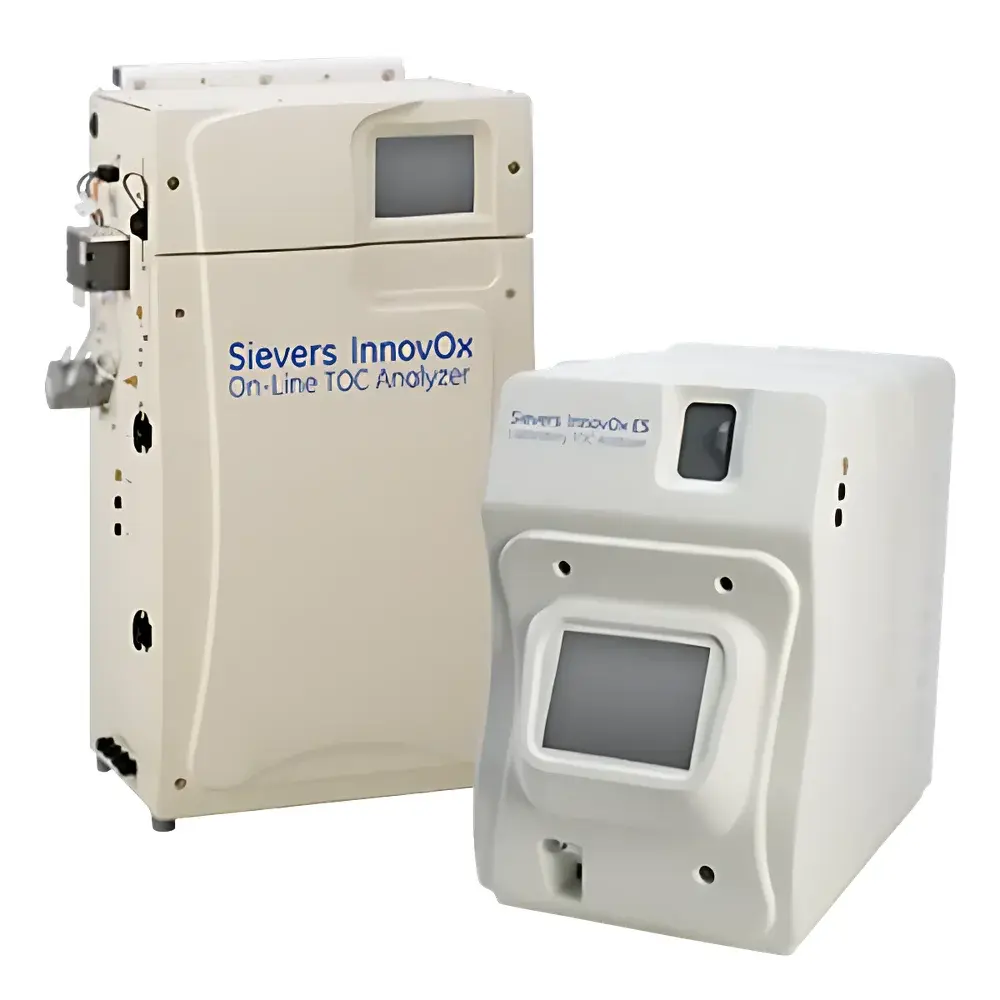
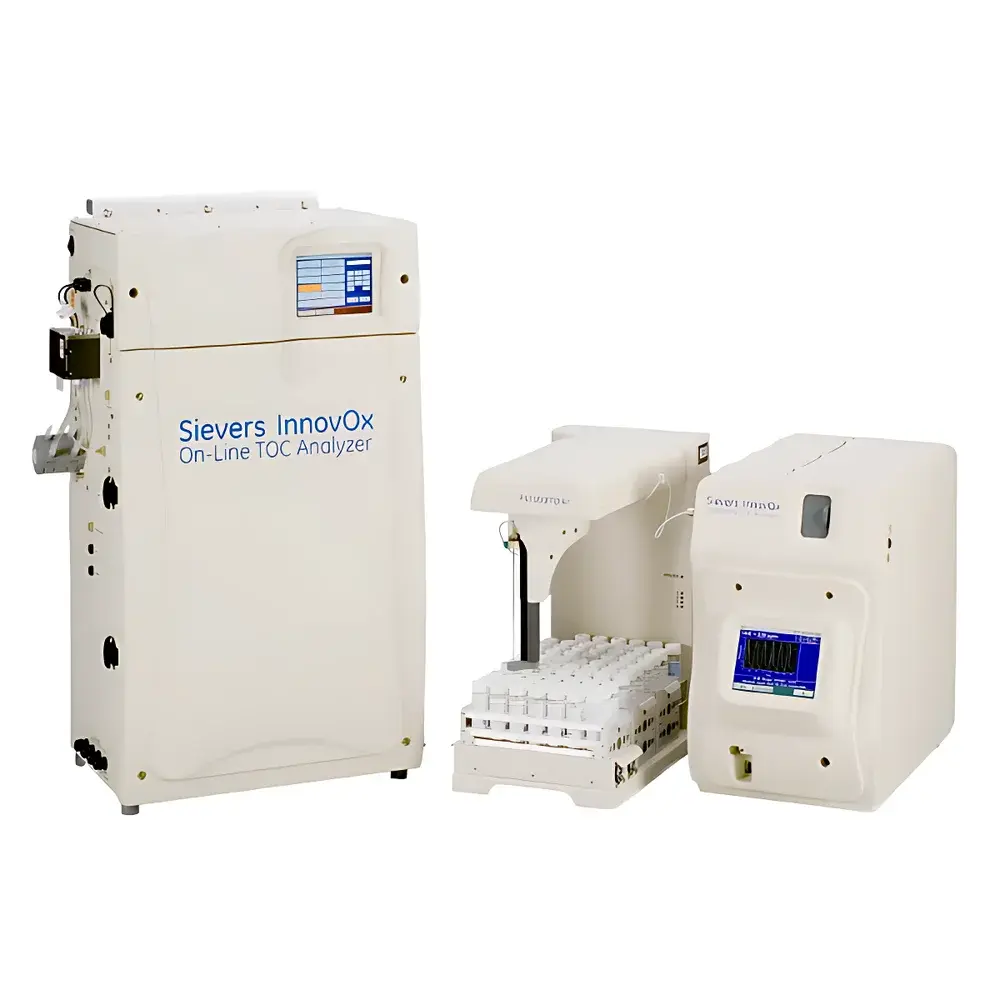
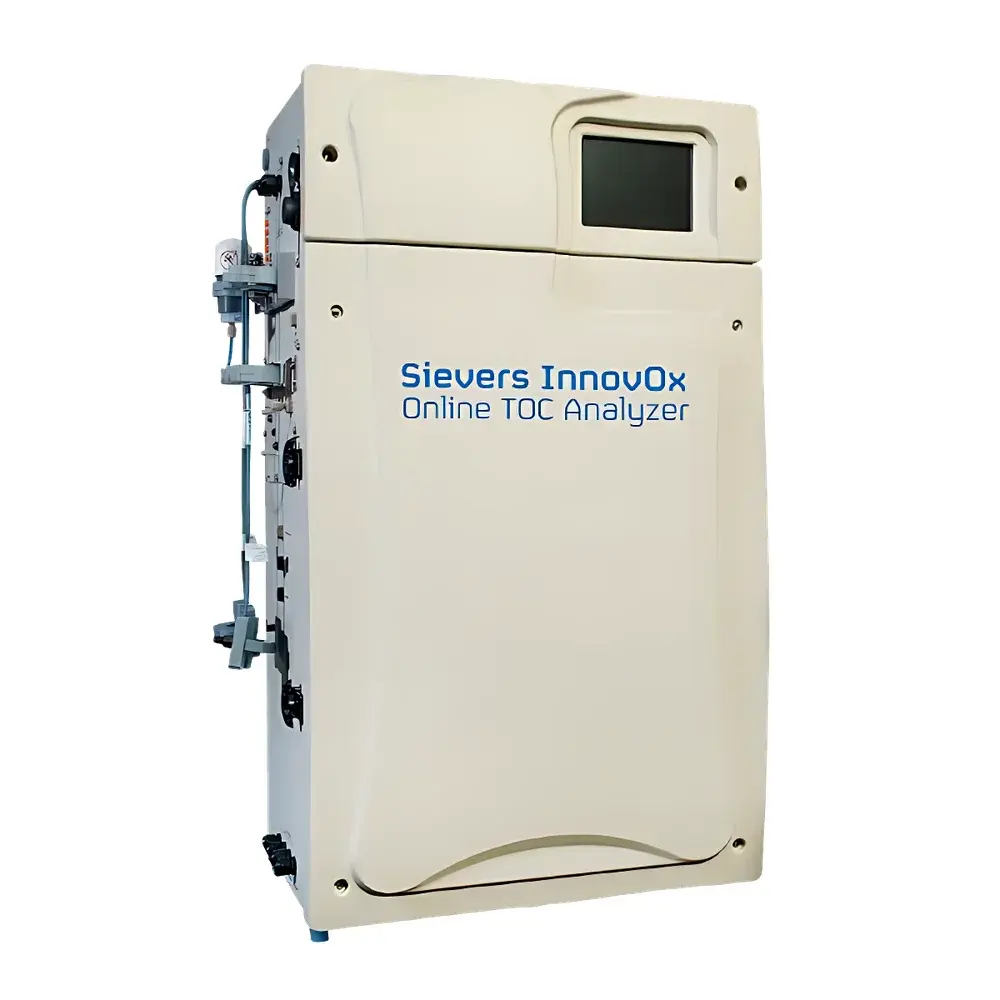
Sievers InnovOx Online Total Organic Carbon (TOC) Analyzer
| Brand | Sievers / Veolia |
|---|---|
| Origin | USA |
| Manufacturer Type | Original Equipment Manufacturer (OEM) |
| Product Category | Imported Instrument |
| Model | Sievers InnovOx Online |
| Instrument Type | Online TOC Analyzer |
| Detection Principle | Non-Dispersive Infrared (NDIR) Absorption |
| Oxidation Method | Supercritical Water Oxidation (SCWO) |
| Measurement Range | 0.5 – 50,000 ppm TOC |
| Accuracy | ±3% (at 50 ppm NPOC) |
| Resolution | 0.001 ppb |
| Detection Limit | 0.05 ppm NPOC |
| Repeatability | RSD ≤ 1.5% |
Overview
The Sievers InnovOx Online Total Organic Carbon (TOC) Analyzer is an industrial-grade, continuous-monitoring instrument engineered for high-reliability measurement of total organic carbon in demanding aqueous matrices—including saline water, wastewater effluents, pharmaceutical process streams, and environmental surface or groundwater. It employs a proprietary supercritical water oxidation (SCWO) technique coupled with non-dispersive infrared (NDIR) detection to achieve near-complete (>99%) oxidation of refractory organic compounds—such as cellulose, humic substances, and halogenated organics—that resist conventional persulfate or UV/persulfate oxidation methods. Unlike thermal catalytic or combustion-based TOC analyzers, the InnovOx Online operates at precisely controlled conditions of 375 °C and 3200 psi within a sealed reaction chamber, where water enters its supercritical state—exhibiting both liquid-like density and gas-like diffusivity—to enable rapid, homogeneous, and residue-free oxidation without catalyst degradation or quartz tube fouling. This architecture eliminates routine consumable replacement (e.g., catalysts, UV lamps, or combustion tubes), supporting uninterrupted operation for up to 30 days on a single reagent charge.
Key Features
- Supercritical water oxidation (SCWO) technology delivering >99% oxidation efficiency across diverse, high-salinity, and particulate-laden samples (up to 800 µm particle diameter)
- Wide dynamic linear range: 0.5–50,000 ppm TOC, enabling seamless analysis from ultrapure water to concentrated industrial waste streams
- High analytical robustness: ≤1.5% RSD repeatability and ±3% accuracy (at 50 ppm NPOC); calibration stability maintained for up to six months under routine operation
- Multi-stream capability: Configurable for up to five independent sample inlet lines via optional manifold modules—ideal for centralized monitoring of parallel process points
- Intuitive 7-inch color touchscreen interface with context-sensitive navigation, real-time diagnostics, and embedded method editor for custom analysis protocols (NPOC, TOC, TC, IC, TC–IC)
- Comprehensive connectivity: One Ethernet port (supporting Modbus TCP, HTTP, and SNMP), three USB ports (for data export, firmware updates, or peripheral integration), and configurable analog/digital I/O for PLC or DCS interfacing
- Regulatory-ready design: Compliant with ISO 8466-2, ASTM D5905, USP , and EP 2.2.44; supports audit trails, electronic signatures, and 21 CFR Part 11-compliant data management when paired with validated software platforms
Sample Compatibility & Compliance
The InnovOx Online accepts samples across a broad physicochemical spectrum: conductivity up to 100 mS/cm, suspended solids ≤800 µm, temperature range 10–60 °C, and ambient operating environment of 10–40 °C (non-condensing, indoor use only). Its SCWO core enables reliable quantification of TOC in seawater, brine recycle streams, pulp and paper effluents, and biopharmaceutical cleaning validation rinse waters—matrices that routinely challenge conventional TOC analyzers. The system meets CE marking requirements and carries ETL certification to UL 61010-1 and CSA C22.2 No. 61010-1 safety standards. It is designed for GLP/GMP environments and supports full traceability through time-stamped event logs, calibration history, and user-access-level controls aligned with FDA expectations for instrument qualification (IQ/OQ/PQ).
Software & Data Management
Data acquisition and reporting are managed via the embedded firmware and optionally extended through Sievers’ validated InnovOx Connect software suite. This platform provides secure remote access, automated report generation (PDF/CSV), configurable alarm thresholds (email/SMS/relay outputs), and trend visualization with statistical process control (SPC) overlays. All raw chromatograms, calibration curves, and system diagnostic records are stored with immutable timestamps and operator attribution. Audit trail functionality complies with 21 CFR Part 11 requirements—including electronic signature capture, change control logging, and prevention of data deletion—ensuring full defensibility during regulatory inspections. Data export formats support LIMS integration via ASTM E1384 or HL7 messaging protocols.
Applications
- Real-time TOC monitoring in pharmaceutical purified water (PW) and water-for-injection (WFI) distribution loops
- Effluent compliance tracking for municipal and industrial wastewater treatment plants (per EPA 40 CFR Part 136)
- Process water quality assurance in semiconductor fab ultrapure water (UPW) systems
- Environmental monitoring of groundwater contamination plumes and landfill leachate
- Performance verification of advanced oxidation processes (AOPs), membrane filtration, and activated carbon beds
- TOC mass balance studies in chemical manufacturing and bioreactor feedstock characterization
FAQ
What oxidation method does the InnovOx Online use, and why is it superior for saline samples?
It uses supercritical water oxidation (SCWO), which achieves complete oxidation of organics—including salt-tolerant compounds—without catalyst poisoning or chloride interference common in UV/persulfate systems.
Can the analyzer operate unattended for extended periods?
Yes—typical reagent interval exceeds 30 days under continuous operation; system self-diagnostics and predictive maintenance alerts minimize manual intervention.
Is the InnovOx Online compliant with pharmaceutical water quality standards?
Yes—it meets USP , EP 2.2.44, and JP 17 requirements for TOC testing of PW and WFI, and supports full 21 CFR Part 11 data integrity workflows.
How many sample streams can be monitored simultaneously?
Up to five independent liquid streams using the optional multi-port sampling manifold, each with dedicated flow control and auto-purge sequencing.
What is the lowest detectable TOC concentration?
The method detection limit (MDL) is 0.05 ppm NPOC; resolution is specified at 0.001 ppb for high-precision low-level trending.
Related Products







