
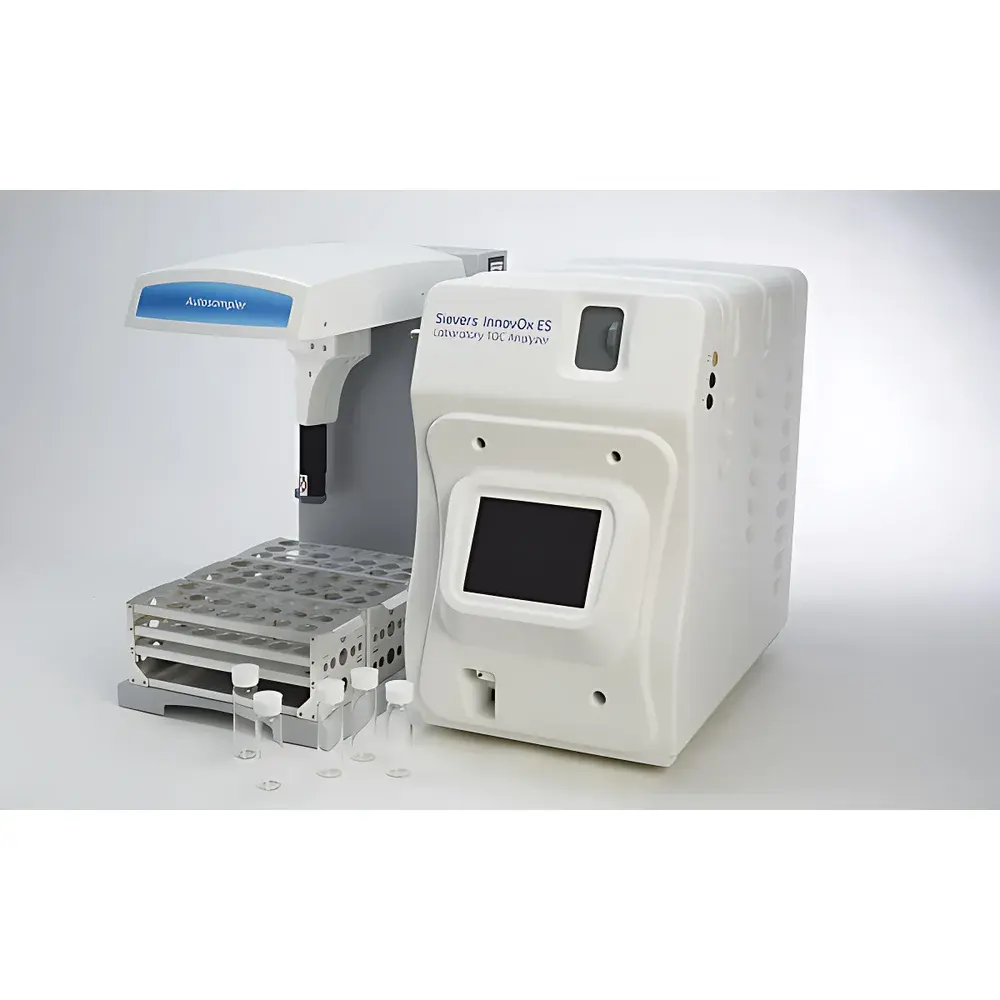
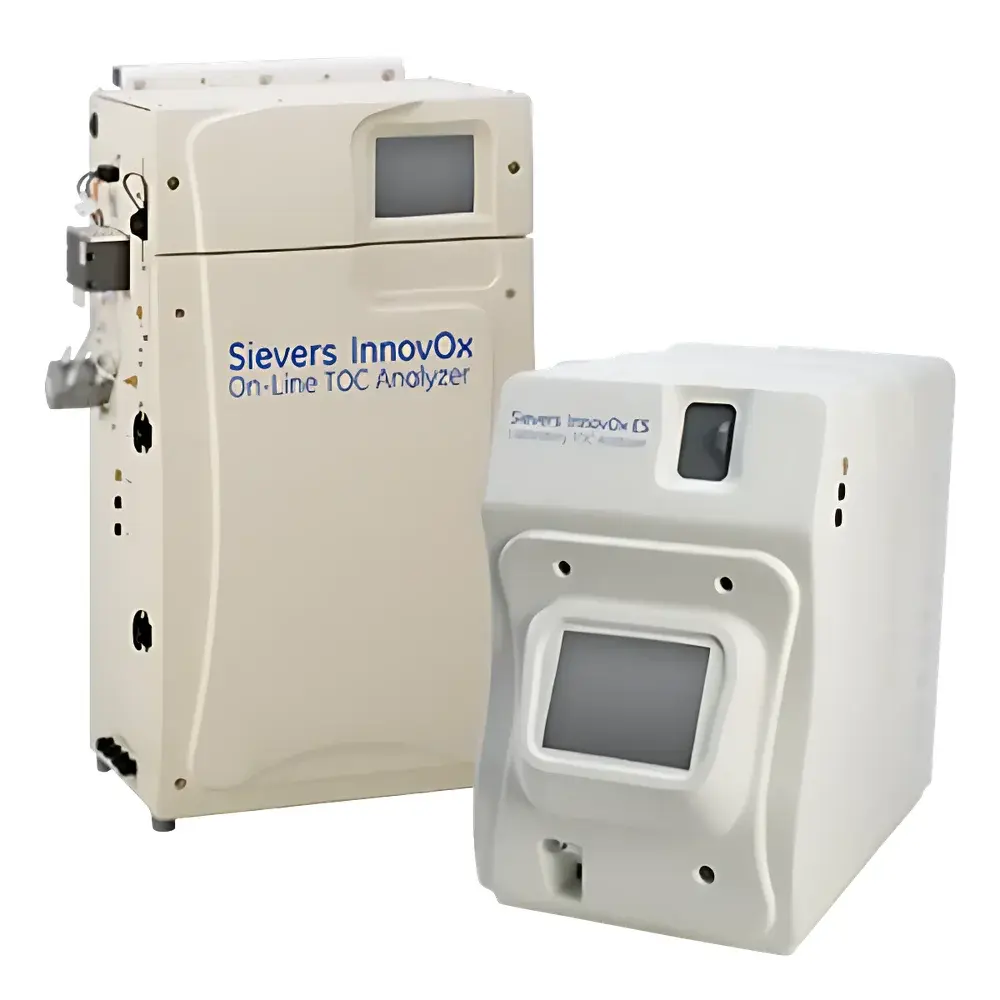
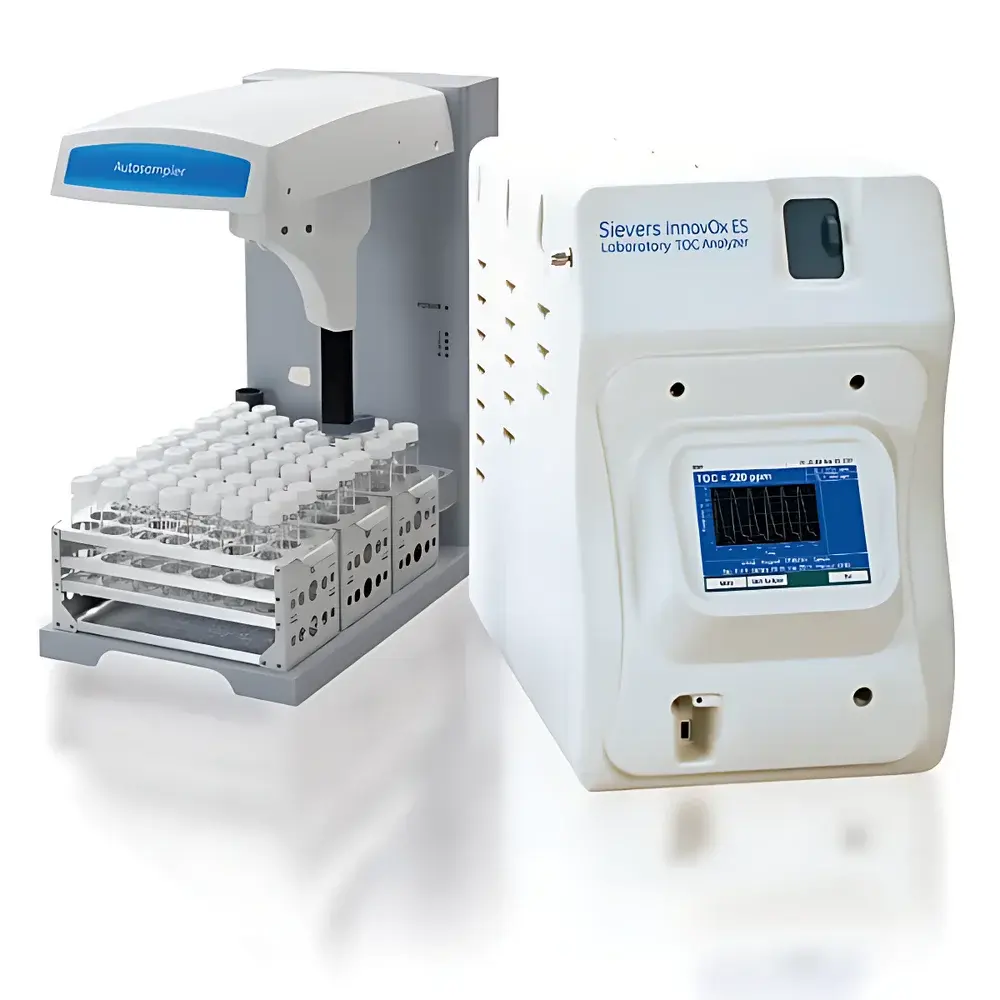
Sievers InnovOx ES Lab Total Organic Carbon Analyzer
| Brand | Sievers (Veolia) |
|---|---|
| Origin | USA |
| Manufacturer Type | Original Equipment Manufacturer (OEM) |
| Product Category | Imported Instrument |
| Model | Sievers InnovOx ES Lab |
| Instrument Type | Laboratory TOC Analyzer |
| Detection Principle | Non-Dispersive Infrared (NDIR) Absorption |
| Oxidation Method | Supercritical Water Oxidation (SCWO) |
| Measurement Range | 50 ppb – 50,000 ppm TOC |
| Accuracy | ±3% of reading or ±0.25 ppm (whichever is greater), for 1–100 ppm NPOC/TOC |
| Resolution | 0.001 ppb |
| Detection Limit | 50 ppb NPOC |
| Repeatability | RSD ≤ 3% (>5 ppm NPOC or TOC) |
Overview
The Sievers InnovOx ES Lab Total Organic Carbon Analyzer is a high-performance, laboratory-grade instrument engineered for precise and robust quantification of total organic carbon in diverse aqueous matrices. It employs patented supercritical water oxidation (SCWO) technology—operating at temperatures above 374 °C and pressures exceeding 22.1 MPa—to completely mineralize refractory organic compounds, including humic substances, polymers, and halogenated organics, into CO₂. This CO₂ is then quantified via high-stability non-dispersive infrared (NDIR) detection, delivering trace-level sensitivity and exceptional resistance to matrix interferences. Designed for demanding regulatory and industrial environments, the InnovOx ES Lab meets method requirements aligned with US EPA Method 415.3, ASTM D7573, ISO 8245, and pharmacopeial guidelines (USP , EP 2.2.44). Its architecture supports long-term unattended operation with minimal maintenance, making it suitable for QC laboratories, environmental testing facilities, and R&D centers requiring rigorous data integrity and audit readiness.
Key Features
- Patented supercritical water oxidation (SCWO) ensures complete oxidation of complex, recalcitrant organics—including high-salinity brines, cellulose-rich effluents, and viscous process streams—without catalyst degradation or reactor fouling.
- Extended calibration stability: verified performance over six months without recalibration under routine laboratory conditions, reducing operational downtime and standard consumption.
- Dynamic measurement range spanning five orders of magnitude: 50 ppb to 50,000 ppm TOC, enabling analysis of ultrapure water, wastewater, seawater, and industrial process streams on a single platform.
- Multi-mode analysis capability: simultaneous support for TOC, TC, TIC, IC, and NPOC protocols with automated acid sparging and purge steps per ASTM D5997 and ISO 8245.
- Integrated Ethernet interface and three USB ports enable secure remote access via web browser, direct data export to USB storage, and seamless integration into LIMS or ELN systems.
- Color LCD touchscreen interface with intuitive workflow navigation; no proprietary software installation required for basic operation or diagnostics.
- Robust mechanical design compliant with UL 61010-1, CSA C22.2 No. 61010-1, and CE directives; rated for indoor use up to 3,000 m altitude and 95% relative humidity (non-condensing).
Sample Compatibility & Compliance
The InnovOx ES Lab accepts samples with suspended particulates up to 800 µm in diameter and accommodates temperature ranges from 10–60 °C. It is validated for high-salinity matrices (e.g., seawater, chlor-alkali brines), fiber-laden pulp and paper effluents, pharmaceutical rinse waters, and municipal wastewater—without dilution or pretreatment. The system complies with data integrity requirements under FDA 21 CFR Part 11 when operated with optional audit trail and electronic signature modules. All analytical methods are traceable to NIST-traceable potassium hydrogen phthalate (KHP) and sodium bicarbonate standards. Instrument qualification documentation (IQ/OQ/PQ) templates are provided to support GLP and GMP validation processes.
Software & Data Management
Operation is managed through an embedded web server accessible via any modern browser—eliminating dependency on Windows-specific applications. Raw absorbance signals, oxidation efficiency logs, pressure/temperature profiles, and calibration history are stored locally with timestamped metadata. Data export formats include CSV, PDF reports, and XML for LIMS ingestion. Optional software packages provide advanced features: trend analysis across batches, automatic outlier flagging based on user-defined RSD thresholds, and electronic record retention aligned with ALCOA+ principles (Attributable, Legible, Contemporaneous, Original, Accurate, Complete, Consistent, Enduring, Available).
Applications
- Pharmaceutical manufacturing: TOC monitoring of purified water (PW), water for injection (WFI), and clean-in-place (CIP) rinse solutions per USP and EU Annex 1.
- Power generation: boiler feedwater and condensate analysis to prevent corrosion and deposition in steam cycles.
- Environmental compliance: municipal wastewater discharge reporting per NPDES permits and EPA Clean Water Act requirements.
- Chemical and petrochemical industries: real-time tracking of organic load in scrubber effluents, catalyst regeneration streams, and desalination reject brines.
- Food & beverage quality control: verification of cleaning efficacy in CIP systems and source water safety assessment.
- Academic and government research: kinetic studies of organic pollutant degradation, carbon flux modeling in bioreactors, and method development for emerging contaminants.
FAQ
What oxidation method does the InnovOx ES Lab use, and why is it advantageous for challenging matrices?
It uses supercritical water oxidation (SCWO), which achieves near-complete (>99.9%) carbon recovery for recalcitrant compounds without catalyst poisoning or salt precipitation—critical for high-TDS or fibrous samples.
Can the instrument differentiate between TOC and NPOC modes automatically?
Yes. The system executes fully automated acidification, sparging, and oxidation sequences per ASTM D5997, with configurable sparge times and acid dosing volumes.
Is the 50 ppb detection limit achievable in all sample types?
The stated LOD applies to low-conductivity, particle-free matrices under controlled lab conditions (e.g., reagent water). For complex samples, method detection limits may vary and should be established per EPA guidance.
Does the analyzer support 21 CFR Part 11 compliance out of the box?
Basic audit trail functionality is built-in; full Part 11 compliance requires configuration of user roles, electronic signatures, and secure data archiving—supported via optional software modules and documented SOPs.
How often does the SCWO reactor require maintenance?
Under normal operation with representative process waters, preventive maintenance intervals are recommended every 12 months; consumables include quartz reaction tubes and NDIR detector windows, both field-replaceable without tools.
Related Products







