
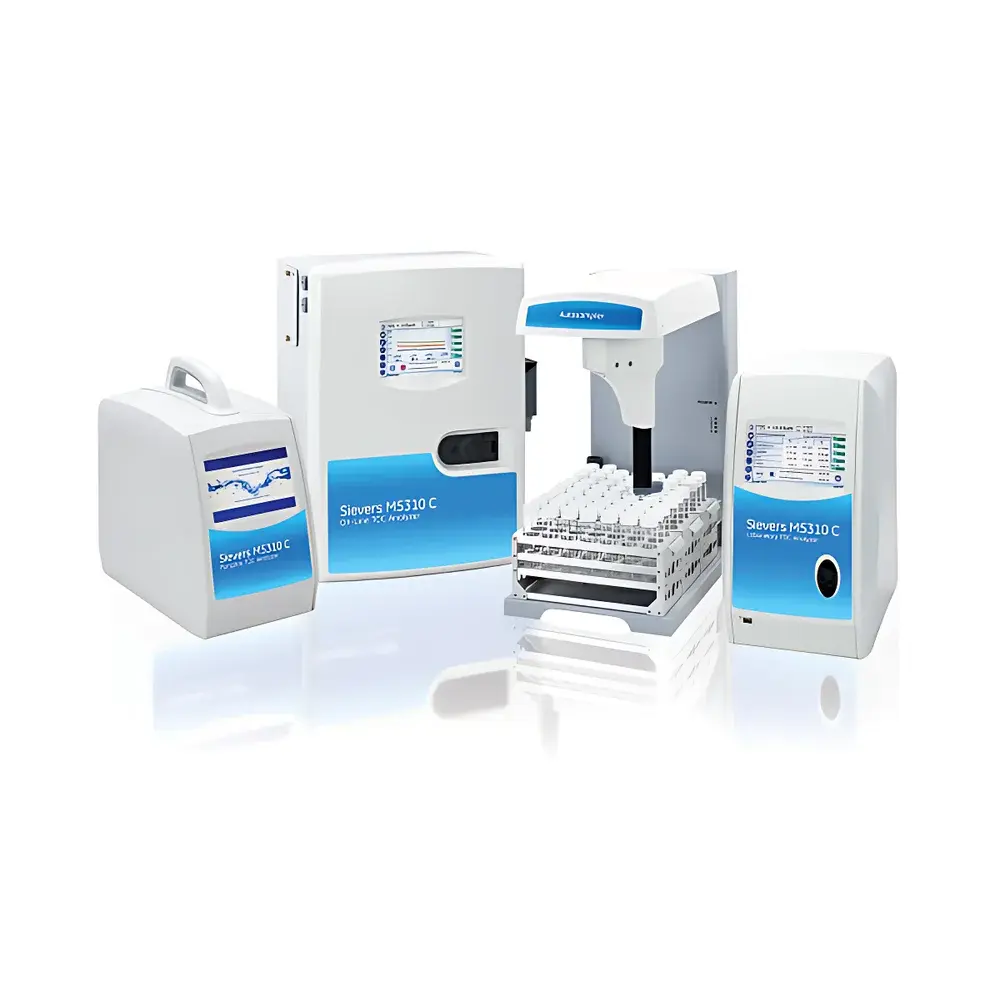
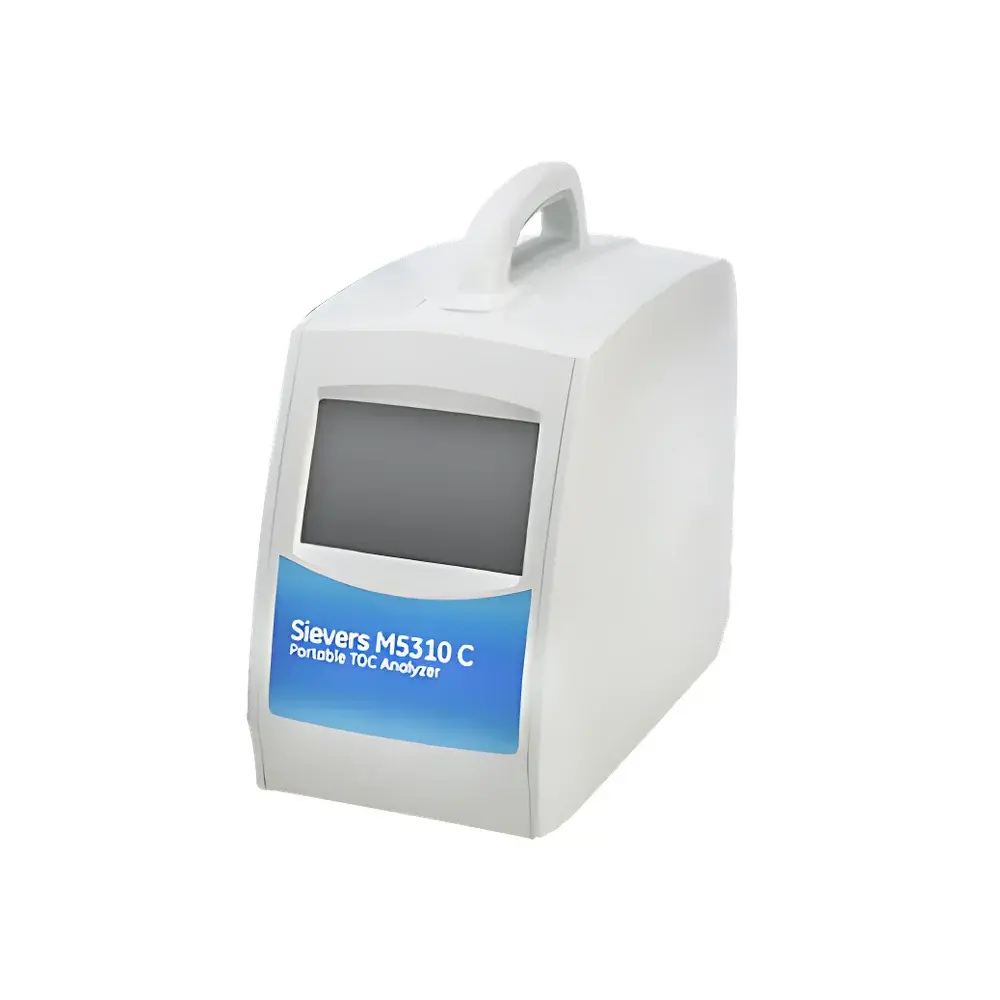
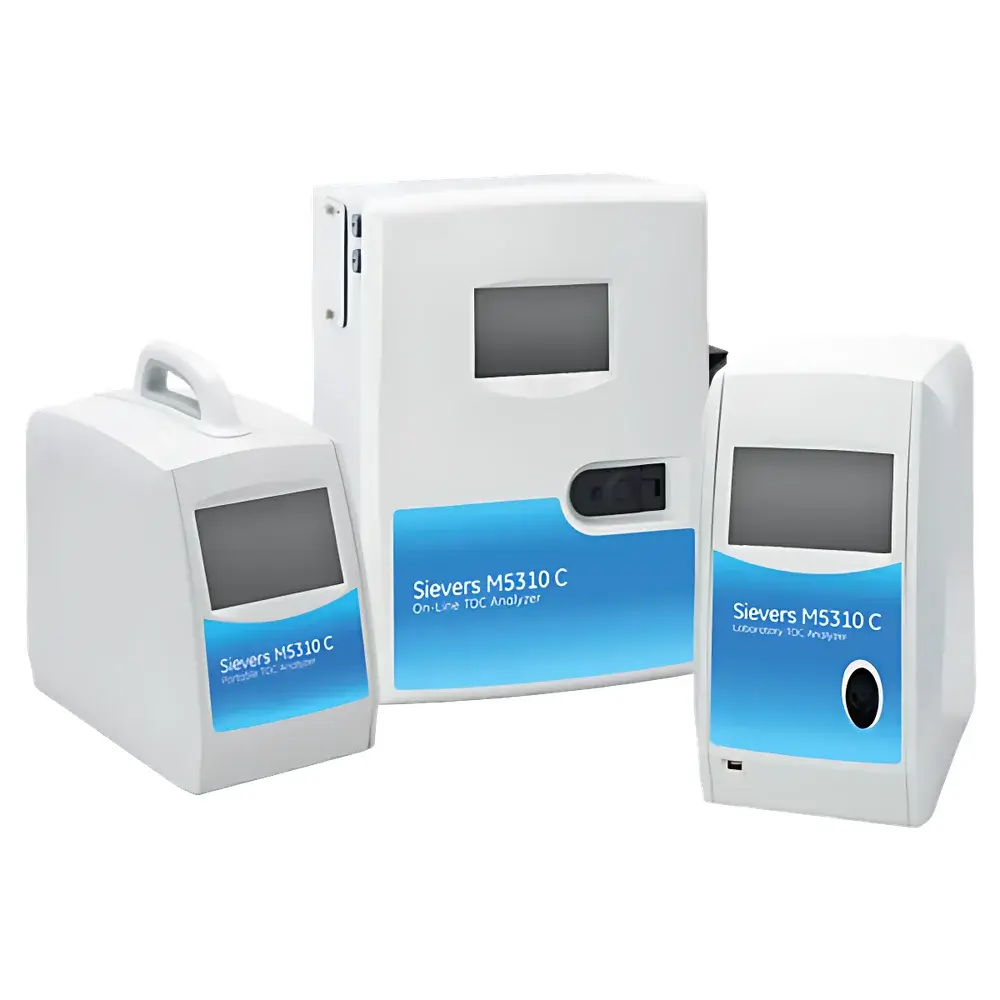
Sievers M5310 C Portable Total Organic Carbon (TOC) Analyzer
| Brand | Sievers (Veolia) |
|---|---|
| Origin | USA |
| Manufacturer Type | Original Equipment Manufacturer (OEM) |
| Product Category | Imported Instrument |
| Model | M5310 C Portable |
| Instrument Type | Portable TOC Analyzer |
| Detection Principle | Membrane Conductivity Detection |
| Oxidation Method | UV/Persulfate Oxidation |
| Measurement Range | 4 ppb – 50 ppm |
| Accuracy | ±2% or ±0.5 ppb (whichever is greater) |
| Resolution | 0.1 ppb |
| Detection Limit | 4 ppb |
| Repeatability | <1% RSD |
Overview
The Sievers M5310 C Portable Total Organic Carbon (TOC) Analyzer is a field-deployable, laboratory-grade instrument engineered for precise, reliable quantification of non-purgeable organic carbon in water matrices. It employs a dual-stage oxidation methodology—combining 185/254 nm ultraviolet irradiation with catalyzed persulfate—to fully mineralize recalcitrant organic compounds—including humic substances, fulvic acids, and low-molecular-weight organics—into carbon dioxide. The resulting CO₂ is selectively stripped from the aqueous stream via gas-permeable membrane separation and measured using high-stability membrane conductivity detection. This US EPA–validated approach (Methods 5310 C and 415.3) ensures regulatory compliance for drinking water, pharmaceutical water systems (PW, WFI), wastewater effluent, and environmental surface water monitoring. Unlike combustion-based TOC analyzers, the M5310 C requires no carrier gas, external reagent lines, or high-temperature furnaces—reducing infrastructure dependencies and operational complexity while maintaining trace-level sensitivity down to 4 ppb.
Key Features
- True portability: Weighing only 9.8 kg (21.6 lb) with integrated battery-ready design for mobile deployment across distribution networks, treatment plants, and remote sampling sites.
- Two-minute analysis cycle: Delivers quantitative TOC results in ≤120 seconds—twice the speed of legacy 5310 C platforms—without compromising precision or recovery fidelity.
- Self-optimizing operation: Fully automated calibration, verification, blank subtraction, and method-driven reagent dosing eliminate manual intervention and operator-induced variability.
- Intuitive 7-inch WVGA color touchscreen interface with graphical diagnostics, contextual alarm navigation, and one-tap troubleshooting workflows—designed for rapid resolution without service dispatch.
- Robust 12-month calibration stability: Validated under GLP-compliant conditions; reduces scheduled maintenance to <4 hours annually and eliminates routine recalibration during normal operation.
- Integrated data architecture: Onboard relational database supports timestamped sample logging, method versioning, audit trail capture, and export-ready CSV/Excel reporting—fully compatible with LIMS integration via Ethernet or USB host.
Sample Compatibility & Compliance
The M5310 C accepts discrete grab samples (via syringe or auto-sampler), continuous online streams (with optional flow cell and pressure regulation), and timed-interval monitoring configurations. It accommodates sample temperatures from 5–95 °C (41–203 °F); above 60 °C, PVDF iOS tubing is recommended for chemical resistance. Sample inlet pressure tolerance extends to 100 psig, with minimum flow requirements of >50 mL/min for online mode and 0.5 mL/min for discrete analysis. The analyzer meets ETL and CE safety standards, carries IP21 ingress protection, and operates reliably at altitudes up to 3,000 m. Its measurement protocol satisfies US EPA 5310 C, ASTM D5907, ISO 8245, and pharmacopeial requirements (USP , EP 2.2.44, JP 2.59) for purified water and water-for-injection quality control. Automatic TOC removal efficiency calculation—comparing influent and effluent concentrations—is embedded for DBPR (Disinfectants and Disinfection Byproducts Rule) compliance reporting.
Software & Data Management
The embedded firmware implements secure, role-based access control and full 21 CFR Part 11–aligned electronic recordkeeping—including user authentication, audit trail generation (with immutable timestamps), electronic signatures, and change history for all analytical methods and calibration events. All raw and processed data reside in an indexed SQL-compatible onboard database, enabling rapid search by date range, sample ID, method name, or QC status. Export options include USB mass storage, Ethernet file transfer, and analog 4–20 mA output (three configurable channels). Optional software packages support advanced trend analysis, SPC charting, and automated report generation aligned with ISO/IEC 17025 documentation requirements.
Applications
- Drinking water utilities: Real-time TOC profiling pre- and post-filtration to optimize coagulant dosing and assess disinfection byproduct precursor load.
- Pharmaceutical manufacturing: Routine monitoring of PW/WFI loops per FDA guidance and EU GMP Annex 1; validation support for system qualification (IQ/OQ/PQ).
- Wastewater treatment: Effluent compliance tracking against NPDES permits; evaluation of biological treatment efficiency via TOC mass balance.
- Environmental field studies: Rapid assessment of organic loading in rivers, lakes, and groundwater—especially where transport of benchtop instruments is impractical.
- Industrial process water: Monitoring boiler feedwater, semiconductor rinse water, and food/beverage production lines for organic contamination events.
FAQ
Does the M5310 C require external carrier gas or compressed air?
No. It operates entirely without carrier gas, zero-air generators, or auxiliary gas supplies—relying solely on membrane-based CO₂ extraction.
Can the instrument perform TOC removal rate calculations automatically?
Yes. When configured with dual online inlets (influent + effluent), it computes real-time % TOC removal and logs differential values with full traceability.
What regulatory standards does its oxidation/detection method satisfy?
It complies with US EPA Methods 5310 C and 415.3, ASTM D5907, ISO 8245, and pharmacopeial monographs including USP and EP 2.2.44.
Is the UV lamp replaceable by the end user?
Yes—the 185/254 nm low-pressure mercury lamp is a field-serviceable consumable with documented replacement procedure and disposal guidance per local hazardous waste regulations.
How is data integrity ensured during power interruption or network loss?
All measurements are written to non-volatile memory prior to display; audit trails and method parameters persist across reboots, and unsent data queues automatically resume transmission upon network recovery.
Related Products







