
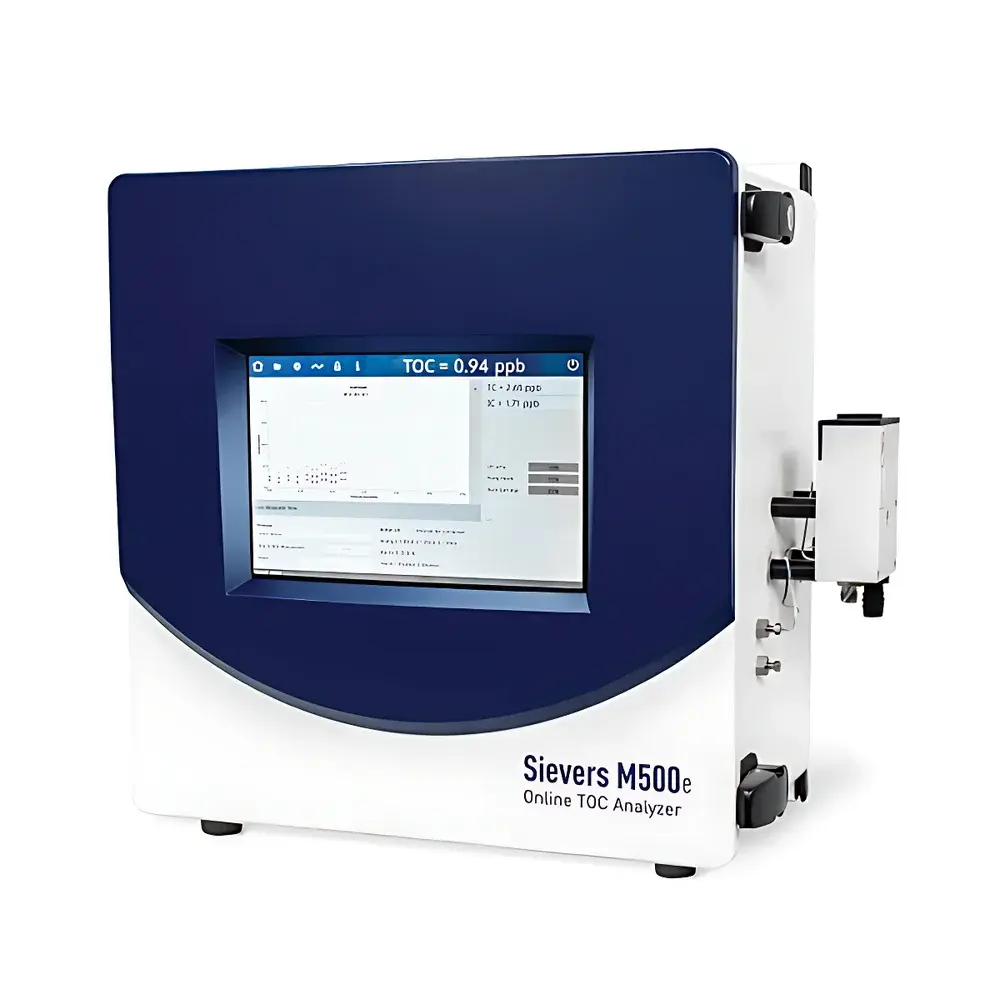
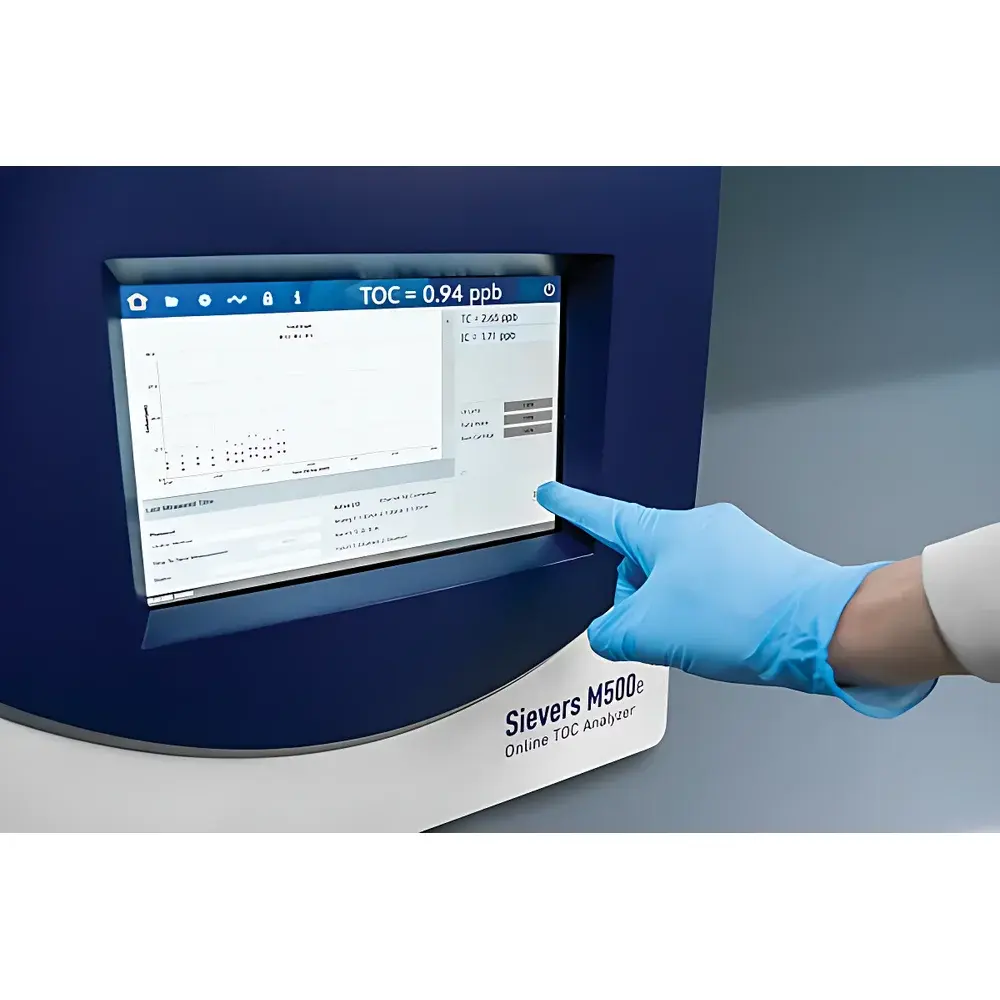
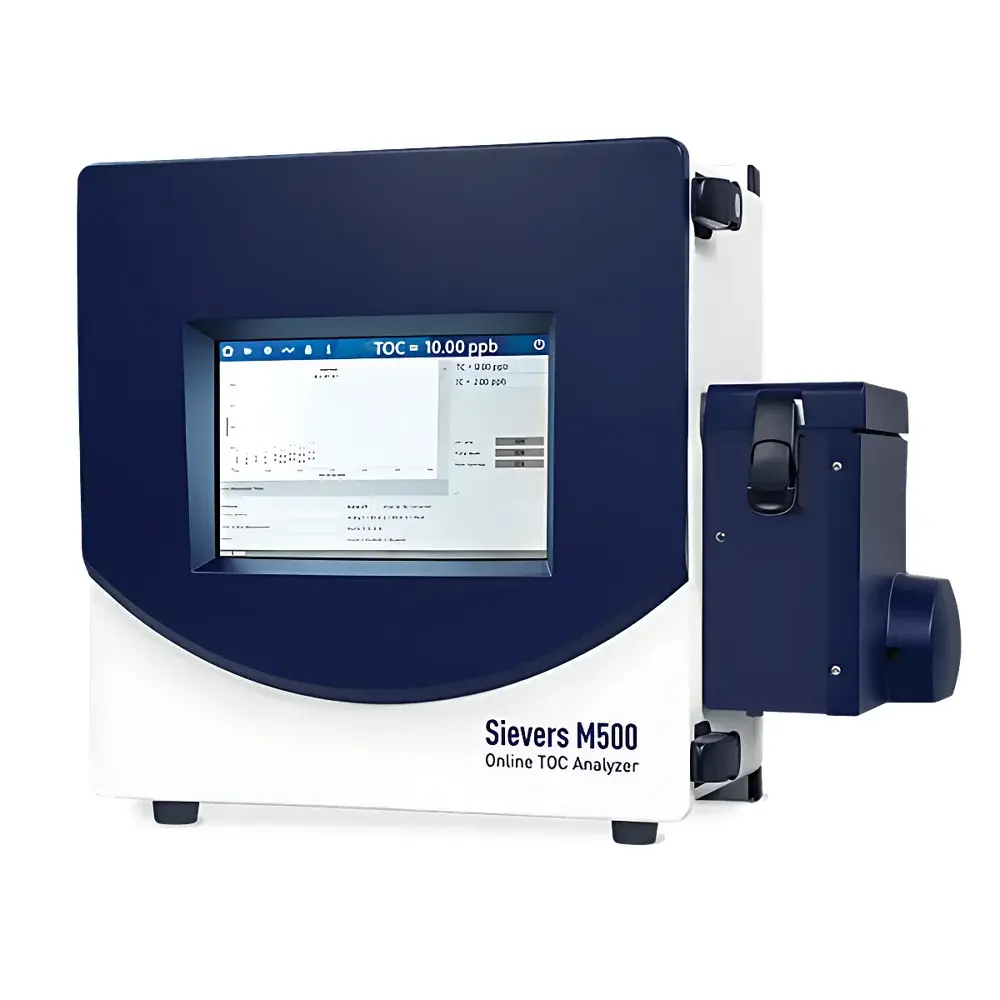
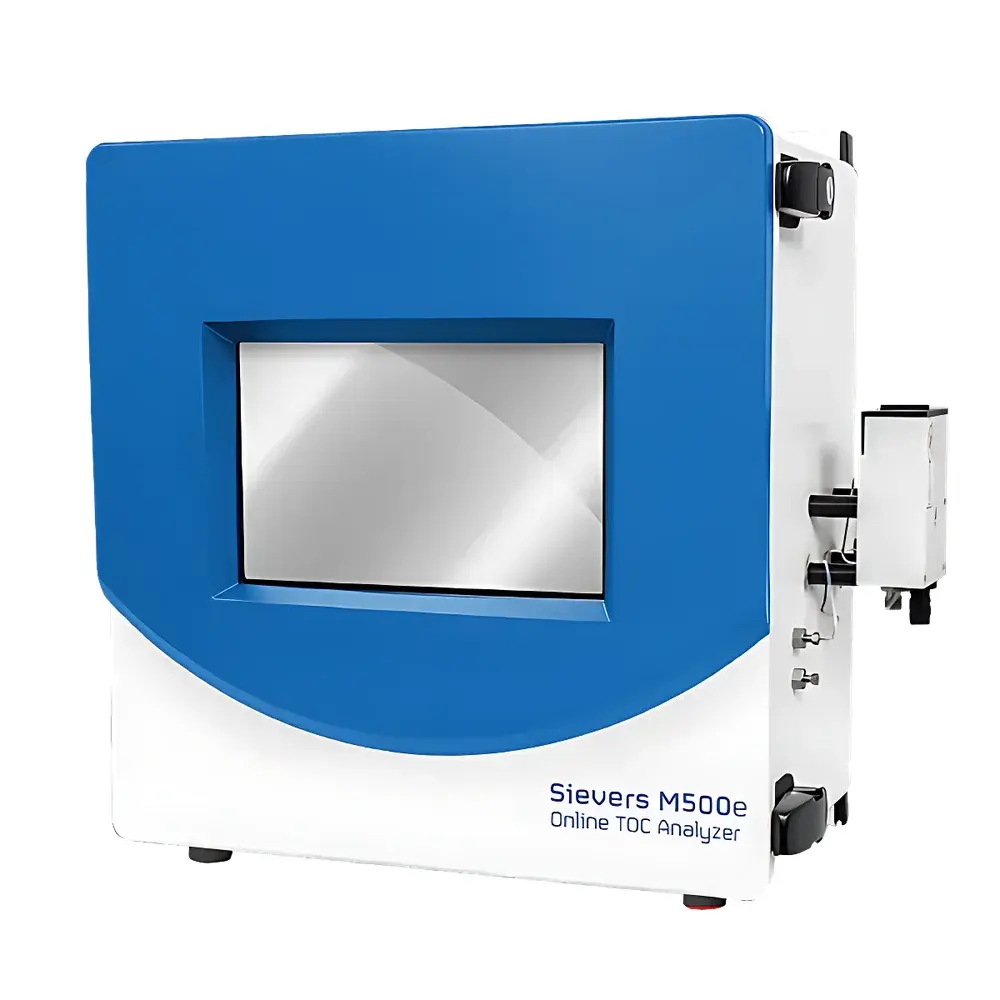
Sievers M500e Online Total Organic Carbon Analyzer
| Brand | Sievers (Veolia) |
|---|---|
| Origin | USA |
| Manufacturer | Veolia Water Technologies |
| Type | Online TOC Analyzer |
| Model | M500e |
| Detection Principle | Membrane Conductivity Detection |
| Oxidation Method | UV Photolysis (185/254 nm) |
| Measurement Range | 0.03–2500 ppb as TOC |
| Accuracy | ±5% of reading or ±0.1 ppb, whichever is greater |
| Resolution | 0.01 ppb |
| Detection Limit | 0.03 ppb |
| Repeatability | RSD <1% or ±0.03 ppb, whichever is greater |
| Linear Range | 0.03–2500 ppb TOC |
| Analysis Time (Continuous Online) | 3 min |
| Calibration Stability | Up to 12 months |
| Sample Flow Rate | ≥50 mL/min |
| Sample Temperature Range | 1–95 °C |
| Sample Pressure Rating | ≤100 psig |
| pH Range for Specified Accuracy | 5.5–8.0 |
| Ozone Tolerance | Continuous exposure to ≤50 ppb O₃ |
| Conductivity Range | 0.01–800 µS/cm |
| Conductivity Accuracy | ±0.005 µS/cm or ±1%, whichever is greater |
| Display | 10.1" capacitive touchscreen (1280×800) |
| Connectivity | Ethernet, Wi-Fi (802.11ac/a/b/g/n, dual-band), RS-232, USB, 3× 4–20 mA outputs, 4 alarm relays |
| Communication Protocols | Modbus TCP/IP, PROFINET (standard), PROFIBUS (optional) |
| Enclosure Rating | IP55 |
| Safety Certifications | CE, ETL Listed (UL 61010-1), CSA C22.2 No. 61010-1 |
| Pollution Degree | 2 |
| Operating Environment | Indoor only |
| Dimensions (H×W×D) | 43.4×55.9×28.7 cm |
| Weight | 16.3 kg |
Overview
The Sievers® M500e Online Total Organic Carbon (TOC) Analyzer is an industrial-grade, real-time water quality monitoring system engineered for continuous measurement of ultra-trace organic carbon in ultrapure water (UPW), pharmaceutical process water, semiconductor rinse water, and critical utility streams. It employs a proven, reagent-free membrane conductivity detection method coupled with low-pressure ultraviolet (UV) photolysis at 185 nm and 254 nm wavelengths to fully oxidize non-purgeable organic compounds into CO₂, which is then quantified via high-sensitivity, temperature-compensated conductivity measurement across a gas-permeable membrane. This principle eliminates interferences from inorganic carbon species, chloride, and other ionic contaminants—making it particularly robust for high-purity applications where traditional persulfate-based oxidation methods introduce reagent-derived background noise or carryover risk. Designed for GMP, FDA 21 CFR Part 11, and ISO 9001-compliant environments, the M500e delivers regulatory-ready data integrity through hardware-enforced audit trails, electronic signatures, and secure user-access controls.
Key Features
- Reagent-free, membrane-conductivity-based detection ensures long-term stability, minimal maintenance, and zero chemical consumption—reducing operational cost and waste disposal burden.
- Sub-ppb detection capability with 0.03 ppb limit of detection (LOD) and 0.01 ppb resolution supports compliance with stringent USP , EP 2.2.44, and JP 6.02 specifications for purified and water-for-injection (WFI) systems.
- 3-minute continuous online analysis cycle enables rapid response to process excursions, supporting real-time control loop integration and proactive contamination mitigation.
- Dual-band Wi-Fi (2.4/5 GHz) and Gigabit Ethernet enable seamless integration into enterprise SCADA, MES, and LIMS platforms with native support for Modbus TCP/IP and PROFINET; PROFIBUS available via optional module.
- Automatic zero compensation and accelerated rinse protocol reduce post-maintenance stabilization time by >50%, achieving sub-0.1 ppb baseline recovery within 90 seconds after high-TOC exposure.
- IP55-rated enclosure with corrosion-resistant stainless-steel wetted parts and full internal temperature regulation ensures reliable operation in humid, chemically aggressive cleanroom and utility corridor environments.
- 10.1-inch high-resolution capacitive touchscreen interface supports multilingual operation (English, Japanese, Chinese, Korean, German), intuitive calibration workflows, and embedded diagnostic logging per IEC 62443-3-3 cybersecurity guidelines.
Sample Compatibility & Compliance
The M500e is validated for direct online sampling of water streams with conductivity ≤1 µS/cm and pH 5.5–8.0—covering UPW (ASTM D5127), WFI (USP ), purified water (EP 2.2.44), and semiconductor process rinse water (SEMI F63). Its ozone tolerance (continuous 50 ppb, intermittent 200 ppb) permits deployment downstream of ozone-based disinfection systems without signal drift or membrane degradation. The analyzer meets electromagnetic compatibility (EMC) requirements per IEC 61326-1 and safety standards per UL 61010-1, CSA C22.2 No. 61010-1, and EN 61010-1. Data management architecture complies with FDA 21 CFR Part 11 Subpart B for electronic records and signatures, including role-based access control, immutable audit trails, and configurable retention policies aligned with ALCOA+ principles.
Software & Data Management
Sievers Insight™ software—embedded and remotely accessible—provides full lifecycle data governance: automated calibration verification (CV), system suitability testing (SST), and performance qualification (PQ) reporting per ASTM D8079 and USP . All measurements are timestamped, digitally signed, and stored with metadata (operator ID, method version, environmental conditions). Raw conductivity and TOC values are exportable in CSV/Excel format; trend dashboards support SPC charting (X-bar/R, CUSUM) and deviation alerting via email/SNMP traps. Firmware updates are delivered over-the-air with cryptographic signature validation to ensure integrity and traceability.
Applications
- Real-time TOC monitoring in pharmaceutical water-for-injection (WFI) distribution loops and point-of-use locations.
- Ultrapure water quality assurance in semiconductor fab UPW plants and tool coolant recirculation systems.
- Validation and routine surveillance of purified water systems per EU GMP Annex 1 and WHO TRS 970.
- TOC trending in biopharmaceutical clean steam condensate and process skid rinse water.
- Regulatory submission support for ANDA, BLA, and MA dossier documentation requiring raw data archiving and audit readiness.
FAQ
What sample flow rate is required for stable M500e operation?
A minimum continuous flow of 50 mL/min is required to maintain laminar flow across the oxidation chamber and membrane sensor—ensuring reproducible mass transfer and oxidation efficiency.
Can the M500e be installed in outdoor or unconditioned environments?
No. The analyzer is rated for indoor use only, with operating ambient temperature limited to 5–40 °C and relative humidity ≤95% non-condensing. External environmental exposure voids warranty and compromises conductivity cell stability.
Is manual calibration required on a scheduled basis?
Calibration is performed using certified NIST-traceable sucrose standards; however, due to inherent stability of the UV/membrane system, calibration verification (CV) is recommended every 7 days, with full calibration only required upon CV failure or after major maintenance.
How does the M500e handle high-chloride or high-alkalinity samples?
The membrane conductivity detector is insensitive to chloride, sulfate, and carbonate ions. However, sample pH must remain between 5.5 and 8.0 to prevent CO₂ hydration equilibrium shifts that affect conductometric response accuracy.
Does the M500e support remote firmware updates and diagnostics?
Yes—via secure HTTPS connection to Veolia’s authorized support portal. Updates include digital signature validation, rollback capability, and pre-update system health checks logged in the audit trail.
Related Products







