
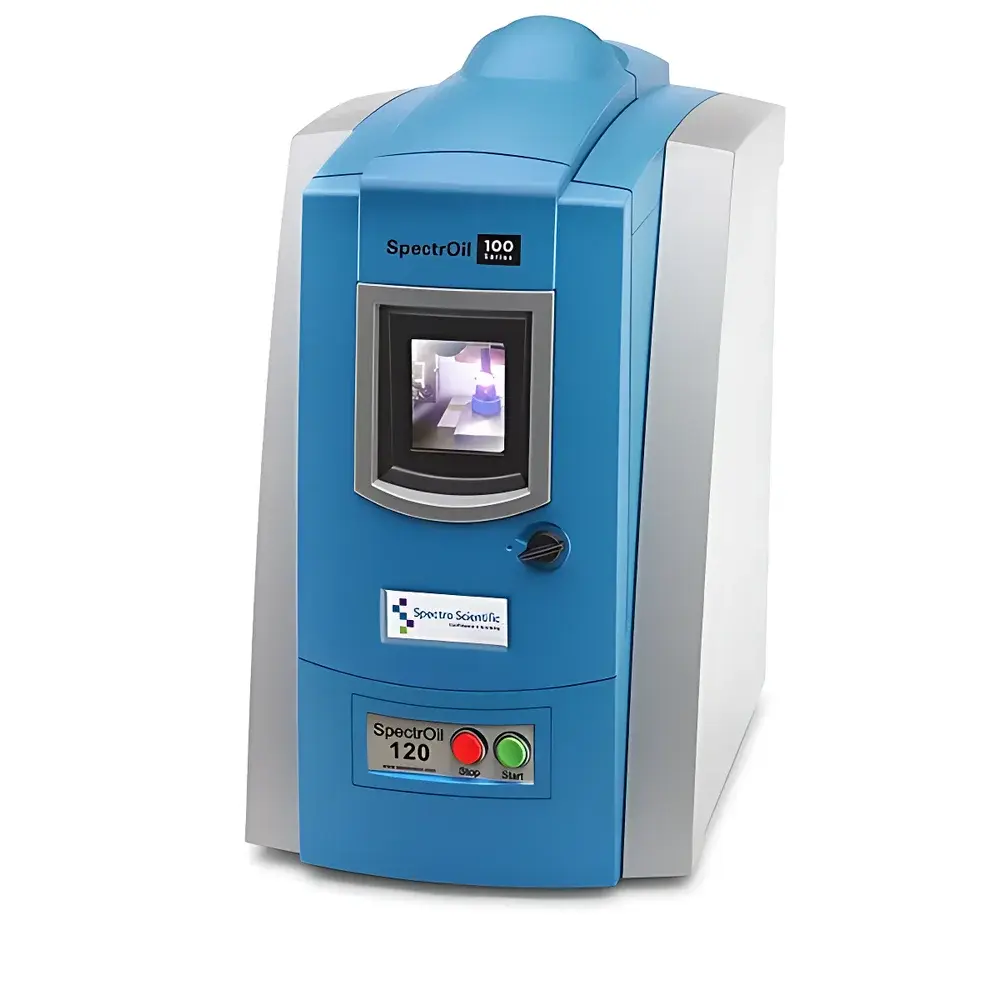
Spectro Scientific Model 120C Rotating Disc Electrode Atomic Emission Spectrometer for Lubricant Wear Metal Analysis
| Brand | Spectro Scientific |
|---|---|
| Origin | USA |
| Manufacturer Type | Original Equipment Manufacturer (OEM) |
| Origin Category | Imported Instrument |
| Model | 120C |
| Pricing | Available Upon Request |
Overview
The Spectro Scientific Model 120C is a benchtop rotating disc electrode atomic emission spectrometer (RDE-AES) engineered for rapid, quantitative elemental analysis of wear metals, contaminants, and additive elements in lubricating oils, hydraulic fluids, diesel fuel, coolant, and industrial process water. It operates on the fundamental principle of arc/spark excitation in a controlled gaseous environment: a rotating disc electrode continuously transports a thin film of undiluted sample into the inter-electrode gap, where high-voltage AC discharge vaporizes, atomizes, and excites analyte atoms. The resulting atomic emission spectra are collected and resolved by a fixed-grating optical system with photomultiplier tube (PMT)-based detection. Unlike ICP-OES or XRF, RDE-AES requires no acid digestion, solvent dilution, or carrier gas—enabling direct analysis of neat oil with minimal sample preparation and inherent resistance to matrix-induced spectral interference.
Key Features
- Direct analysis of 2 mL undiluted lubricant sample—no solvents, no dilution, no digestion
- Simultaneous quantification of up to 31 elements—including Fe, Cu, Al, Cr, Pb, Sn, Si, Na, Ca, Mg, Zn, P, B, Mo, V, Ni, Ti, Ag, Cd, Mn, Ba, Sr, K, Li, As, Sb, Bi, Co, Ga, In, and Te—in under 30 seconds per run
- Detection limits for most transition and refractory metals at sub-ppm (µg/g) levels, validated per ASTM D6595 protocol
- Robust, field-deployable architecture with vibration-dampened optical bench and sealed PMT detector array
- Pre-aligned, maintenance-free optical path with fixed-wavelength PMT channels—no moving parts or wavelength calibration drift
- Integrated argon purge system ensures stable plasma conditions and minimizes atmospheric nitrogen/oxygen spectral interference
Sample Compatibility & Compliance
The Model 120C is validated for use with mineral-based, synthetic, and bio-based lubricants; turbine, engine, gear, and hydraulic oils; diesel and jet fuels; glycol-based coolants; and aqueous industrial fluids. Its measurement methodology conforms strictly to ASTM D6595 (“Standard Test Method for Determination of Wear Metals and Contaminants in Used Lubricating Oils or Used Hydraulic Fluids by Rotating Disc Electrode Atomic Emission Spectrometry”) and ASTM D6728 (“Standard Test Method for Determination of Trace Elements in Fuel Oils by Rotating Disc Electrode Atomic Emission Spectrometry”). Instrument performance meets ISO/IEC 17025 requirements for testing laboratories when operated within defined environmental and procedural controls. Data integrity is supported through configurable audit trails, user access levels, and electronic signature capability compliant with FDA 21 CFR Part 11 for regulated environments.
Software & Data Management
The instrument is controlled via Spectro’s proprietary SpectroSoft™ v5.x platform, a Windows-based application designed for analytical traceability and routine QC workflows. Software modules include method editor (for custom calibration curve selection), automated quality control (QC) checks (blanks, standards, duplicates), trend analysis with statistical process control (SPC) charts, and full data export to LIMS-compatible CSV, XML, or PDF formats. All raw spectral intensities, background corrections, and calibration coefficients are stored with timestamped metadata. SpectroSoft supports GLP/GMP-compliant reporting with customizable templates aligned to OEM oil analysis protocols (e.g., Caterpillar S•O•S, Komatsu KOMTRAX, Shell LubeAnalyst).
Applications
- Condition-based monitoring of rotating machinery: early detection of abnormal wear patterns (e.g., elevated Fe + Cr suggests bearing fatigue; Cu + Pb indicates bushing wear)
- Contamination tracking: identification of coolant ingress (Na, K, Si), dirt ingestion (Si, Al), or cross-fluid mixing (e.g., glycol in oil via B detection)
- Additive package verification: monitoring depletion of Zn, P, Ca, Mg, and Mo to assess remaining service life
- Root cause failure analysis in wind turbine gearboxes, marine propulsion systems, power generation turbines, and heavy-duty off-highway equipment
- On-site lab support for mobile service units and refinery maintenance teams requiring turnkey elemental screening without infrastructure dependency
FAQ
Does the Model 120C require daily recalibration?
No—calibration stability is verified weekly using certified reference oils; drift correction is applied automatically during each analysis via internal standard normalization (e.g., using internal Si or C lines).
Can it analyze highly viscous or soot-laden oils?
Yes—sample viscosity up to 500 cSt is accommodated by adjustable disc rotation speed and optimized electrode gap geometry; soot content up to 5% w/w does not impair precision due to non-thermal excitation and spectral deconvolution algorithms.
Is method transfer possible between different RDE-AES instruments?
Yes—SpectroSoft supports standardized method files (.smf) that preserve calibration coefficients, integration windows, and interference corrections across Model 120C, 130, and 140 platforms.
What maintenance is required beyond routine cleaning?
Annual PM includes electrode replacement, argon line filter inspection, and PMT gain verification; no optical realignment or grating servicing is needed over the instrument’s service life.
Related Products






