
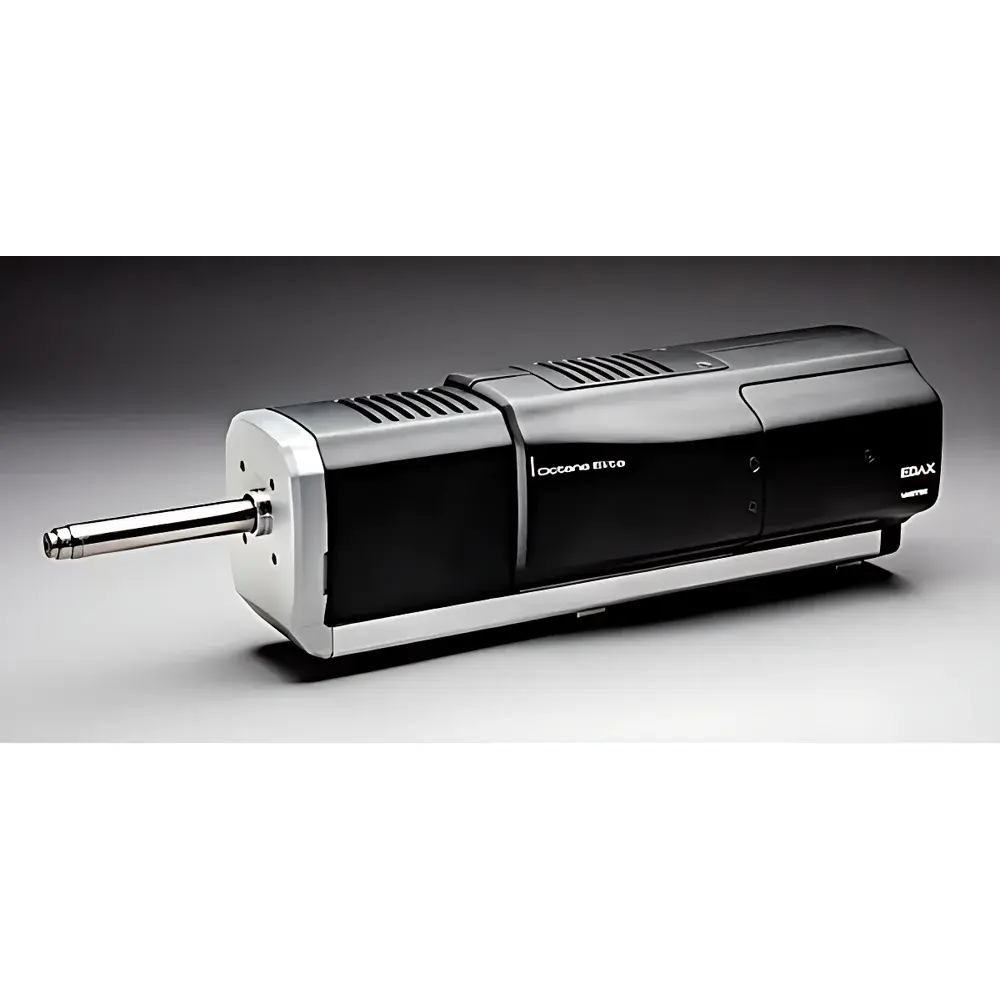
EDAX Octane Elite Energy Dispersive Spectrometer
| Brand | EDAX |
|---|---|
| Origin | USA |
| Model | Octane Elite |
| Energy Resolution | 125 eV (Mn Kα) / 123 eV (optimized configuration) |
| Peak-to-Background Ratio | Not specified |
| Maximum Output Count Rate | 400,000 cps |
| Detector Active Area | 30 mm² (Octane Elite Plus) or 70 mm² (Octane Elite Super) |
| Window Material | Silicon Nitride (Si₃N₄) |
| Vacuum Compatibility | Fully sealed ultra-high vacuum detector housing |
| Integration | Compatible with SEM, FIB-SEM, and TEM platforms |
Overview
The EDAX Octane Elite Energy Dispersive Spectrometer (EDS) is a high-performance silicon drift detector (SDD)-based microanalysis system engineered for precision elemental characterization in scanning electron microscopy (SEM), focused ion beam–SEM (FIB-SEM), and transmission electron microscopy (TEM) environments. Leveraging fundamental X-ray physics principles—specifically the detection and energy discrimination of characteristic X-rays emitted from specimen atoms under electron beam excitation—the Octane Elite delivers enhanced sensitivity across the full elemental range, with particular emphasis on light elements (B to F) and trace-level quantification at low accelerating voltages (≤5 kV). Its core innovation lies in the integration of a monolithic silicon nitride (Si₃N₄) window, which replaces conventional polymer or beryllium windows to significantly improve low-energy X-ray transmission (<1 keV), thereby enabling robust detection of boron, carbon, nitrogen, and oxygen without compromising vacuum integrity or mechanical stability.
Key Features
- Ultra-thin silicon nitride (Si₃N₄) window: Provides >90% transmission efficiency for C Kα (0.277 keV) and N Kα (0.392 keV) X-rays, enabling reliable light-element analysis under standard high-vacuum SEM conditions.
- High-speed pulse processing electronics: Fully integrated digital signal processing architecture supports real-time dead-time correction, pile-up rejection, and adaptive filtering—ensuring spectral fidelity across count rates from 1,000 to 400,000 cps.
- Dual-detector configurations: Available in two active-area variants—Octane Elite Plus (30 mm²) optimized for high spatial resolution mapping in nanoscale SEM/FIB workflows, and Octane Elite Super (70 mm²) engineered for maximum solid-angle collection and throughput in bulk-phase or low-beam-current applications.
- Motorized detector positioning: Integrated electric actuator enables software-controlled tilt, rotation, and retract/reposition functions—critical for multi-instrument configurations (e.g., EDS–EBSD–WDS co-localization) and automated alignment in dual-beam FIB-SEM systems.
- Vacuum-sealed, all-metal detector housing: Designed for long-term operational reliability in UHV-compatible instruments; eliminates window replacement cycles and reduces maintenance downtime.
Sample Compatibility & Compliance
The Octane Elite is validated for use with conductive, semi-conductive, and insulating samples—when paired with appropriate charge compensation (e.g., low-vacuum mode, beam deceleration, or conductive coating). It meets key international standards for analytical instrumentation, including ISO/IEC 17025 requirements for calibration traceability of energy scale and resolution verification. When deployed in regulated environments (e.g., semiconductor process control labs or pharmaceutical materials testing), its data acquisition and reporting modules support audit-ready workflows compliant with FDA 21 CFR Part 11 (electronic records/signatures) and GLP/GMP documentation protocols via optional TEAM™ software licensing. No hazardous materials (e.g., Be windows) are used, ensuring compliance with RoHS and REACH directives.
Software & Data Management
Controlled exclusively through EDAX’s TEAM™ Software Suite (v5.x or later), the Octane Elite integrates seamlessly with both legacy and next-generation SEM platforms. The software provides automated spectral acquisition, live elemental mapping, quantitative ZAF/φ(ρz) matrix corrections, and phase identification via correlation with crystallographic databases. Advanced features include Smart Diagnostics (real-time detector health monitoring), Smart Acquire (intelligent dwell-time optimization based on local count rate), and intelligent pile-up correction algorithms that dynamically adjust pulse processing thresholds. All raw spectra, map metadata, and processing parameters are stored in vendor-neutral HDF5 format, supporting third-party interoperability and long-term archival per ISO 14644 cleanroom documentation standards.
Applications
- Light-element quantification in polymers, ceramics, and battery cathode/anode materials (e.g., Li, B, C, O, F).
- High-resolution elemental distribution mapping of grain boundaries, precipitates, and interfacial layers in metallurgical and geological specimens.
- In-situ compositional analysis during FIB cross-sectioning and TEM lamella preparation.
- Automated particle analysis and inclusion classification in steel, aluminum, and additive manufacturing powders (ASTM E1508, ISO 16534).
- Multi-modal correlative analysis when coupled with EDAX’s EBSD (TEAM™ Pegasus) or WDS (TEAM™ Trident) modules for simultaneous crystallographic–compositional–morphological characterization.
FAQ
What is the energy resolution specification for the Octane Elite, and under what conditions is it measured?
The nominal energy resolution is 125 eV at Mn Kα (5.89 keV) under standard operating conditions (200,000 cps output, 100 K detector temperature). An optimized configuration achieves 123 eV, typically verified using certified reference materials per ASTM E1508 Annex A2.
Is the Si₃N₄ window compatible with low-vacuum or environmental SEM modes?
No—the Octane Elite requires high or ultra-high vacuum operation (≤1×10⁻⁵ Pa) due to its fully sealed detector architecture and absence of differential pumping stages.
Can the Octane Elite be retrofitted onto older SEM models?
Yes, provided the host instrument supports standard EDAX hardware interfaces (e.g., PCIe-based spectrometer controller) and has adequate port clearance and vacuum feedthrough compatibility; EDAX offers OEM integration kits and system validation services.
Does the motorized actuator support programmable position memory for multi-detector setups?
Yes—TEAM™ Software allows up to 8 user-defined detector positions to be saved and recalled automatically during multi-technique session sequencing.
How does the Octane Elite handle high-count-rate artifacts such as pulse pile-up?
Its embedded FPGA-based electronics implement real-time adaptive pile-up rejection with sub-microsecond latency, preserving peak shape integrity and preventing false peak generation even at sustained outputs exceeding 350,000 cps.



