
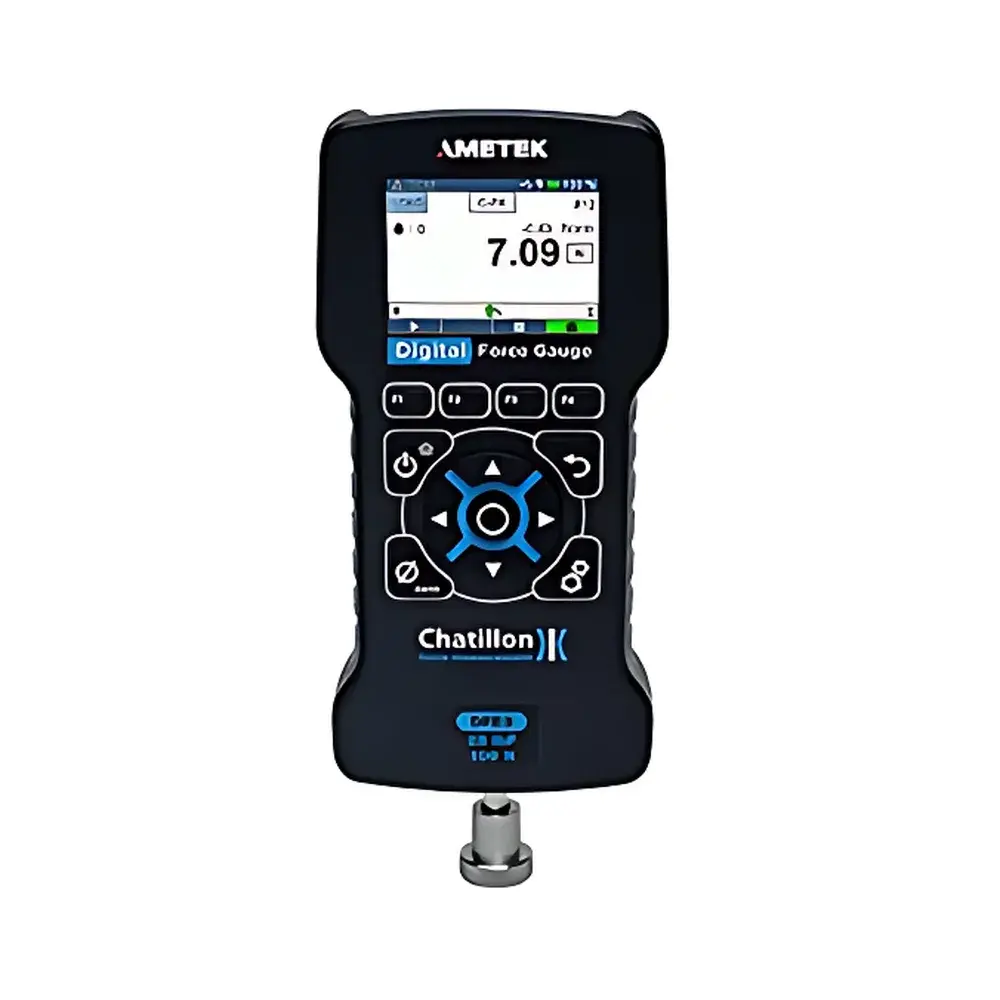
Chatillon DFE3 Series Digital Force Gauge
| Brand | Chatillon |
|---|---|
| Origin | USA |
| Model | DFE3 |
| Force Range | 2–500 lbf (10–2500 N) |
| Accuracy | ±0.2% of full scale |
| Sampling Rate | Up to 30 kHz |
| Display | Full-color LCD, adjustable brightness & invertible orientation |
| Units | ozf, gf, lbf, kgf, N |
| Interface | USB |
| Enclosure | Rugged rubberized keypad & impact-resistant housing |
| Compliance | CE, RoHS |
| Included | Portable carrying case, USB cable, calibration certificate |
Overview
The Chatillon DFE3 Series Digital Force Gauge is a precision-engineered, entry-level force measurement instrument designed for high-reliability mechanical testing in production, quality control, and incoming inspection environments. Built upon a robust microprocessor architecture and calibrated using traceable NIST-certified standards, the DFE3 operates on a strain-gauge-based transduction principle—converting mechanical load into proportional electrical signals with high linearity and thermal stability. Its primary function is static and dynamic tensile/compressive force measurement across defined test cycles, supporting both manual handheld operation and bench-mounted fixture integration. Unlike research-grade gauges requiring complex setup, the DFE3 prioritizes operational simplicity without compromising metrological integrity—making it suitable for operators with minimal metrology training while maintaining compliance-ready data capture capabilities.
Key Features
- Full-color, high-contrast LCD display with user-configurable brightness and 180° screen inversion—optimized for ergonomic viewing under varying ambient lighting conditions.
- Ergonomic, over-molded housing with integrated grip geometry and shock-absorbing rubber keypad—designed for extended handheld use and resistance to industrial handling wear.
- Real-time sampling at up to 30 kHz—enabling accurate capture of transient peak forces, such as snap-through events or spring engagement loads.
- Intuitive menu navigation with password-protected configuration lockout—preventing unauthorized modification of test parameters, units, or pass/fail thresholds.
- Built-in statistical functions including load averaging, % deviation calculation, drop detection (for break-point identification), and real-time pass/fail status indication based on user-defined upper/lower limits.
- On-device data storage with automatic timestamping and batch ID assignment—supporting GLP-compliant record retention prior to export.
Sample Compatibility & Compliance
The DFE3 accommodates a broad range of sample geometries and material types—including plastics, elastomers, adhesives, fasteners, packaging seals, medical device components, and consumer electronics assemblies—when paired with appropriate fixtures (e.g., tension hooks, compression plates, or custom jigs). It complies with international electromagnetic compatibility (EMC) directives (EN 61326-1) and carries CE and RoHS markings. While not certified to ISO/IEC 17025 for accredited calibration laboratories, its factory calibration adheres to ASTM E4 and ISO 7500-1 standards for force-measuring instruments. The included calibration certificate documents as-shipped accuracy against NIST-traceable reference standards, facilitating internal audit readiness and supplier qualification documentation per IATF 16949 or ISO 9001 requirements.
Software & Data Management
The DFE3 integrates seamlessly with optional ForceTest 3.0 software—a Windows-based application enabling advanced test method definition, graphical real-time force-time curve visualization, statistical reporting (mean, SD, Cp/Cpk), and automated PDF/Excel export. ForceTest 3.0 supports FDA 21 CFR Part 11 compliance through electronic signature capability, audit trail logging, and user role-based access control. All exported datasets include embedded metadata: operator ID, test date/time, gauge serial number, calibration due date, and environmental conditions (if logged via external sensors). Raw ASCII data files are structured for direct import into MATLAB, JMP, or Minitab for further statistical process control (SPC) analysis.
Applications
- End-of-line functional testing of assembled products (e.g., button actuation force, hinge torque verification, latch engagement strength).
- Incoming material inspection—verifying tensile strength consistency of gaskets, O-rings, or adhesive tapes against specification limits.
- Quality assurance of medical devices—measuring peel strength of sterile packaging, catheter push-pull force, or syringe plunger break-loose force per USP and ISO 8537.
- Automotive component validation—testing clip retention force, trim panel fitment resistance, or seatbelt buckle release load.
- Educational labs and vocational training—introducing fundamental concepts of force, stress, and material response in controlled, repeatable experiments.
FAQ
What is the recommended recalibration interval for the DFE3?
Annual recalibration is advised under normal usage; however, frequency should be adjusted per internal quality policy—especially after exposure to overload, physical shock, or extreme temperature/humidity fluctuations.
Can the DFE3 perform continuous monitoring during a slow ramp test?
Yes—the gauge supports real-time streaming mode via USB, allowing continuous force acquisition synchronized with external motion controllers or PLC triggers.
Is the DFE3 compatible with third-party test stands?
Yes—it features standard 1/4″-20 threaded mounting holes and outputs analog-compatible RS-232/USB signals, enabling integration with motorized stages from brands such as Mark-10, Mecmesin, or ZwickRoell.
Does the device support multiple language interfaces?
The firmware interface is English-only; however, ForceTest 3.0 software offers localized UI options including German, French, Spanish, and Japanese.
How is traceability maintained during data export?
Each exported file contains embedded digital signatures, unique test identifiers, and hardware-specific calibration metadata—ensuring full chain-of-custody alignment with ISO/IEC 17025 Annex A.2 requirements.



